



TLDR:
- Bitcoin faces continued structural pressure amid inactive stablecoin liquidity.
- Stablecoin Supply Ratio shows negative readings across short, medium, and long-term oscillators.
- Price rebounds struggle as capital remains in stablecoins instead of spot exposure.
- Market shift depends on renewed stablecoin demand, not short-term price momentum.
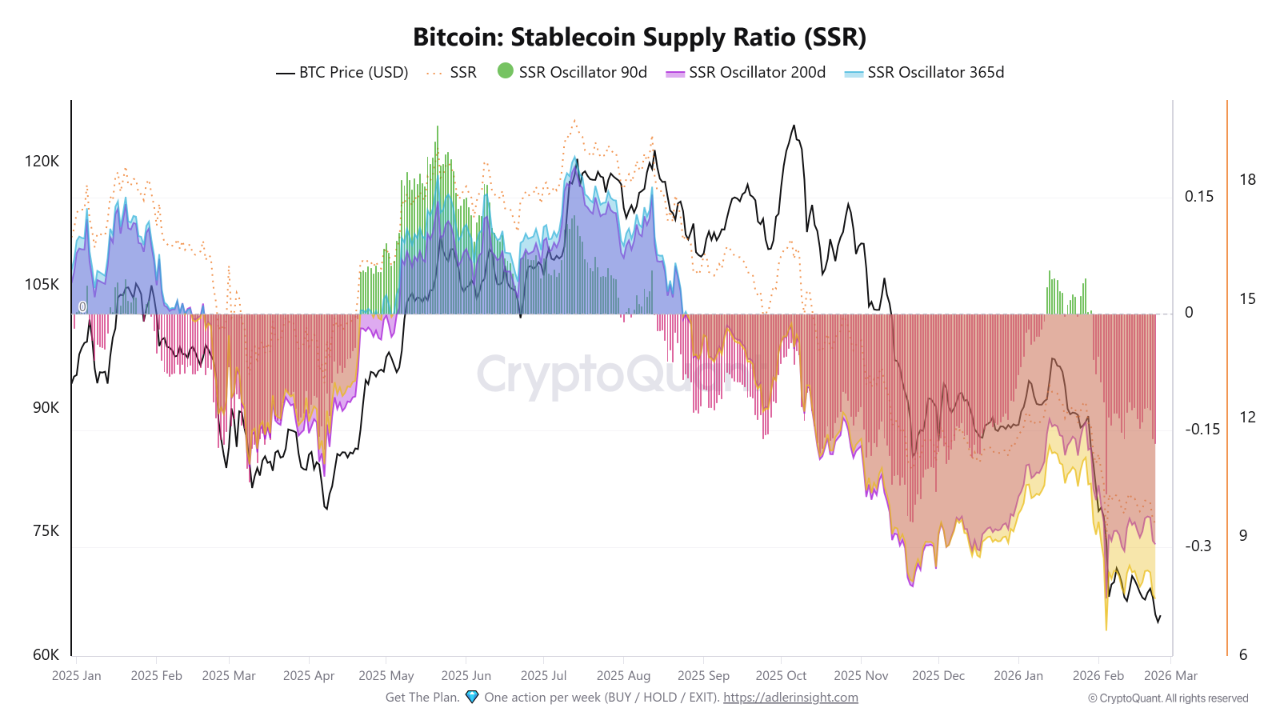
Bitcoin continues to trade under structural pressure, with the Stablecoin Supply Ratio (SSR) remaining negative across 90-day, 200-day, and 365-day oscillators.
Following a peak above $120,000 mid-year, Bitcoin’s price shifted from expansion to contraction, producing successive lower highs into late Q4 and early Q1.
The break below the zero line signaled a structural change in liquidity, reflecting deeper market conditions rather than temporary fluctuations.
Stablecoin Supply Remains Dormant Despite Available Capital
A compressed SSR indicates that stablecoin supply is large compared to Bitcoin’s market capitalization. During expansion phases, rising oscillator readings signal capital moving from stablecoins into Bitcoin, supporting upward momentum.
Currently, stablecoin liquidity exists but remains largely inactive, failing to convert into spot exposure.
The negative SSR across all timeframes suggests that defensive positioning dominates the market. Investors appear hesitant, even as substantial capital remains ready to deploy.
Source: Cryptoquant
This creates a divergence where available liquidity does not translate into buying pressure or price support.
Earlier in the year, positive oscillator readings correlated with strong price structure and controlled volatility. Sustained upside movement occurred as stablecoin demand actively entered Bitcoin, reinforcing momentum. The current absence of such behavior demonstrates passive liquidity conditions.
Downside Volatility Persists Amid Limited Demand
Following the rollover of SSR readings across short, medium, and long-term oscillators, downside volatility has increased.
Price rebounds have lacked follow-through, reflecting insufficient absorption of supply during corrective phases. This trend shows that market participants are not actively deploying stablecoin capital to stabilize Bitcoin.
Historical on-chain data shows extended negative SSR regimes often precede larger inflection points. However, confirmation requires changes in investor behavior and renewed stablecoin deployment.
Without this, the market may continue under structural pressure, as liquidity remains passive despite readiness.
Market observers note that the next meaningful shift in Bitcoin will likely coincide with renewed stablecoin demand rather than purely price-driven momentum.
The system’s current configuration emphasizes the need for capital rotation to support price recovery. Recent market commentary also reflects the cautious stance of investors waiting for clearer signals.

