



TLDR
- Cardano is hovering near $0.27, facing critical resistance at a descending trendline around $0.28 that has consistently rejected upward moves
- Futures open interest has declined to $462 million, and the long-to-short ratio of 0.79 reflects dominant bearish sentiment
- Price action remains significantly below the 50-day and 100-day EMAs, both positioned above the $0.30 mark
- The Relative Strength Index stands at 46, below the neutral threshold, indicating limited momentum strength
- Manufacturing PMI has climbed to 52.4%, marking the third straight monthly gain in a 40-month period—a pattern historically linked to ADA rallies
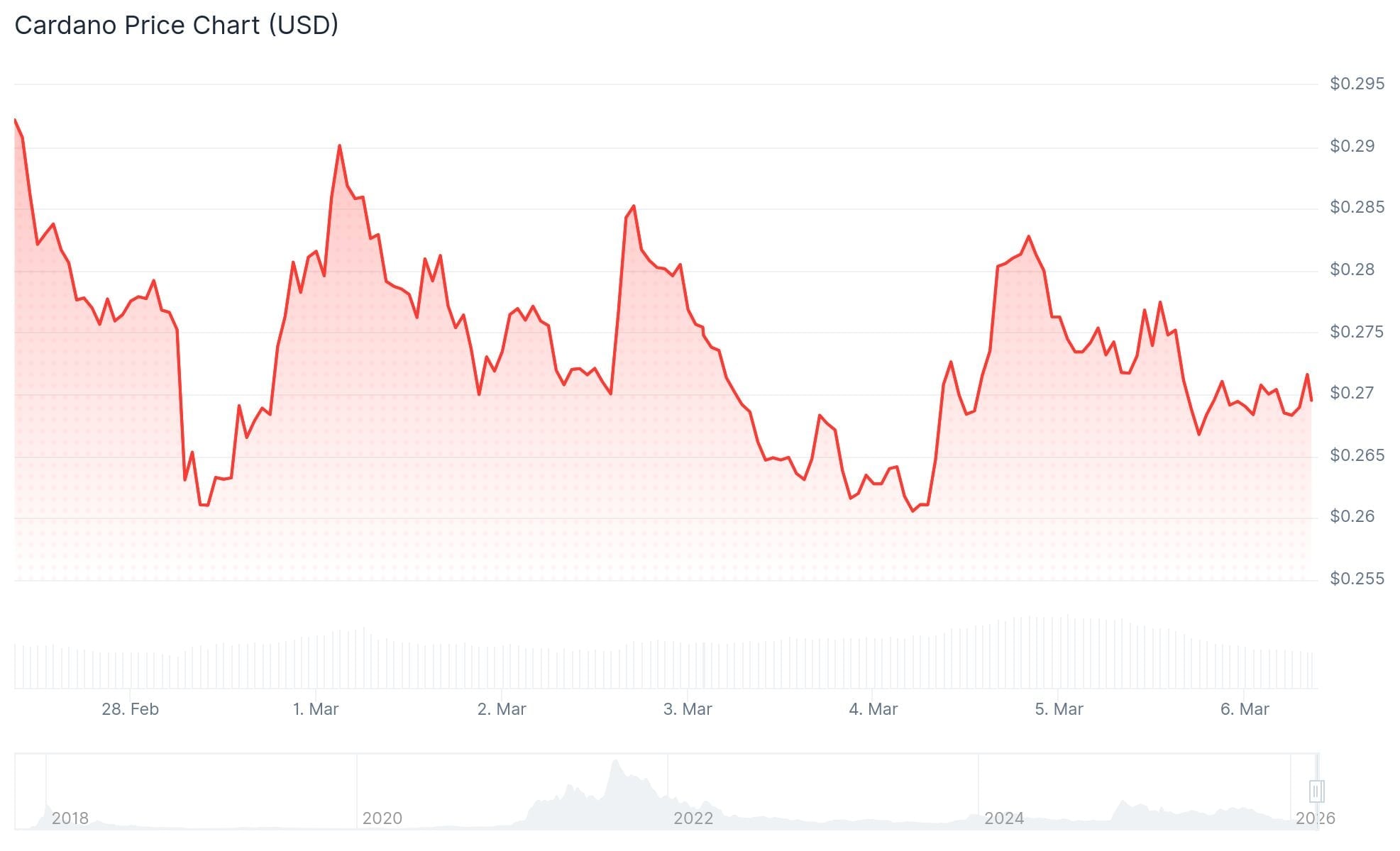
Cardano (ADA) continues to trade around the $0.27 level this Thursday, March 6, as the cryptocurrency tests a critical descending trendline positioned near $0.28. This technical barrier has proven formidable in recent sessions, rejecting price advances and maintaining its role as the primary short-term obstacle.
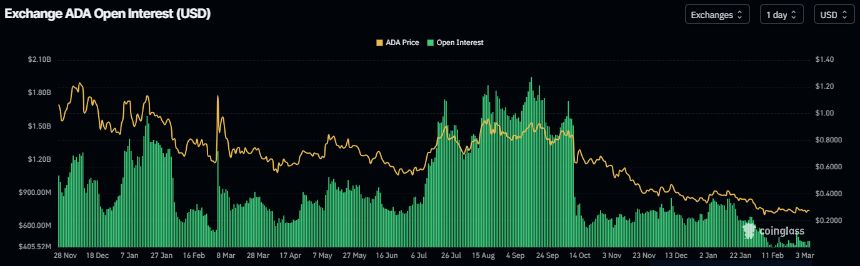
Futures market data reinforces the bearish narrative. Open interest in Cardano futures contracts has contracted to $462 million, marking a steady decline since the middle of January.
When open interest decreases while price action remains stagnant or declines, it typically indicates waning trader participation and reduced market conviction.
CoinGlass data shows the long-to-short ratio currently at 0.79—approaching its lowest reading in more than 30 days. This metric reveals that short positions outnumber long positions, confirming that market participants are predominantly betting on further price declines.
From a technical perspective, ADA remains substantially below both its 50-day and 100-day Exponential Moving Averages, which are clustered above the $0.30 threshold. This distance underscores the prevailing downtrend that has gripped the asset.
The daily Relative Strength Index registers at 46. Though it has rebounded from oversold conditions, the indicator remains beneath the 50 centerline, signaling that bullish momentum has yet to establish itself convincingly.
The MACD indicator shows marginally positive readings, but the histogram displays minimal movement. This configuration suggests consolidation rather than the emergence of a definitive trend reversal.
Key Price Levels to Watch
Looking at resistance zones, the immediate hurdle lies at the descending trendline near $0.28. A more formidable barrier exists at $0.32, where the downward-sloping EMAs also intersect.
A sustained daily close above $0.32 would be necessary to invalidate the current bearish framework and signal potential trend change.
On the downside, support is established at $0.26, with a secondary floor at $0.24. Should ADA breach the $0.24 level, it would likely trigger additional selling pressure.
Under current conditions, ADA appears poised to remain range-bound between $0.26 and $0.29 absent a significant market catalyst.
Macro Indicator Points to Possible Shift
Bitcoin recently broke through the $73,000 barrier, reaching a one-month peak, yet ADA failed to capitalize on this momentum. The altcoin registered only modest gains and couldn’t sustain a close above the prior session’s high.
Crypto analyst Dan Gambardello has highlighted the manufacturing Purchasing Managers Index (PMI) as a potentially significant indicator for Cardano’s medium to long-term trajectory.
The PMI, which measures manufacturing sector vitality, currently registers at 52.4%. This marks the third consecutive monthly advance over a 40-month timeframe.
Gambardello emphasizes that historical PMI expansion periods have frequently coincided with bullish cycles for ADA price performance.
The present configuration also bears resemblance to the 2019 correction phase, during which ADA experienced red monthly candles in six out of seven months before staging a substantial recovery.
Quantitative tightening concluded in December 2025. According to Gambardello, this development coupled with an ascending PMI creates a macro environment similar to the conditions that preceded Cardano’s previous significant price rally.
Cardano is now experiencing its sixth consecutive monthly decline following a negative February close.

