



TLDR
- Military operations by US and Israeli forces against Iran resulted in the effective shutdown of Strait of Hormuz shipping lanes, disrupting a waterway responsible for transporting 20% of the world’s crude oil.
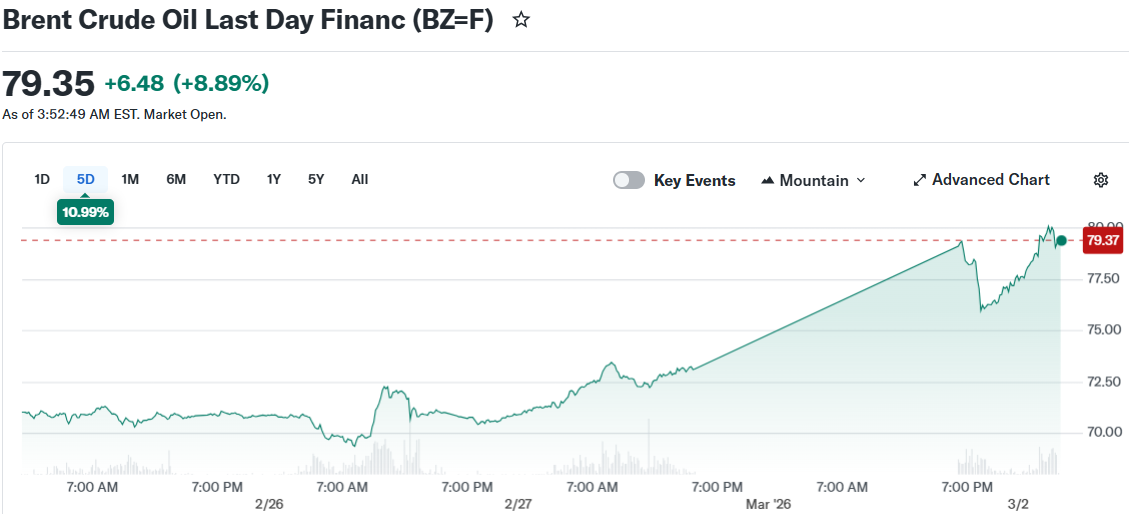
- Brent crude prices soared up to 13%, reaching the highest levels observed since January 2025, with diesel futures climbing as much as 20%.
- Saudi Aramco suspended activities at its Ras Tanura facility following drone attacks; multiple explosions occurred across Dubai, Abu Dhabi, and Kuwait City.
- Energy analysts from Wood Mackenzie project crude could surpass $100 per barrel if the passage remains closed; JPMorgan estimates a 25-day blockade would necessitate production shutdowns across Middle Eastern oil producers.
- Major energy companies Exxon Mobil and Chevron saw stock gains as markets anticipated elevated oil prices, with both maintaining Strong Buy recommendations from financial analysts.
Crude oil markets experienced dramatic price increases Monday following weekend military strikes by US and Israeli forces against Iran, resulting in an effective halt to shipping through the Strait of Hormuz.
Brent crude, the international pricing benchmark, climbed as much as 13% to reach levels not seen since January 2025. The commodity was changing hands near $80 per barrel Monday morning. West Texas Intermediate futures advanced over 7%, trading around $72 per barrel.
The Strait of Hormuz, situated along Iran’s coastline, serves as the transit route for approximately 20% of global petroleum supplies. Shipping companies and commodity traders voluntarily suspended vessel movements as regional tensions escalated.
During the military exchanges, Iran’s Supreme Leader Ayatollah Ali Khamenei was killed. Iranian forces retaliated with attacks targeting Israeli positions and American military installations throughout Saudi Arabia, Qatar, the UAE, Kuwait, and Bahrain.
Saudi Aramco suspended refining operations at its Ras Tanura complex following drone attacks in the vicinity. Reports of explosions emerged from Dubai and Abu Dhabi. According to Agence France-Presse, smoke was observed rising from the American embassy compound in Kuwait City.
Tehran claimed responsibility for downing an American fighter aircraft that went down in Kuwait. President Trump stated US military forces destroyed nine Iranian naval vessels and indicated operations would persist until mission objectives were achieved.
Diesel futures experienced dramatic increases of up to 20% alongside crude oil advances. OPEC+ members convened for a previously scheduled weekend meeting where they agreed to increase production allocations by 206,000 barrels daily beginning in April.
What Analysts Are Saying
Citigroup’s energy analysts forecasted Brent trading within an $80-to-$90 range throughout the upcoming week. Morgan Stanley revised its second-quarter Brent projection upward to $80 per barrel from a previous estimate of $62.50.
According to Wood Mackenzie, oil prices could breach the $100-per-barrel threshold if the Hormuz passage remains inaccessible. JPMorgan’s research team cautioned that a 25-day closure scenario would compel major producing nations to completely halt output as storage capacity reaches maximum levels.
Iran produces approximately 3.3 million barrels daily, representing roughly 3% of worldwide supply. Its strategic position adjacent to the strait provides disproportionate leverage over international energy transportation.
In comments to the New York Times, Trump indicated the US military campaign against Iran would continue for “four to five weeks.” He additionally expressed willingness to remove sanctions should new Iranian leadership demonstrate cooperation.
Energy Stocks React
Exxon Mobil shares climbed 2.67% while Chevron stock advanced 1.41% as market participants rotated into energy sector positions. Both corporations are positioned to capture benefits from elevated crude pricing, which expands profitability for oil production operations.
Exxon disclosed full-year 2025 profits totaling $28.8 billion, representing a decline from $33.7 billion achieved in 2024. Chevron announced fourth-quarter 2025 adjusted earnings of $1.52 per share, generating quarterly revenues approaching $46.9 billion.
Street consensus maintains Strong Buy ratings for both equities. Exxon’s average analyst price target sits at $144.63, while Chevron’s target reaches $187.26, accompanied by a dividend yield of 4.5%.
President Trump informed the New York Times that military operations targeting Iran would proceed without interruption, with no indications of de-escalation evident as of Monday morning.
Get 3 Free Stock Ebooks
Discover top-performing stocks in AI, Crypto, and Technology with expert analysis.
- Top 10 AI Stocks - Leading AI companies
- Top 10 Crypto Stocks - Blockchain leaders
- Top 10 Tech Stocks - Tech giants


