



TLDR
- Brent crude advanced 2.8% to reach $83.8 per barrel while WTI increased 2.6% to $76.5 during Wednesday trading
- Iran’s Revolutionary Guard has seized the Strait of Hormuz, issuing warnings about potential missile and drone attacks on vessels
- Iraq suspended production operations at multiple major oil facilities, creating additional supply constraints
- President Trump indicated the U.S. Navy might provide tanker escorts through the Strait to maintain energy supplies
- Crude benchmarks have posted gains across four consecutive sessions, reaching their strongest position since January 2025
Crude oil benchmarks extended their winning streak on Wednesday as dual supply disruptions drove Brent to territory not visited since the start of 2025.
Brent futures advanced 2.8% during early market activity, settling at $83.8 per barrel. Meanwhile, U.S. West Texas Intermediate futures registered a 2.6% gain, touching $76.5 per barrel.
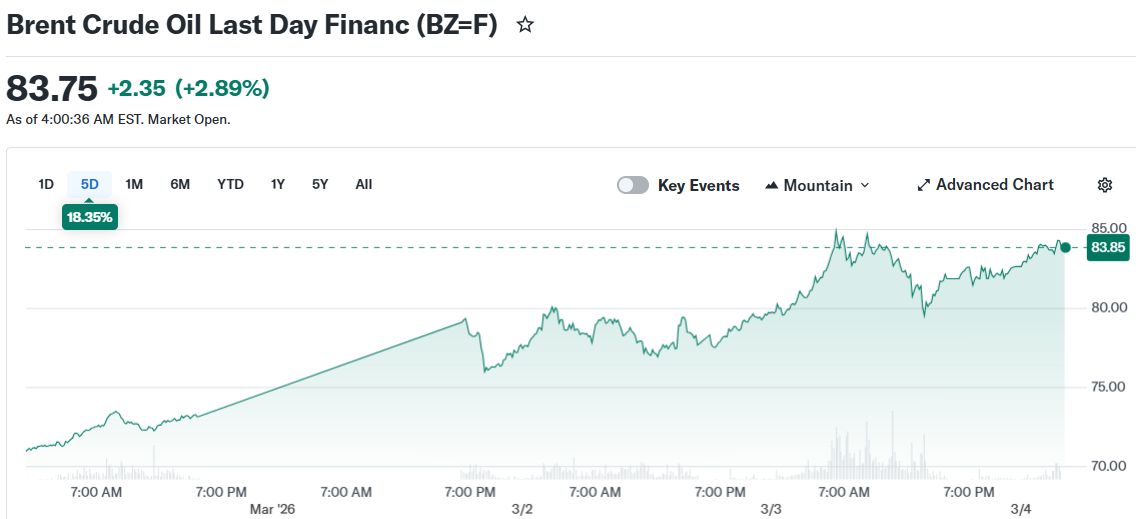
The upward momentum marked the fourth consecutive session of gains for petroleum markets. Both primary crude benchmarks now sit at their loftiest perch in more than twelve months.
The primary catalyst emerged when Iran’s Islamic Revolutionary Guard Corps declared it had assumed control over the Strait of Hormuz. The military force issued stark warnings that vessels navigating the strategic waterway face potential targeting by missiles and unmanned aerial vehicles.
The Strait of Hormuz serves as a critical artery for global energy trade. Roughly one-fifth of worldwide petroleum exports transit through this confined passage daily.
Disturbances affecting this chokepoint typically generate immediate upward pressure on oil prices. Market observers suggest valuations may remain elevated should vessel movement continue facing restrictions.
The regional confrontation entered its fifth consecutive day Wednesday. Iran simultaneously intensified operations targeting American military installations and diplomatic compounds throughout the region.
Iraq Suspends Operations at Key Production Sites
A secondary factor pressuring markets originated from Iraq. Reports from Bloomberg indicated Baghdad had suspended crude production at several of its most significant facilities.
This decision diminishes the volume of petroleum accessible to international buyers. When combined with the Hormuz situation, market participants drove valuations substantially higher.
Earlier this week, prices experienced a temporary retreat. Brent descended to $78.40 per barrel following Trump’s social media commentary regarding energy strategy.
The President declared America would guarantee the “free flow of energy to the world.” Deutsche Bank’s strategist Jim Reid observed that prices touched $78.40 before rebounding past $82.
Trump additionally suggested the U.S. Navy might commence escort operations for petroleum tankers navigating the Strait of Hormuz when necessary. This announcement temporarily eased market anxiety.
Market Rebounds Despite Presidential Reassurance
The respite proved fleeting. Valuations surged back beyond $82 per barrel that same trading day and maintained their ascent through Wednesday’s session.
The Revolutionary Guard’s explicit threats regarding maritime attacks were identified by Deutsche Bank’s Reid as a principal factor driving the price reversal.
Brent crude touched $83.60 per barrel Wednesday, hovering near its peak level since early 2025. WTI extended its rally for a third consecutive session, reaching $76.45.
The circumstances surrounding the Strait of Hormuz constitute the predominant focus for petroleum traders currently.
Iraq’s production suspension at critical facilities compounds supply concerns in an already constrained marketplace.
Get 3 Free Stock Ebooks
Discover top-performing stocks in AI, Crypto, and Technology with expert analysis.
- Top 10 AI Stocks - Leading AI companies
- Top 10 Crypto Stocks - Blockchain leaders
- Top 10 Tech Stocks - Tech giants


