



Key Takeaways
- Jeffrey Wilcke, an Ethereum co-founder, deposited 79,258 ETH (approximately $157M) to Kraken on March 7
- Co-founder Vitalik Buterin offloaded 17,196 ETH (around $35M) during February, contributing to insider selling concerns
- Since the beginning of 2026, ETH has declined 34%, currently hovering between $1,944 and $1,976
- Spot Ethereum ETFs witnessed $82.85M in net outflows during one trading session, with Fidelity’s FETH responsible for $67.57M
- Market observers suggest ETH might decline to $1,800 or potentially $1,500 if critical support zones fail
On March 7, Ethereum co-founder Jeffrey Wilcke deposited 79,258 ETH onto the Kraken trading platform. At the time of execution, this transaction represented roughly $157 million in value.
Blockchain monitoring service Lookonchain detected the activity spread across four separate wallet addresses. These addresses had remained dormant for approximately seven months prior to this movement.
Analysts from SpotOnChain observed a circular transaction pattern in the data. These identical wallets had previously withdrawn the exact same ETH quantity from Kraken around 10 months earlier, during a period when ETH traded near the $2,600 mark.
This pattern indicates the tokens were likely held in custodial storage and are now being returned to the exchange, presumably for liquidation. Wilcke maintains control of 27,241 ETH stored on-chain, currently valued at approximately $53.56 million.
In recent years, Wilcke has distanced himself from direct Ethereum development activities. His current focus centers on private gaming projects.
Vitalik Buterin’s Recent Sales
During February, Vitalik Buterin liquidated 17,196 ETH, generating approximately $34.96 million. This volume surpassed his publicly announced intention to sell 16,384 ETH.
Buterin explained the proceeds would fund open-source initiatives spanning software and hardware development in sectors including finance, governance, and biotechnology. He began 2026 controlling more than 240,000 ETH and currently maintains approximately 224,000 ETH.
Additionally, a historic Ethereum ICO-era wallet became active after extended dormancy. This wallet, silent for 10.6 years, transferred 100.275 ETH. The original investment during the ICO amounted to merely $124.
Ethereum Price Struggles Continue
Since the start of 2026, ETH has experienced a 34% decline. Recent trading has kept the asset confined between $1,944 and $1,990.
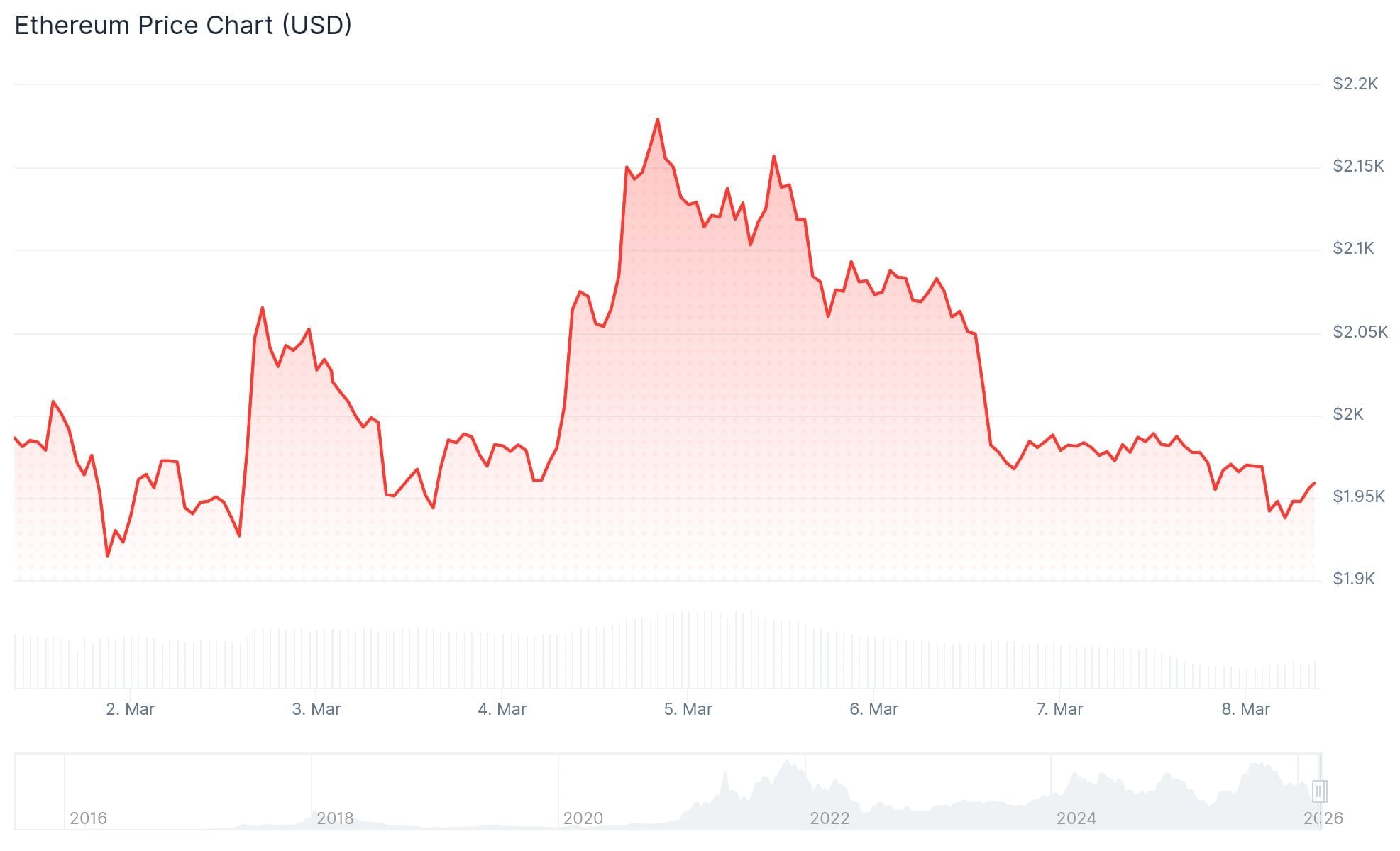
Earlier this week, ETH mounted a recovery from approximately $1,900, reaching a temporary peak around $2,180 on March 5. However, this upward momentum proved short-lived, with prices retreating beneath the $2,000 threshold.
Near-term support appears established around $1,960. The critical psychological barrier remains at $2,000, while a more substantial resistance zone exists between $2,040 and $2,080.
Ethereum spot exchange-traded funds experienced $82.85 million in net withdrawals during a single trading day. Fidelity’s FETH product accounted for $67.57 million of this exodus. FETH’s total cumulative outflows have now surpassed $218 million.
Polymarket analysts estimate a 67% likelihood that ETH will decline to $1,800. A technical market analyst identified an ascending wedge formation developing since early February, projecting $1,500 as the subsequent major support level should this pattern fail.
Corporate treasury buyers have also reduced their ETH accumulation activity as prices have deteriorated. The next significant support area is projected between $1,850 and $1,900.

