


Key Highlights
- Precious metal slipped 0.1% to approximately $5,187 per ounce Wednesday, maintaining levels well above $5,000
- Escalating oil costs, fueled by Middle East conflict involving the U.S. and Israel, are stoking inflation concerns
- Critical Strait of Hormuz passage has been essentially closed, putting approximately 20% of worldwide oil and gas shipments at risk
- February’s U.S. Consumer Price Index registered 2.4% annually, meeting expectations but covering pre-conflict period
- Financial markets anticipate Federal Reserve will maintain current rates at upcoming March 18 policy meeting
The precious metal market remained relatively stable Wednesday as competing pressures balanced each other out. Spot gold declined a modest 0.1% to approximately $5,187 per ounce, while futures contracts for April delivery fell 0.9% to roughly $5,194.
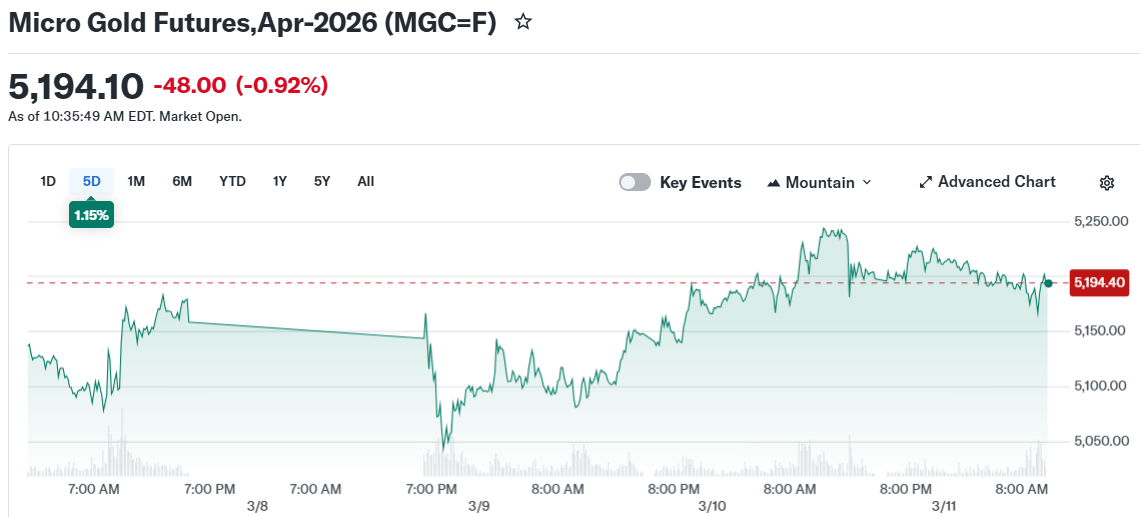
The yellow metal has experienced significant swings since reaching a near-peak of approximately $5,600 per ounce in the final weeks of January. Despite the subsequent retreat, prices have consistently remained above the $5,000 threshold.
The military confrontation involving the United States, Israel, and Iran reached its twelfth consecutive day Wednesday, with aerial bombardments persisting among all parties involved. President Trump indicated Monday evening that hostilities were nearing conclusion, though actual combat operations demonstrated little evidence of de-escalation.
The ongoing military engagement has virtually closed the Strait of Hormuz, a critical maritime corridor responsible for transporting approximately one-fifth of global petroleum and liquefied natural gas supplies.
Oil prices gained ground Wednesday as traders expressed skepticism about whether the International Energy Agency’s unprecedented reserve release initiative could adequately compensate for potential Middle Eastern supply shortfalls.
Escalating energy costs are elevating inflation projections. This development weighs on gold because it diminishes the probability of Federal Reserve interest rate reductions. Since the precious metal generates no yield, it becomes less appealing when borrowing costs remain elevated or increase.
An appreciating U.S. dollar combined with climbing Treasury yields are applying additional downward force on gold values. A robust dollar increases the cost of gold for international purchasers.
Consumer Price Data Meets Projections
The Labor Department disclosed Wednesday that American consumer prices advanced 2.4% during the twelve-month period ending February, aligning with both the previous month’s figure and expert predictions.
On a monthly basis, prices climbed 0.3%, accelerating from January’s 0.2% gain. Both energy and food expenses registered increases. The core Consumer Price Index, which excludes volatile food and energy components, posted a 2.5% year-over-year reading, matching January’s level.
Nevertheless, the February data predominantly reflects conditions before the Iran confrontation commenced in late February. Market observers anticipate March statistics will reveal a more pronounced inflationary uptick.
Upcoming Fed Meeting and PCE Release
Market participants are currently focused on two crucial forthcoming data releases. The Personal Consumption Expenditures index for January arrives Friday, with forecasters projecting a 3.1% annual rate.
The PCE serves as the Federal Reserve’s primary inflation gauge and has registered higher readings than CPI throughout recent months.
The Federal Reserve’s two-day policy gathering wraps up March 18. Market consensus strongly anticipates officials will keep interest rates unchanged.
Swissquote analyst Carlo Alberto De Casa observed that market participants seem to be expanding their positions in gold as a protective asset amid the continuing Middle East crisis.
Spot gold was quoted at $5,187 per ounce during Wednesday’s European trading session.
Get 3 Free Stock Ebooks
Discover top-performing stocks in AI, Crypto, and Technology with expert analysis.
- Top 10 AI Stocks - Leading AI companies
- Top 10 Crypto Stocks - Blockchain leaders
- Top 10 Tech Stocks - Tech giants


