


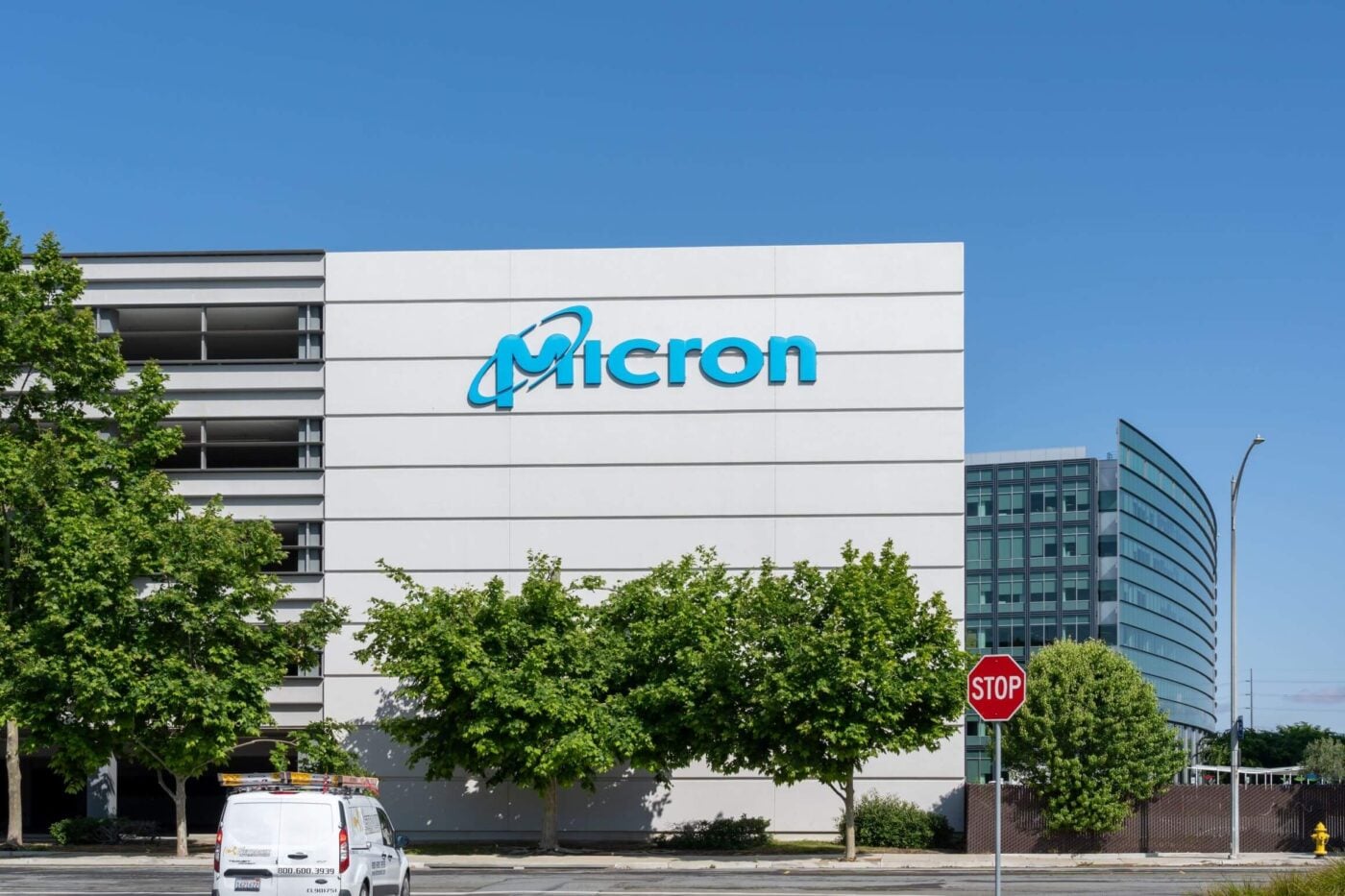
Key Takeaways
- Micron (MU) shares tumbled approximately 20% across five consecutive trading days following stellar Q2 financial results
- The decline came after Google introduced TurboQuant, a compression technology potentially reducing AI memory requirements by up to 6x
- Fellow memory manufacturer SanDisk (SNDK) experienced an 11% decline following the identical announcement
- Morgan Stanley’s Joseph Moore maintained his Buy recommendation, characterizing the pullback as an attractive entry point
- Analyst consensus remains at Strong Buy with a mean price target of $536.55, suggesting approximately 51% potential appreciation
Micron Technology delivered an outstanding fiscal second quarter performance, posting revenue growth exceeding 190% compared to the prior year, reaching $23 billion. The semiconductor giant simultaneously achieved all-time highs across key metrics including gross margin, earnings per share, and operating cash flow. Everything appeared flawless.
Then the tech giant Alphabet intervened.
Google introduced TurboQuant, an innovative compression technology the company claims can slash memory requirements for operating large language models by as much as six times. This revelation triggered an immediate and substantial decline across memory-focused semiconductor stocks.
SanDisk (SNDK) experienced an 11% decline following the disclosure. Micron’s shares plummeted roughly 20% across merely five trading days. Additional downward pressure emerged from investor anxiety regarding the company’s substantial capital expenditure plans slated for fiscal 2027.
Notwithstanding impressive quarterly performance, the market’s negative response illustrated apprehension that memory demand — representing the foundation of Micron’s operations — might face structural headwinds if artificial intelligence systems require diminished memory capacity.
Morgan Stanley Challenges the Narrative
Not all market observers agree the selloff is justified. Morgan Stanley’s Joseph Moore — recognized as a five-star analyst — reaffirmed his Buy stance on both Micron and SanDisk following the downturn.
Moore characterized the decline as a “healthy pricing in of durability concerns” rather than evidence of deteriorating fundamentals. He communicated to investors that those attempting to draw parallels with previous memory cycles are fundamentally misunderstanding current market dynamics.
Regarding TurboQuant specifically, Moore classified it as an “evolutionary development, with basically no surprises for memory,” following consultations with industry sources. He anticipates memory shortages will intensify rather than diminish, with customers prepaying for substantial volume commitments due to expectations of persistent supply constraints.
At present earnings capacity, Moore projects Micron and SanDisk will produce annual cash flow equivalent to 15%-25% of their respective market capitalizations. He believes this cash generation capability “is going to last for long enough to see the stocks move materially higher.”
The emerging phase of AI expansion focuses on inference — the mechanism through which large language models process problems in real time. This continuous operation demands sustained memory utilization, positioning Micron advantageously through its DRAM, NAND, and high bandwidth memory (HBM) portfolio.
Current Valuation Analysis
Micron’s present valuation has attracted comparisons to the Magnificent Seven technology stocks. Using forward price-to-earnings multiples, Micron trades at a discount relative to several AI-related competitors, including Nvidia and Alphabet, both experiencing recent pullbacks as well.
The Street consensus stands at Strong Buy, featuring 26 Buy recommendations against only two Hold ratings. The consensus price target of $536.55 represents roughly 51% appreciation potential from present trading levels.
The equity remains up approximately 286% over the trailing twelve months, even accounting for the recent correction.
Micron’s 52-week trading range extends from $61.54 to $471.34, positioning the current price of $355.62 significantly below recent peaks while substantially above cycle lows.
Get 3 Free Stock Ebooks
Discover top-performing stocks in AI, Crypto, and Technology with expert analysis.
- Top 10 AI Stocks - Leading AI companies
- Top 10 Crypto Stocks - Blockchain leaders
- Top 10 Tech Stocks - Tech giants


