


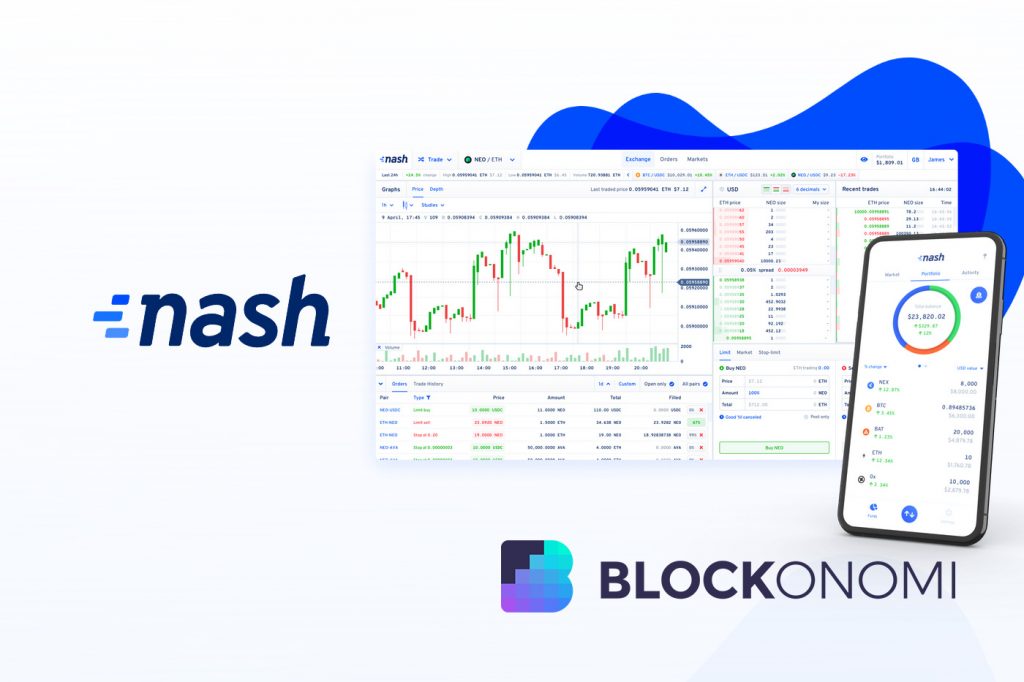
Nash, a “Layer-2” cryptocurrency exchange, is organizing the first ever non-custodial trading competition.
Nash League is a month-long trading contest beginning on 15 December with prizes for high-volume solo traders and teams. Larger prize pools become available as trading volume generated throughout the competition increases, with a top pool of $1,000,000.
Trading competitions like Bybit’s World Series of Trading are a popular promotional tool among centralized cryptocurrency exchanges.
What makes Nash League different is that Nash is not a centralized exchange.
Centralized exchanges take control of users’ assets and offer “paper trading” of numbers in a database. This allows for high-performance APIs and order-matching, but is inherently vulnerable to hackers. It’s also arguably opposed to the purpose of cryptocurrency, which was created as a decentralized tool offering self-custody of assets.
Nash’s unique technology provides the performance and features required to organize a trading competition without taking control of users’ assets.
The Nash League competition will prove that this non-custodial approach can handle significant trading activity.
Please Note: This is a Press Release
Nash League is the first non-custodial trading competition
Trading competitions place a number of requirements on exchanges:
- A user accounts system capable of tracking volume over time.
- Liquid, high-performance markets with order books, capable of sustaining significant trading activity and processing orders quickly.
- Robust APIs for algorithmic traders who generate a lot of volume, as well as for market-making partners who help maintain orderbook liquidity.
Existing decentralized exchanges (DEXes) lack these features:
- The majority of decentralized exchanges have no accounts system. While this preserves anonymity, it does not meet compliance requirements and makes the volume-tracking required for a trading competition impossible.
- Decentralized exchanges based directly on blockchains face inherent performance limits. Blockchain computation cycles are slow, and DEX orderbooks and atomic swaps just aren’t fast enough for a trading competition.
- Decentralized exchanges can’t offer the APIs required by algorithmic traders and market makers. Trading on DEXes requires using a complete private key to sign transactions. This approach is insecure, with API keys being left on servers that potentially offer full control of user assets.
Nash has developed new technology that overcomes these obstacles.
Unique technology
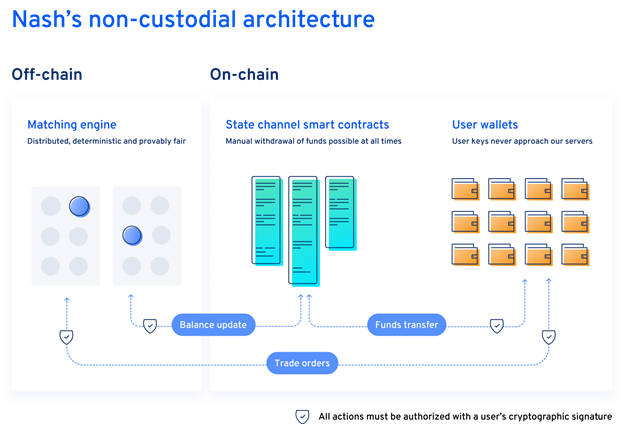
Trading on Nash takes place across state channels (like Bitcoin’s Lightning Network) connected to an off-chain matching engine. The matching engine tracks trades and updates balances across chains periodically, overcoming speed bottlenecks around settlement.
This allows for centralized-like trading performance without taking custody of assets, which remain on their original blockchains. With the ability to place and cancel orders in under 20ms, Nash is more than equipped to handle a trading competition.
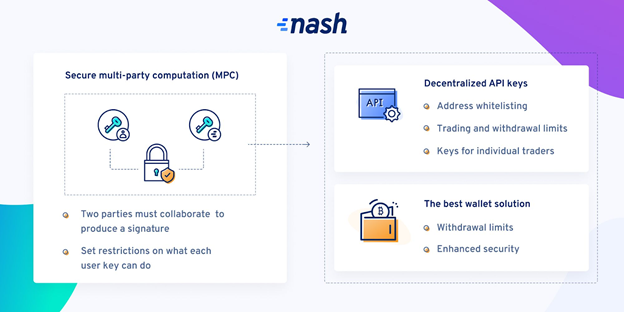
In another first for an exchange, Nash provides blockchain signatures using secure multi-party computation (MPC), not a user’s full private key. This allows for secure API keys and wallets with attached security policies.
Centralized exchanges can generate individual API keys with their own security policies easily – but Nash is able to accomplish this in an entirely non-custodial manner.
Nash partners
Algorithmic-trading firms and bot companies are keen to take advantage of this technology.
Nash is currently partnering with Margin, Tuned and Haas, who will all be offering integrations with the exchange, making their high-performance bots and trading terminals available in a non-custodial setup.
As part of the Nash League competition, all three companies are captaining teams, letting their retail users compete against each other collectively with the bots and tools they know.
Nash League will prove that non-custodial exchanges are capable of supporting a high-volume competition like those of centralized exchanges. Traders will hence have a powerful argument for moving to non-custodial exchanges in future.


