



TLDR
- Suspected projectile attacks struck three commercial vessels in the Strait of Hormuz and Persian Gulf waters Wednesday
- Crude oil markets rebounded more than 3% following Tuesday’s dramatic 12% plunge triggered by a retracted Navy escort claim
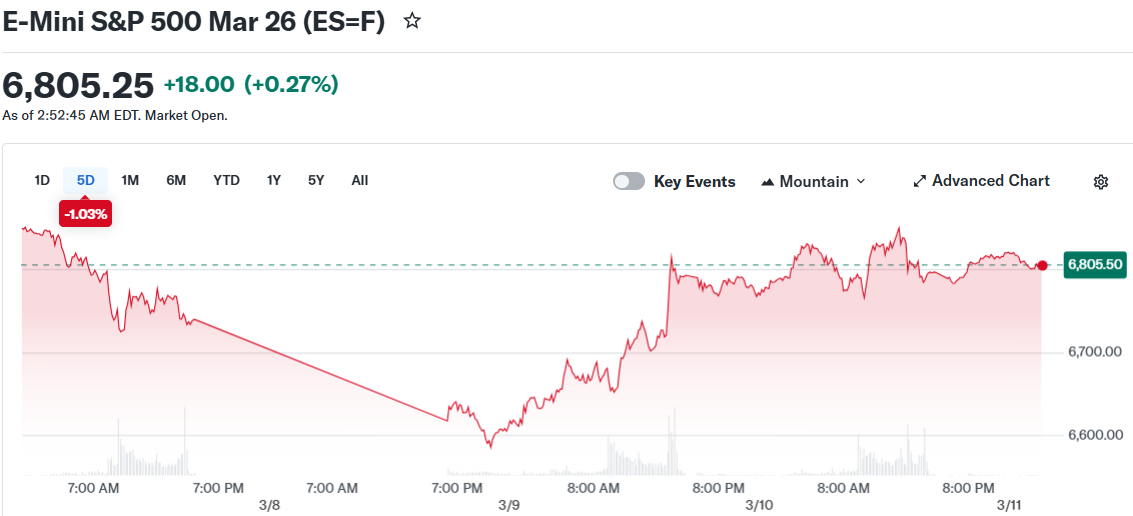
- Major US equity index futures declined modestly in Wednesday morning trading
- International Energy Agency announces historic oil reserve release plan exceeding previous records
- Critical February Consumer Price Index inflation data scheduled for release Wednesday at 8:30 a.m. ET
Equity markets faced downward pressure Wednesday morning as traders monitored escalating tensions involving Iran while anticipating crucial inflation metrics.
Futures contracts for both the S&P 500 and Nasdaq 100 indexes declined between 0.1% and 0.2% during early trading hours. Dow Jones Industrial Average futures similarly weakened following Tuesday’s nearly unchanged closing session.
Oil prices staged a notable recovery Wednesday following unprecedented volatility in prior sessions. West Texas Intermediate crude advanced 3.4% to reach $86.43 per barrel, while Brent crude climbed 2.7% to $90.25 per barrel.
The rebound follows extraordinary market movements. Crude briefly touched $120 per barrel Monday before plummeting 12% Tuesday—marking the sharpest single-session decline in four years.
Tuesday’s collapse occurred after US Energy Secretary Chris Wright posted on social media claiming Naval forces were providing escort services for oil tankers traversing the Strait of Hormuz. Officials subsequently deleted the post and clarified that military escort operations for commercial vessels are not currently underway in that strategic passage.
British Naval authorities reported Wednesday that three separate vessels sustained damage from suspected projectile impacts in regional waters. The incidents involved a cargo vessel in the Strait of Hormuz near Oman, a container ship west of Ras Al-Khaimah, and a bulk carrier positioned northwest of Dubai.
Emergency crews successfully extinguished a fire aboard the cargo vessel with no reported environmental contamination. A minimal crew complement remains aboard the damaged ship.
Oil Supply Response Takes Shape
Saudi Aramco announced operational adjustments to redirect crude shipments through the Red Sea facility at Yanbu, utilizing its East-West pipeline infrastructure to completely avoid the Strait of Hormuz chokepoint.
The International Energy Agency unveiled plans for a reserve release surpassing the 182 million barrels deployed during the 2022 Russia-Ukraine crisis. This proposed action would represent the agency’s largest reserve deployment since its establishment.
Deutsche Bank’s Jim Reid indicated that market dynamics continue responding primarily to developments surrounding Iran and petroleum supply chains. While characterizing sentiment as “cautiously more optimistic,” Reid acknowledged limited indications of near-term conflict resolution.
Inflation Data Could Shift Fed Expectations
Beyond energy market fluctuations, financial analysts are focusing intensely on February’s Consumer Price Index report, scheduled for release at 8:30 a.m. ET Wednesday. Forecasters anticipate inflation will mirror January’s 2.4% annual rate, with core measurements projected around 2.5%.
January’s Personal Consumption Expenditures index will follow Friday.
These figures are anticipated to influence market expectations regarding Federal Reserve monetary policy direction, particularly as recent employment sector indicators have demonstrated softening trends.
In corporate news, Oracle shares surged following robust quarterly results and optimistic forward guidance. Adobe and Dollar General have earnings announcements scheduled for Thursday.
The 10-year Treasury yield registered 4.156% Wednesday morning, showing modest decline from prior session levels.
Get 3 Free Stock Ebooks
Discover top-performing stocks in AI, Crypto, and Technology with expert analysis.
- Top 10 AI Stocks - Leading AI companies
- Top 10 Crypto Stocks - Blockchain leaders
- Top 10 Tech Stocks - Tech giants


