


Key Takeaways
- XRP declined 2.4% over a 24-hour period, settling around $1.36 with trading activity between $1.34 and $1.40
- Market-wide selloff intensified due to Middle Eastern geopolitical tensions pushing oil prices upward
- Ripple announced integration of stablecoin capabilities, including RLUSD, into its payment infrastructure
- Technical analysis shows crucial support at $1.3320 with resistance positioned at $1.3880
- Market observers note RLUSD could potentially rival XRP’s traditional bridge currency function within Ripple’s network
On Tuesday, March 3, 2026, XRP experienced a 2.4% decline over 24 hours, settling near $1.36 based on CoinGecko market data. The digital asset fluctuated within a $1.34 to $1.40 price corridor throughout the trading day.
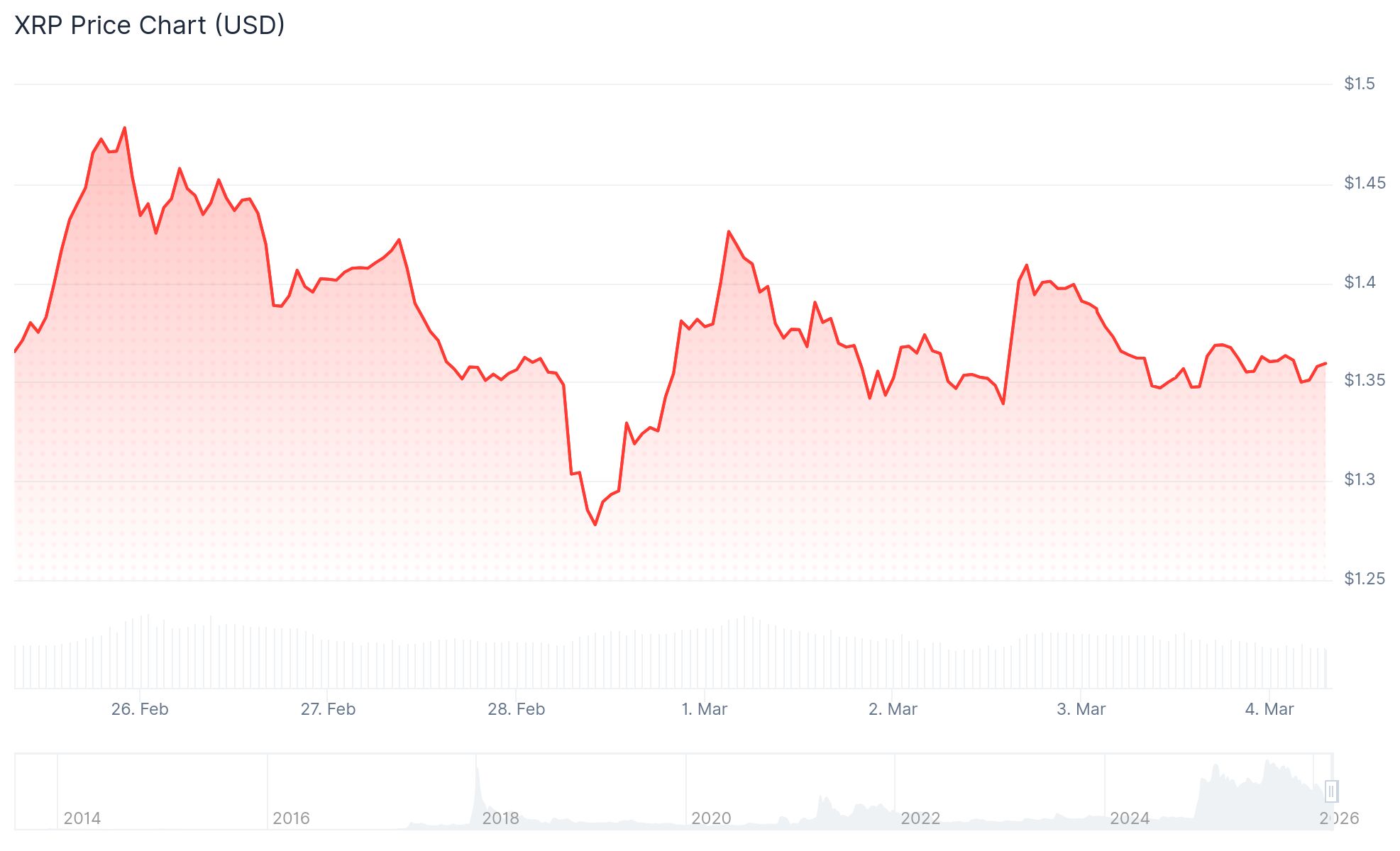
The token maintained a market capitalization hovering around $83 billion. Trading volume reached approximately $3 billion within the same 24-hour timeframe.
The price decline mirrored a wider retreat across risk-sensitive assets. Market participants attributed the selloff primarily to intensifying U.S.-Israel military operations targeting Iran.
“The market is concerned that the US is getting pulled deeper into this conflict,” said Tim Ghriskey, senior portfolio strategist at Ingalls & Snyder.
Bitcoin experienced a parallel downturn, declining 1.35% to $68,496 during the identical period. Data from Chainalysis revealed significant cryptocurrency withdrawals from Iranian trading platforms, totaling $10.3 million between Saturday and Monday.
Ripple Unveils Enhanced Payment Infrastructure
Tuesday brought Ripple’s announcement regarding the expansion of its Ripple Payments platform to accommodate both conventional fiat currencies and stablecoin assets. The firm is strategically positioning RLUSD, its dollar-backed stablecoin, as a primary instrument alongside XRP within the enhanced platform.
“Success in this space requires enterprise-grade infrastructure, extensive licensing, and deep liquidity,” said Monica Long, Ripple’s president.
Throughout the previous year, Ripple has strategically transformed itself into a stablecoin infrastructure provider. This transformation included the $200 million acquisition of Rail, a stablecoin payment solutions company, and the subsequent RLUSD launch following the Genius Act’s passage, which established clearer regulatory guidelines for stablecoins.
Implications for XRP’s Market Position
Historically, XRP has functioned as the primary bridge currency within Ripple’s international payment infrastructure. RLUSD now presents an additional option operating within the identical ecosystem.
Certain market analysts contend this development presents complications for XRP’s value proposition. Financial institutions utilizing XRP for transaction settlements typically execute conversions almost instantaneously, generating minimal sustained buying pressure.
RLUSD introduces a stable, regulatory-compliant alternative that may prove more attractive to banking institutions and financial service providers.
From a technical analysis perspective, XRP is currently positioned beneath its 100-hourly Simple Moving Average. A descending trend line has established itself with resistance concentrated near $1.3880 on the hourly timeframe.
Should the price breach $1.3880, subsequent resistance levels appear at $1.40 and $1.4320. On the downside, support levels are identified at $1.3320, followed by $1.3085.
XRP reached peak values approaching $3.50 in late 2025 before entering a correction phase. The token has remained below $1.50 since that downward adjustment.
As of Tuesday’s close, XRP was valued at roughly $1.36.

