


Key Highlights
- XRP maintains trading levels around $1.35, showing consecutive daily gains despite ongoing market pressures.
- Exchange-traded funds tracking XRP recorded $2.3 million in withdrawals on Monday, with total assets under management declining to $944 million from January’s $1.65 billion peak.
- Open Interest in XRP futures contracts has plummeted to $2.45 billion, representing a dramatic 73% decrease from July’s $10.94 billion high.
- Technical analyst Ali Martinez projects a possible 30% correction before any substantial recovery materializes in 2026.
- Ripple expands its treasury management solution with direct cryptocurrency integration, supporting both XRP and RLUSD stablecoin.
As of Wednesday, April 2, XRP continues to trade just above the $1.35 threshold. While the digital asset has registered gains over two consecutive sessions, enthusiasm from both individual and institutional market participants remains subdued.
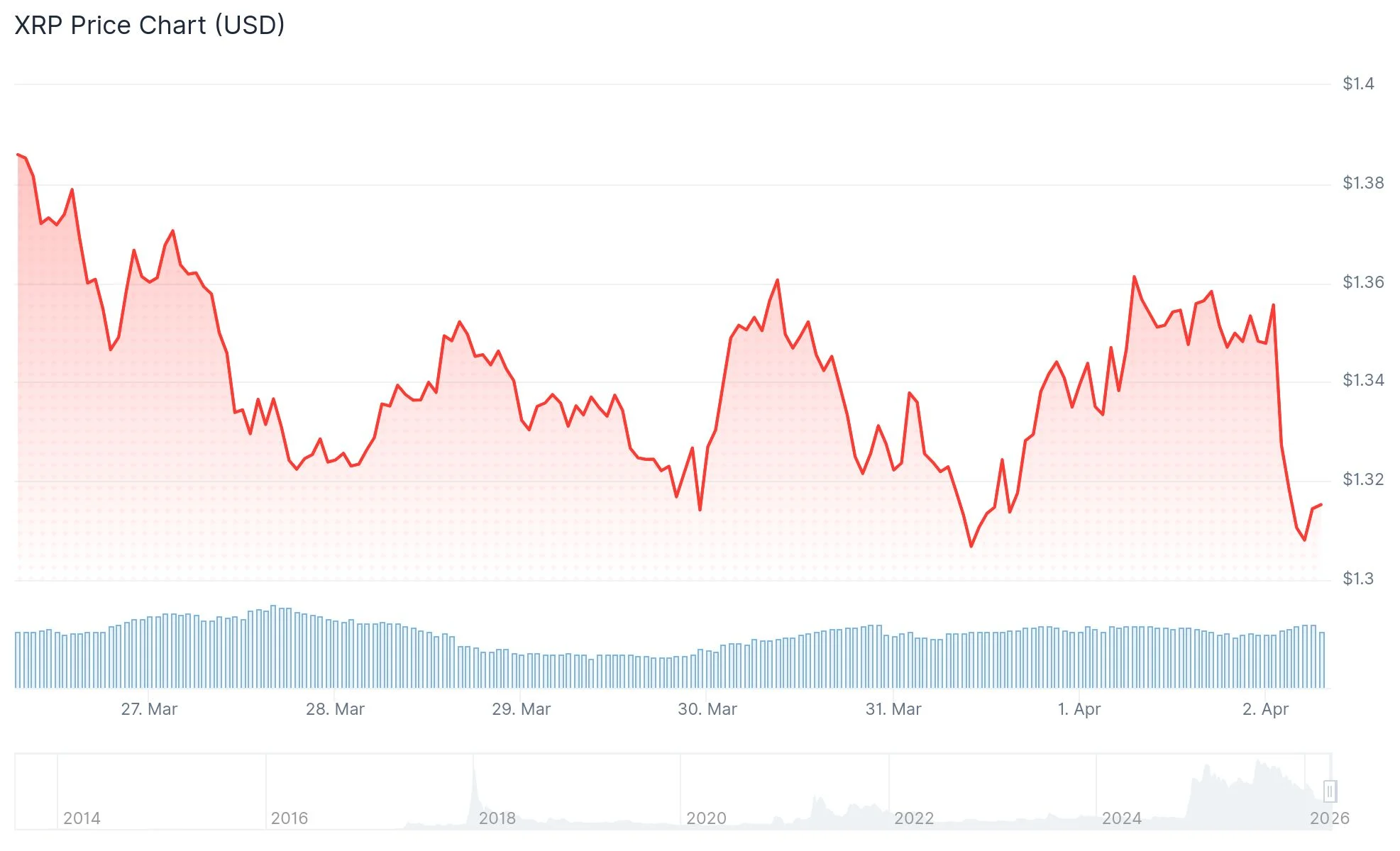
The token began trading at $1.34 before experiencing modest upward movement throughout the day. However, despite these incremental advances, XRP remains confined below a critical declining resistance trendline, with previous recovery efforts losing momentum near the $1.43 level.
Technical indicators paint a challenging picture. The 50-day, 100-day, and 200-day Exponential Moving Averages all remain significantly above current price levels. The Moving Average Convergence Divergence indicator has crossed below its signal line on daily timeframes, while the Relative Strength Index hovers around 43—suggesting sustained bearish momentum without entering oversold conditions.
Broader geopolitical factors have contributed to market headwinds. The extended conflict involving the United States and Israel with Iran, now entering its second month, has created widespread uncertainty across cryptocurrency markets, with attempted recoveries frequently meeting seller resistance.
Declining ETF and Futures Metrics Reveal Softening Interest
Spot XRP exchange-traded funds listed in the United States recorded $2.3 million in redemptions on Monday. Tuesday’s trading session saw minimal flow activity. While cumulative inflows remain at $1.21 billion, total assets under management have contracted to approximately $944 million—a substantial decline from the January 1 peak of $1.65 billion.

Futures market data reveals similar weakness. Open Interest for XRP contracts fell to $2.45 billion on Wednesday from $2.54 billion the previous day. This marks a precipitous decline from the record $10.94 billion registered in July, coinciding with XRP’s all-time high of $3.66. March 2026 represents the inaugural month recording negative net ETF flows since these products launched in November 2025.
Technical strategist Ali Martinez published a comprehensive multi-year chart analysis, identifying what appears to be an ascending triangle formation. The horizontal upper boundary rests near $3.32, and following XRP‘s failure to breach this resistance, the token has surrendered over 55% of its value.
According to Martinez: “Should XRP continue following this ascending triangle pattern, it may present a near-term accumulation opportunity alongside a robust multi-year upward trajectory.” He forecasts a potential additional correction of approximately 30% before any significant reversal, highlighting a multi-year logarithmic support line as a critical technical level.
Ripple Expands Treasury Solution With Native Cryptocurrency Support
On the enterprise front, Ripple has unveiled enhancements to its Ripple Treasury platform, incorporating native blockchain functionality. The newly introduced features, designated as Digital Asset Accounts and Unified Treasury, enable chief financial officers to monitor and control both traditional and digital assets—including XRP and the RLUSD stablecoin—through a consolidated interface.
Ripple’s Chief Executive Officer Brad Garlinghouse revealed that the platform facilitated $13 trillion in payment transactions during the previous year, supporting clients ranging from emerging enterprises to Fortune 500 corporations. While this volume previously excluded cryptocurrency transactions, the updated integration aims to bridge that gap.
The Digital Asset Accounts functionality provides real-time asset valuation, precision to 15 decimal places, and automated transaction documentation. Unified Treasury delivers instantaneous oversight across all digital asset holdings and cash positions.
Several enterprise clients are currently participating in beta testing prior to the platform’s worldwide deployment.

