


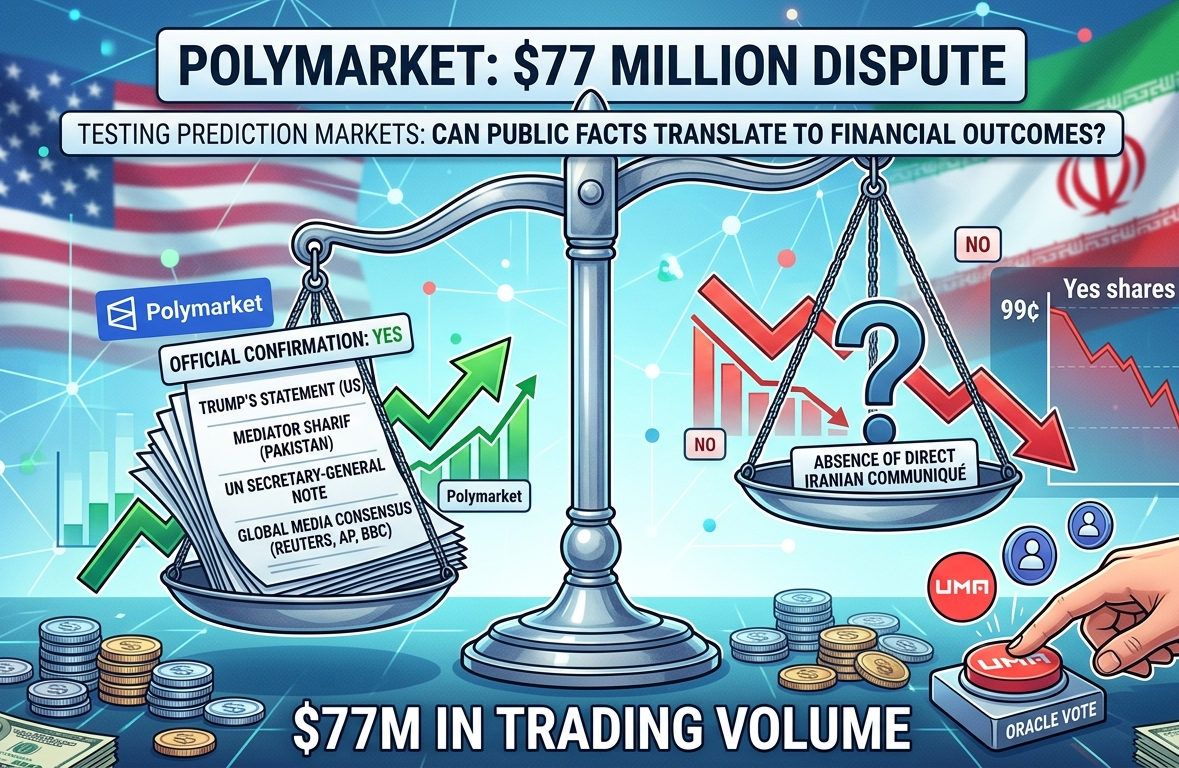
A $77 million dispute on Polymarket is testing one of the central promises of prediction markets: that public facts can be translated into clear financial outcomes.
The market in question asks whether the “US x Iran ceasefire” was extended by April 22, 2026. On paper, the question appears straightforward. A two-week ceasefire was announced on April 7. Before it expired, US President Donald Trump stated that the ceasefire would be extended indefinitely. Pakistan’s Prime Minister Shehbaz Sharif, whose country had acted as mediator, publicly welcomed the extension. The UN Secretary-General issued a Note to Correspondents referring to the extension as a step toward de-escalation. Major international media outlets also reported the development.
Yet on Polymarket, Yes shares have traded at roughly 0.1–0.3 cents, implying a probability of less than 1% that the market will resolve positively. For investors holding Yes positions, this is not simply a pricing anomaly. It is a dispute over whether Polymarket’s own rules are being applied consistently.
According to the investors’ argument, the market should resolve Yes if there was an official ceasefire extension confirmed by both sides, or alternatively if there was an overwhelming consensus of credible media reporting. They point to four pieces of evidence: Trump’s public statement, Pakistan’s confirmation as mediator, the UN note, and broad media coverage from outlets such as Reuters, AP, BBC, Al Jazeera, Axios, CNBC and The Wall Street Journal.
The financial stakes are unusually high.
The market’s trading volume is reported at about $77.2 million. In a Yes resolution, shares pay out $1 each. That means one of the largest holders could receive more than $20 million, according to the investor-side media package.
But the case is not airtight. The central weakness is the absence of a direct public communiqué from the Iranian government explicitly confirming the extension in its own voice. Critics may argue that a statement by Pakistan, even as mediator, is not legally identical to a statement by Iran. They may also argue that Trump’s statement reflected a US decision rather than a fully confirmed bilateral agreement.
This is where the case moves beyond geopolitics and into the infrastructure of prediction markets. Polymarket uses UMA’s oracle system to resolve disputed outcomes. If the result is challenged, UMA token holders may ultimately vote on the correct interpretation. In theory, this mechanism is designed to determine factual outcomes. In practice, this case shows how difficult that becomes when facts depend on diplomacy, legal interpretation and source hierarchy.
The broader issue is not whether one group of traders wins or loses.
It is whether a prediction market can handle ambiguous political events without appearing to disregard public evidence. If the market resolves No despite official US statements, mediator confirmation, a UN note and broad media reporting, critics will say the platform ignored the substance of its own rules. If it resolves Yes without direct Iranian confirmation, others will argue the oracle accepted inference over formal proof.
Either way, the dispute is likely to become a precedent. For Polymarket and UMA, the question is no longer only whether the ceasefire was extended. It is whether decentralized markets can produce resolutions that users view as fair, consistent and grounded in the same public facts they were invited to trade on.

