


Key Highlights
- Standard Chartered has launched coverage of ARB with an ambitious $10 target for 2030
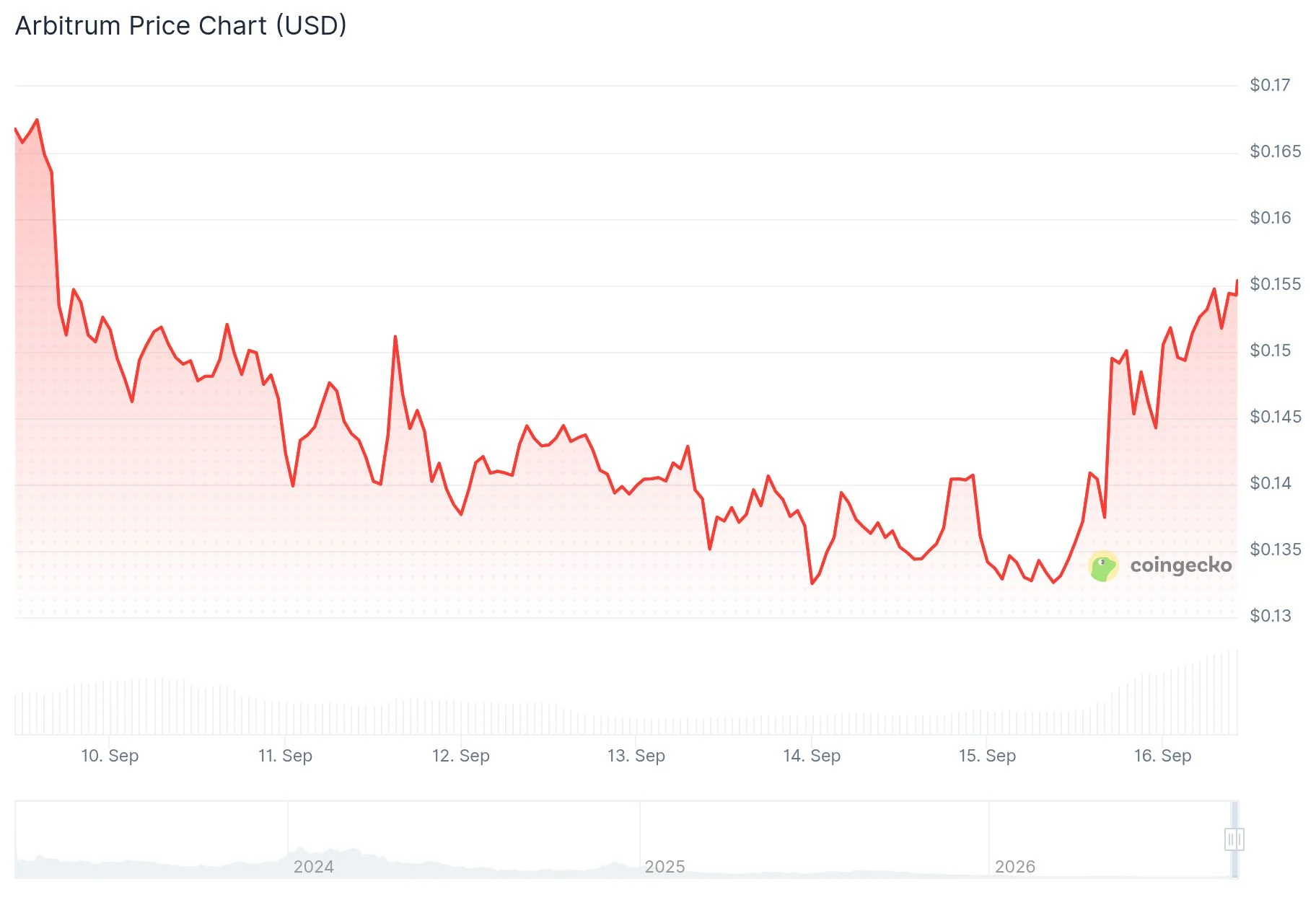
- This projection implies approximately 70 times the token’s current trading range of $0.13–$0.14
- The launch of Robinhood Chain has multiplied Arbitrum’s monthly revenue by a factor of five compared to pre-July figures
- The banking institution anticipates ARB will deliver superior returns versus Bitcoin and Ethereum through the decade
- Potential headwinds include decelerating tokenization adoption and blockchain ecosystem competition
In a notable development for the layer-2 ecosystem, Standard Chartered has published its inaugural research coverage on Arbitrum’s native token ARB, setting a price objective of $10 for year-end 2030. Given the token’s present valuation between $0.13–$0.14, achieving this target would deliver approximately 7,000% returns.
Geoff Kendrick, who leads Standard Chartered’s Global Digital Assets Research division, outlined this projection in client communications. His analysis positions ARB as likely to generate stronger performance than both Bitcoin and Ethereum during this timeframe. The financial institution forecasts Bitcoin reaching $500,000 and Ethereum hitting $40,000 by decade’s end.
Market data from CoinGecko shows ARB has already delivered 86% gains throughout the preceding month.
The research note establishes progressive milestones: $0.50 projected for end-2026, $1.50 for end-2027, $3.50 for end-2028, and $6.50 for end-2029.
Robinhood Chain Transforms Revenue Picture
The cornerstone of Standard Chartered’s investment thesis centers on Robinhood Chain, which commenced operations on July 1, 2026. The retail trading platform constructed its blockchain infrastructure utilizing Arbitrum’s technical framework.
Through Arbitrum’s Expansion Program framework, the network captures a continuous fee representing 10% of net protocol income from third-party chains developed using its technology.
During September’s initial fourteen days, Robinhood Chain generated average daily fee revenue of $2.8 million. Extrapolating current performance, Arbitrum is positioned to collect $5 million in AEP fees for September alone. This figure exceeds Arbitrum’s complete monthly revenue prior to Robinhood Chain’s deployment by more than fivefold.
Kendrick stated: “The early success of Robinhood Chain increases the probability that similar TradFi chains will also launch via the Arbitrum tech stack.”
Real-World Asset Tokenization Underpins Long-Term Outlook
The bank’s comprehensive bullish perspective depends heavily on tokenized real-world asset expansion. Standard Chartered projects tokenized assets will expand to $4 trillion by 2028’s conclusion, ascending from approximately $340 billion presently. Tokenized equity instruments alone may achieve $750 billion during this window.
Data from RWA.xyz indicates tokenized real-world assets currently represent nearly $39 billion in aggregate value.
Arbitrum functions as foundational infrastructure for traditional financial institutions transitioning assets onto blockchain networks. Kendrick emphasized that revenue generation is emerging as a decisive component in digital asset valuation frameworks.
“We see digital assets transitioning from a state where revenue is not yet relevant to one where revenue is critical,” he wrote.
Standard Chartered identified three principal risk factors: tokenization adoption proceeding slower than anticipated, competitive pressure from alternative blockchain platforms, and ARB’s absence of direct value capture mechanisms. The analysis also references pending U.S. regulatory frameworks, including the Clarity Act, alongside DTCC initiatives on tokenized equity securities as important monitoring points.
Current monthly revenue figures for Arbitrum exceed pre-Robinhood Chain levels by more than five times.

