



Key Takeaways
- Brian Armstrong, Coinbase’s CEO, declared Bitcoin’s floor at $60,000 in mid-June 2026
- The cryptocurrency declined to $59,743 on June 5, marking its weakest performance since October 2024
- A community survey conducted by Armstrong revealed 56% of participants reject his bottom thesis
- On-chain metrics highlight Bitcoin’s realized price near $53,600 as a critical support zone
- Despite severe downturns, BTC maintains a 33% compound annual growth rate since August 2017
Bitcoin’s current valuation hovers near $64,000 following a significant decline to $59,743 recorded on June 5, 2026. This represented the weakest price level observed since October of the previous year.
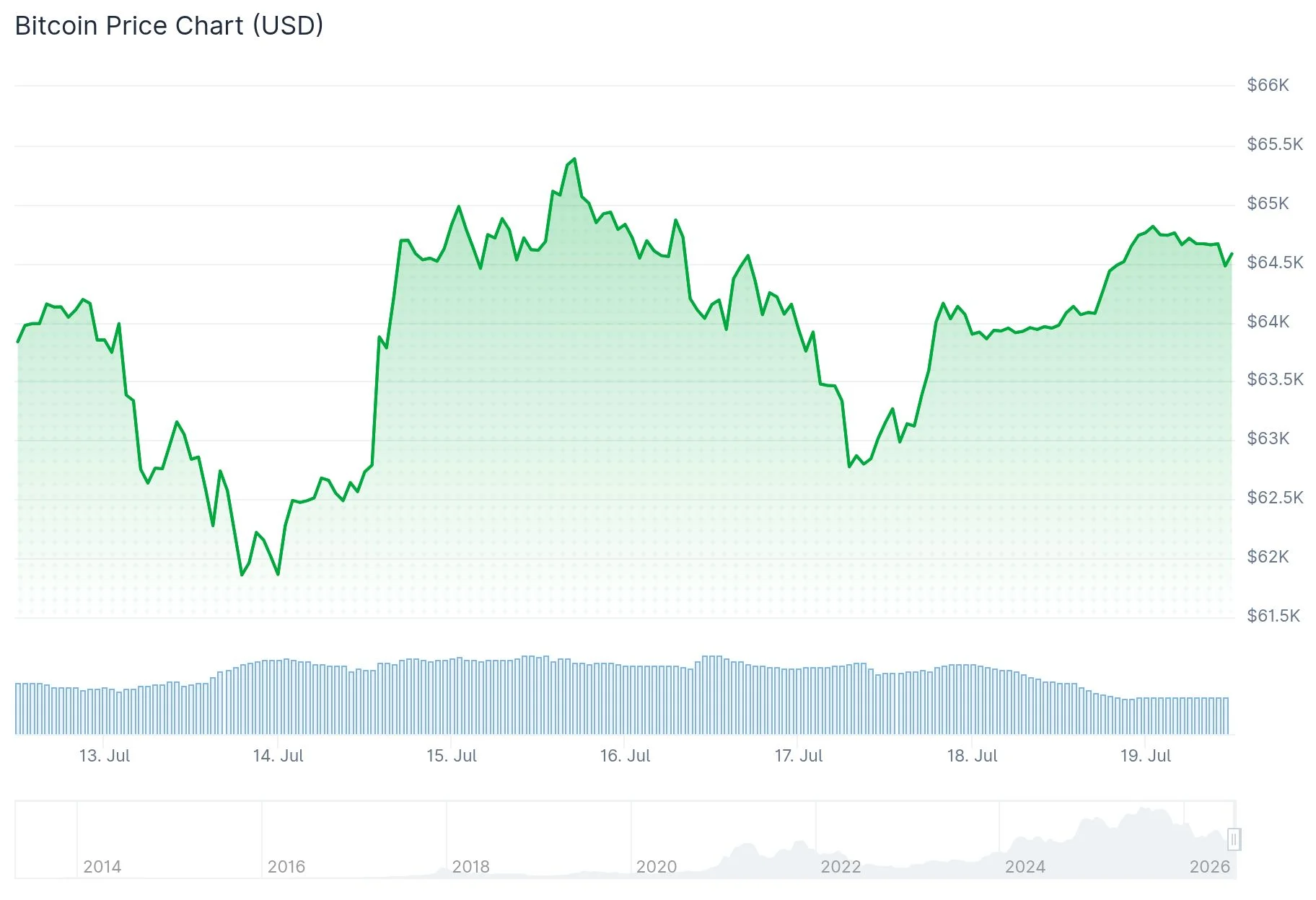
On June 15, Brian Armstrong, the chief executive of Coinbase, made a public declaration that Bitcoin has likely established its cyclical low at the $60,000 threshold. His analysis draws heavily from the cryptocurrency’s established four-year halving pattern.
According to Armstrong’s assessment, the recent correction appears moderate when contextualized against previous market downturns. The June minimum represented approximately a 50% decline from Bitcoin’s peak of $126,000 reached in October 2025. In stark contrast, the 2022 bear market eliminated roughly 75% of the digital asset’s value.
Following the $59,743 low point, Bitcoin experienced a swift rebound exceeding $66,000 within days. This price action indicates accumulation activity from market participants who perceived these levels as favorable entry zones.
It’s worth acknowledging that Armstrong maintains vested interests in Bitcoin’s market performance. As Coinbase’s co-founder alongside Fred Ehrsam in 2012, the platform’s financial health depends significantly on cryptocurrency trading activity and asset valuations.
Examining the Underlying Metrics
Armstrong’s reliance on the halving cycle theory carries substantial historical precedent. Earlier market cycles demonstrated Bitcoin establishing lows approximately 12 to 18 months following peak valuations, subsequently recovering to establish fresh record highs.
Nevertheless, blockchain analytics present a more reserved perspective. Bitcoin recently traded in proximity to its realized price of approximately $53,600. This metric represents the aggregate cost basis throughout all circulating Bitcoin units — effectively the weighted average acquisition price among holders.
Spot Bitcoin exchange-traded funds, which debuted in early 2024, have failed to deliver the consistent institutional capital influx that many market observers anticipated. Capital movements have demonstrated volatility, alternating between accumulation and distribution phases without establishing definitive directional momentum.
Throughout the period spanning August 2017 to June 2026, Bitcoin has delivered a compound annual growth rate of 33%, persisting through substantial market collapses in 2018, 2022, and the 2025–2026 timeframe.
Community Sentiment Challenges Armstrong’s Thesis
In a revealing development, Armstrong launched a sentiment survey on X during mid-July to measure market conviction. Among the more than 20,000 participants, 56% expressed disagreement that the market floor has been established. A mere 44% supported his bottom-calling perspective.
These divided responses underscore the prevailing uncertainty characterizing current market conditions. Macroeconomic headwinds — encompassing prospective monetary policy adjustments and international political instability — continue representing variables that could exert downward pressure on Bitcoin valuations.
The $53,600 realized price level has emerged as a focal point for market analysts. Should Bitcoin maintain support above this threshold throughout the summer months, Armstrong’s bottom prediction would gain substantial validation. Conversely, a breakdown beneath this level would redirect attention toward identifying the next potential support zones.
Bitcoin is presently valued at approximately $64,594.

