



Key Highlights
- BTC maintained stability within the $77,580–$78,800 range while U.S.-Iran conflict drove oil prices higher by approximately 2%
- Bitcoin emerged as August’s top performer with 23% gains, outpacing gold’s 9% rise and the Nasdaq’s 4% increase
- Following $242.3M in ETF inflows on Aug 27, Bitcoin ETFs experienced $201.9M in outflows on Aug 28, breaking a nine-session positive streak
- BlackRock’s Bitcoin and Ethereum spot ETFs accumulated more than $1.58B over the previous seven days
- Critical resistance levels identified at $79,400–$80,800; key support zones established near $77,000–$75,000
The world’s leading cryptocurrency has maintained its position between $77,580 and $78,800 as new geopolitical developments unfolded in global markets. Following a U.S. military strike on an Iranian island located within the Strait of Hormuz—a critical passage for global oil transport—energy markets responded sharply. WTI crude oil surged nearly 2% to reach $85.10 per barrel, while Brent crude advanced to $92.39.
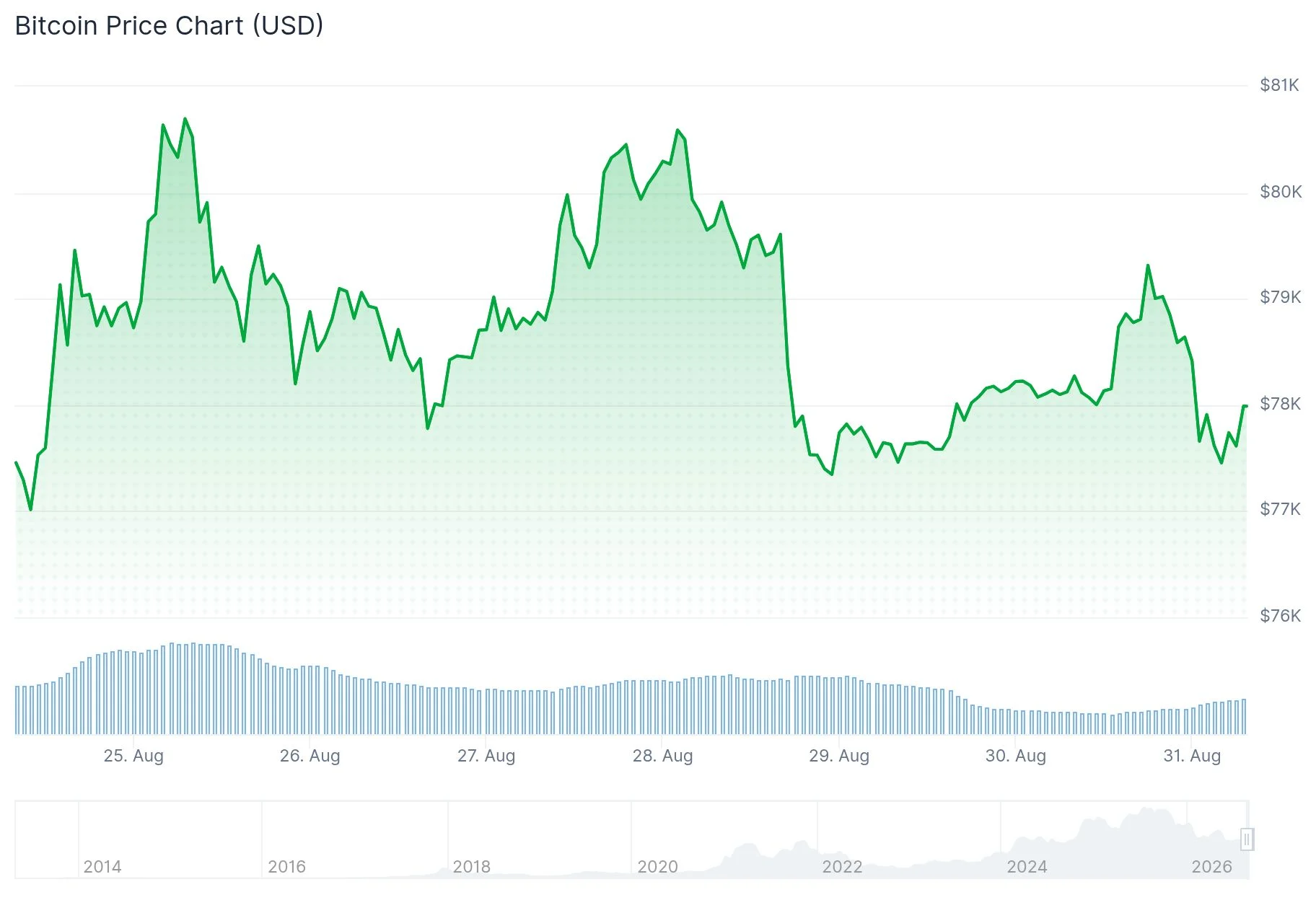
Meanwhile, gold experienced a 0.8% decline, settling at $4,418 per ounce. Nasdaq futures registered a 0.5% decrease. Bitcoin, however, demonstrated remarkable stability with minimal price movement.
Throughout August, BTC has delivered a commanding 23% return, establishing itself as the month’s strongest-performing asset class. During this same timeframe, gold posted a 9% gain, while the technology-heavy Nasdaq managed only a 4% advance.
Market analyst Ted Pillows observed on X that Bitcoin remains “hovering around the $78,000 level” with diminishing momentum indicators. His analysis suggests a potential pullback to $74,000 before BTC can mount another challenge above $81,000.
Blockchain data reveals a contrasting narrative. On-chain specialist Ali Charts documented that large-scale investors acquired more than 39,154 BTC—approximately $3 billion in value—during the past seven days.
Bitcoin ETF Investment Patterns Display Volatility
Data from Farside Investors indicates that spot Bitcoin exchange-traded funds registered $242.3 million in net inflows on August 27. This positive momentum reversed sharply on August 28 with $201.9 million in outflows, terminating a nine-day consecutive inflow period.
Ethereum ETFs demonstrated contrasting behavior, recording $102.1 million in net inflows on August 28—marking their tenth consecutive session of positive flows.
Investment giant BlackRock’s spot Bitcoin and Ethereum ETF products collectively attracted upwards of $1.58 billion throughout the previous week. Strategy’s Michael Saylor shared his Bitcoin tracking metrics on August 30 accompanied by the message “We’re back,” suggesting the company may be preparing for another acquisition.
Critical Economic Indicators to Monitor This Week
Federal Reserve Chair Kevin Warsh delivered remarks at Jackson Hole with a notably hawkish stance. His assessment indicated that inflation remains above target levels and current monetary conditions lack sufficient restrictiveness. Market pricing now reflects a 58% probability of an interest rate increase in September.
The upcoming economic calendar features several key releases: ISM Manufacturing PMI alongside JOLTS job openings data on Tuesday, ADP employment figures and the Federal Reserve Beige Book on Wednesday, and the comprehensive nonfarm payrolls report on Friday.
Vikram Subbaraj, CEO of Giottus, indicated that Bitcoin maintains critical support around the $77,000 level, while facing notable resistance within the $79,400 to $80,800 range.
Achieving a daily closing price above $81,800 would establish a pathway toward the $85,000 target. Conversely, breaking below the $75,000 support level could expose Bitcoin to a decline toward $70,000.
The ETF outflow recorded on August 28 marked the conclusion of nine consecutive sessions with positive flows, introducing a more cautious outlook as markets transition into September.

