



TLDR
- Bullion declined 0.5% to $2,120.16 per ounce Tuesday amid dollar appreciation
- Political instability in France drove the euro down to 17-month lows, supporting the greenback
- Treasury yields climbed to multi-decade peaks, increasing gold’s opportunity cost
- Rate swap markets now indicate roughly 23% odds of an October Fed hike, compared to nearly 70% one week ago
- September Fed policy meeting minutes scheduled for Wednesday release may signal future rate direction
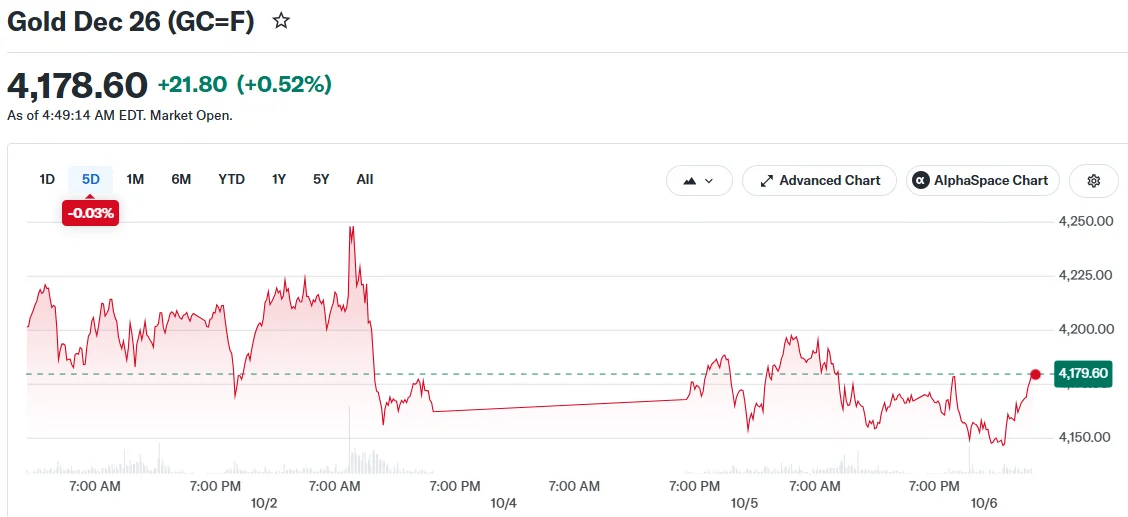
Gold prices retreated Tuesday as an appreciating U.S. dollar and elevated Treasury yields overshadowed diminishing market expectations for additional Federal Reserve interest rate increases. Bullion for immediate delivery shed 0.5% to settle at $2,120.16 per ounce. December gold futures contracted 0.2% to $2,146.80.
Other precious metals followed suit, with silver tumbling 1.2% to $60.35 per ounce. Platinum registered a 1.3% decline to $1,703.71, and palladium slipped 1.4% to $1,161.00.
Greenback Gains Suppress Gold Demand
The U.S. Dollar Index advanced 0.1% to 102.27 Tuesday. The currency had approached yearly highs during Monday’s session.
France’s political instability contributed significantly to dollar appreciation. A selloff in French sovereign debt drove the euro to its weakest level in 17 months.
Emmanuel Moulin, Governor of the Bank of France, cautioned that France risks facing additional constraints from elevated borrowing costs should the government fail to address its fiscal challenges. French bond yields continued their upward trajectory following his remarks.
Dollar appreciation increases the relative cost of gold for international buyers using alternative currencies. This dynamic generally exerts downward pressure on precious metal valuations.
Bond Market Selloff Compounds Headwinds
U.S. Treasuries experienced renewed selling Monday. Long-duration yields touched fresh multi-decade peaks as the bond market extended its monthlong decline.
Rising yields elevate the opportunity cost associated with holding non-yielding assets like gold. Since bullion generates no income, investors frequently rotate into bonds during periods of yield expansion.
Data from the Institute for Supply Management revealed that cost pressures within the U.S. services sector accelerated to their fastest pace in over four years last month. The report intensified inflation concerns already prevalent in financial markets.
Despite persistent pricing pressures, employment data has revealed signs of softening. Federal Reserve policymakers have actively pushed back against market expectations for imminent monetary tightening.
Interest rate swap markets indicated approximately 23% probability of an October rate increase as of Tuesday. This represents a dramatic decline from the roughly 70% probability priced in just one week earlier, following disappointing U.S. employment figures.
Market pricing still reflects expectations for a complete 25-basis-point rate increase by the Fed’s December policy meeting.
The central bank’s September meeting minutes are scheduled for release Wednesday. That gathering marked the initial rate hike in three years. Market participants are scrutinizing the minutes for insight into policymakers’ future intentions.
Bullion surrendered more than 6% during September. Energy-linked inflation concerns, anticipation of elevated U.S. interest rates, and dollar strength all factored into the monthly decline.
The precious metal has declined more than one-fifth since the US-Iran conflict erupted in late February.
ANZ analysts noted that gold has reclaimed some territory from last week’s steep losses. They attributed the recovery to investors reevaluating mounting fiscal pressures globally.
The analysts also highlighted that reduced expectations for Fed tightening have provided modest support. This shift followed last week’s weaker-than-anticipated payroll data.
Spot gold changed hands at $2,139.06 per ounce during Asian market hours. Silver remained stable near $61.05 per ounce.
Platinum drifted lower while palladium posted modest gains. The Bloomberg Dollar Spot Index maintained its level after advancing for four consecutive weeks.
Get 3 Free Stock Ebooks
Discover top-performing stocks in AI, Crypto, and Technology with expert analysis.
- Top 10 AI Stocks - Leading AI companies
- Top 10 Crypto Stocks - Blockchain leaders
- Top 10 Tech Stocks - Tech giants


