



TLDR:
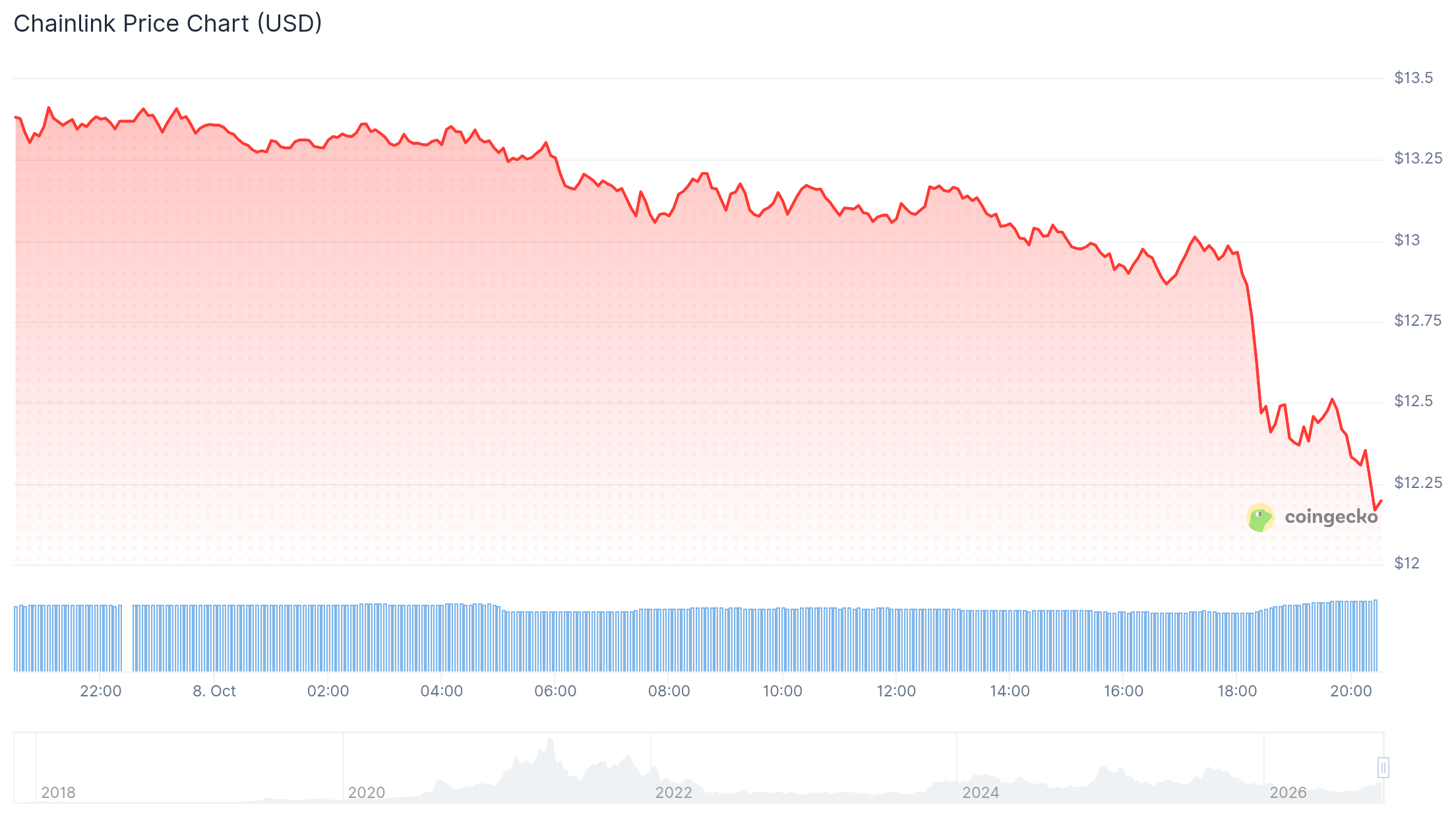
- Chainlink fell 3.02% to $12.97 in 24 hours, with the four-hour chart showing support near $12.80 and resistance around $14.
- CCIP Vault Adapters let users deposit into supported vaults from more than 80 blockchains, while vault strategy and accounting remain on one chain.
- Chainlink ETFs recorded zero net flows on Oct. 7 despite $226.29 million in combined assets and $168.96 million in cumulative inflows.
- CCIP 2.0 lets institutions add verifiers to Chainlink’s 16-operator network; Chainlink had not named a traditional bank using the upgrade.
Chainlink price fell 3.02% to $12.97 over 24 hours on Oct. 8. Bitcoin fell below $83,000, weighing on digital assets. LINK neared $12.80 support as traders assessed Chainlink’s new CCIP Vault Adapters. The adapters enable deposits into supported vaults from more than 80 blockchains.
The launch follows CCIP 2.0, introduced Sept. 28, as institutional adoption remains a key question. Whale activity hit a new 2026 high, with 681 transactions. Those movements do not show whether large holders were buying or selling. Chainlink ETFs recorded zero net flows on Oct. 7, while technical indicators continued to weigh on the Chainlink price.
Chainlink Price Nears $12.80 Support as Selling Pressure Builds
Markets also faced a risk-off backdrop. Concerns about possible U.S. strikes on Iran and tanker attacks near the Strait of Hormuz pushed Brent crude above $100. Higher Treasury yields and a stronger dollar added pressure on risky assets. CoinGlass data showed roughly $550 million in leveraged positions liquidated in under 24 hours. Bitcoin, Ethereum, XRP, and Solana also fell.
Whale data added a separate signal. Whale transactions worth $100,000 or more totaled 681, the highest daily count of 2026 and the most since Nov. 19, 2025. The Chainlink price fell during the same volatile stretch, but transaction counts do not identify buyers or sellers.

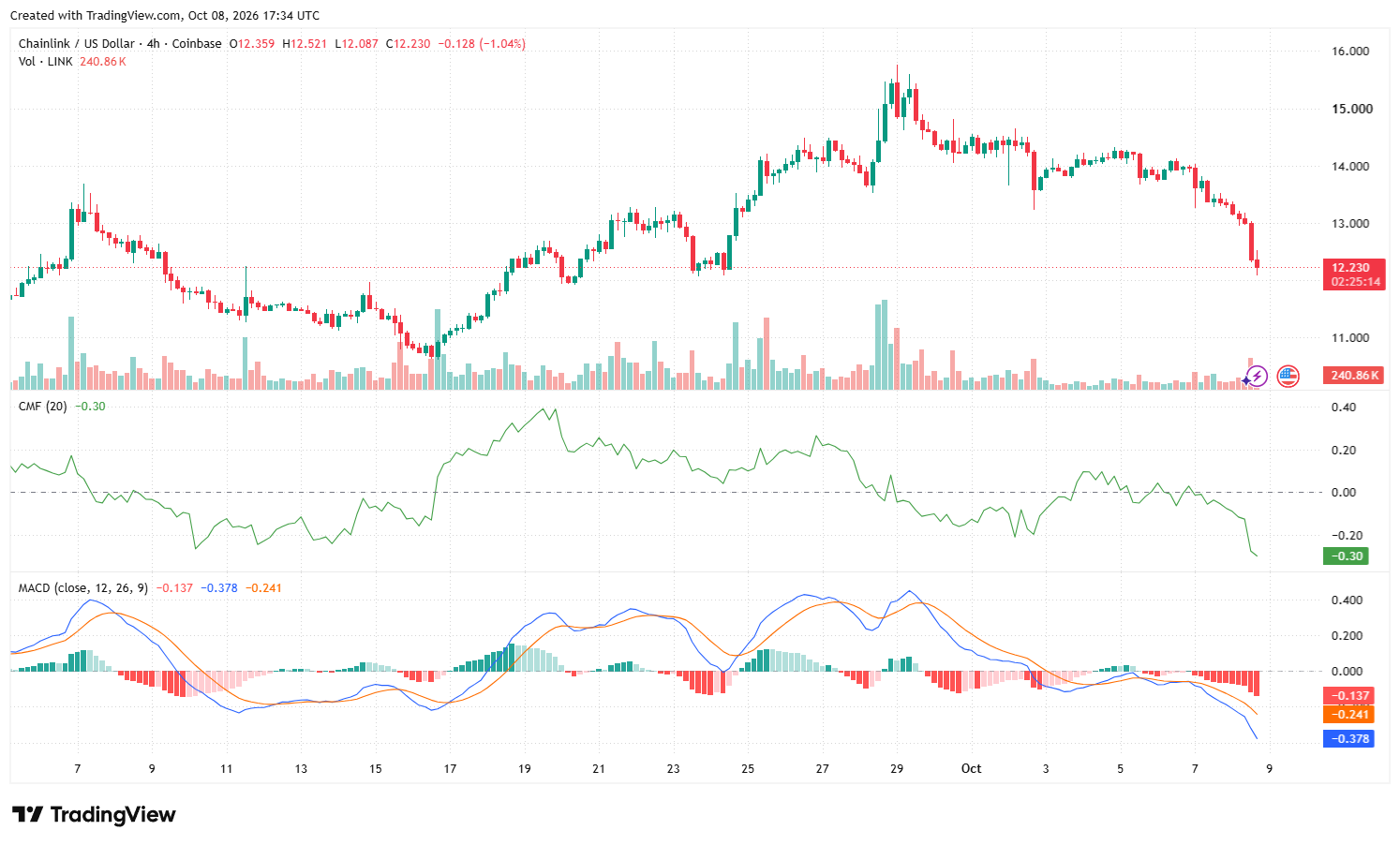
TradingView’s four-hour chart showed Chaikin Money Flow at -0.14. MACD stood at -0.270, below its -0.197 signal line, while its histogram reached -0.074. These readings pointed to selling pressure. SoSoValue data showed Chainlink ETFs had zero net flows in Oct. 7. ETF trading volume was $4.85 million on Oct. 7. ETFs held $226.29 million in assets, with $168.96 million cumulative net inflows.
The Chainlink price analysis placed $12.80 as immediate support. Four consecutive hourly closes below it could expose the next visible level near $12.00. A hold could stabilize the price, while resistance sits around $14.00 and then $15.00. These are chart scenarios, not confirmed price targets.
CCIP Vault Adapters Bring One-Click Deposits Across Chains
Chainlink said CCIP Vault Adapters let users deposit into supported vaults from other chains with one click. Vault strategy and accounting can remain on a single network, avoiding duplicate deployments across chains. The service spans more than 80 blockchains. Chainlink named Aave, Lombard, United Stables, Veda, and Venus among adopters. The adapters address fragmented liquidity by connecting users with vaults beyond the networks where they hold assets.
CCIP 2.0, released Sept. 28, lets institutions add verifiers to Chainlink’s 16 independent node operators. Firms can select confirmation speeds and add KYC, anti-money-laundering, and sanctions checks. Chainlink has named Lombard, a previous CCIP user, as its only verifier adopter.
No bank or traditional asset manager is named as a CCIP 2.0 user. Chainlink says CCIP now supports more than $84 billion in cross-chain token value. Swift, DTCC, UBS, and ANZ connections include pilots and experiments. Chainlink’s launch post named several adopters but did not report deposit or repeat-usage totals for the new service.
The upgrade followed April’s $292 million Kelp DAO bridge exploit. Attackers reportedly fooled a single verifier on the rival LayerZero protocol’s bridge infrastructure. CCIP 2.0 no longer uses Chainlink’s separate Risk Management Network to double-check transactions. Institutions that skip optional verifiers therefore rely on one verifier network.
Payment Abstraction converts customer payments in tokens, stablecoins, or traditional currency into LINK. Those tokens enter a strategic reserve funded by enterprise and on-chain revenue. Greater use could send more LINK to the reserve, but the effect depends on fees, activity, and reserve policy.
The Chainlink price traded 5.8% below its Sept. 28 level after CCIP 2.0 launched. LINK also remained 75.5% below its May 2021 record. Those declines do not show whether the new features changed demand. Broader macro conditions also influenced prices.

