



Quick Summary
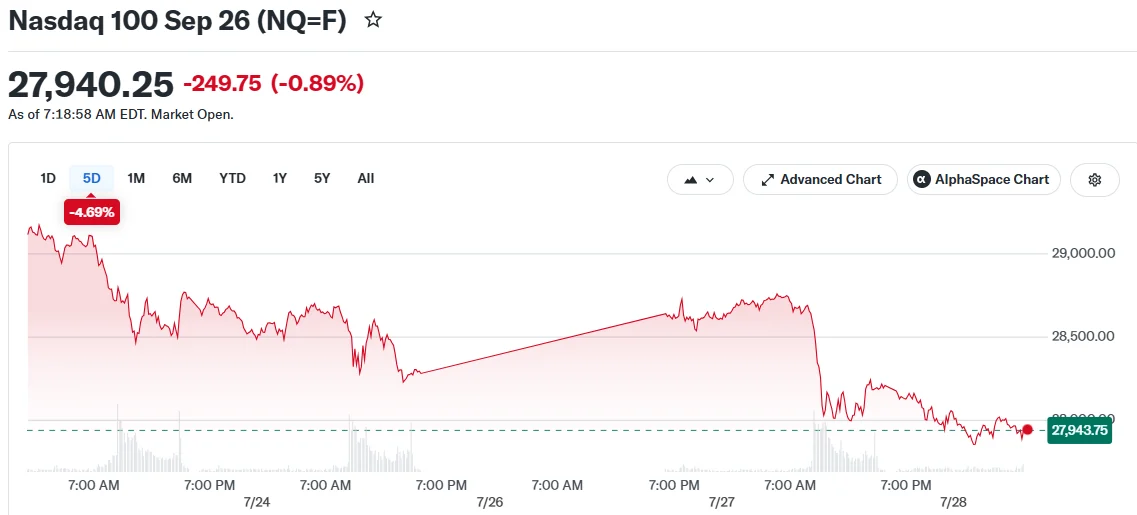
- Nasdaq 100 futures declined 0.7–0.8%, S&P 500 futures dipped 0.1%, and Dow futures climbed approximately 0.3%
- South Korea’s Kospi experienced a dramatic 10%+ plunge, with SK Hynix sliding 14% and Samsung tumbling 13%
- Nvidia’s potential $250 billion OpenAI funding backstop sparked circular financing worries among investors
- Emerging Chinese capabilities in chip production are intensifying concerns for American semiconductor manufacturers
- Federal Reserve’s two-day policy meeting commences Tuesday, with interest rate announcement scheduled for Wednesday
Technology futures tumbled Tuesday morning as semiconductor stocks faced mounting selling pressure amid anxieties about artificial intelligence capital expenditure and escalating rivalry from Chinese manufacturers.
Futures tied to the Nasdaq 100 declined approximately 0.8%, signaling additional technology sector weakness at the opening bell. S&P 500 futures slipped 0.1%, whereas Dow Jones futures moved against the broader trend, advancing roughly 0.3%.
Asian markets initiated the downturn. South Korea’s Kospi benchmark experienced a catastrophic decline exceeding 10% on Tuesday, marking one of the most severe single-session retreats in recent memory.
Memory chip producers SK Hynix and Samsung Electronics bore the brunt of investor exodus. SK Hynix shares plummeted more than 14%, while Samsung declined in excess of 13%.
The widespread liquidation stemmed partially from emerging information that a Chinese government-supported enterprise has achieved mass production of semiconductor manufacturing equipment. This development heightened anxieties that China is narrowing the technological advantage held by American semiconductor companies.
OpenAI Funding Structure Compounds Market Anxiety
Investor confidence in artificial intelligence equities suffered an additional blow following revelations that Nvidia is considering a $250 billion financial backstop arrangement for OpenAI. This proposed structure would create deeper interdependence between the organizations and has ignited apprehension regarding circular capital flows within the AI ecosystem.
Market participants are increasingly skeptical about the profitability of AI-related investments, particularly if Chinese competitors can deliver equivalent technological solutions at reduced costs.
Deutsche Bank analyst Jim Reid summed up the mood: “Renewed worries over AI investment spending, and competition from cheaper Chinese companies, have triggered another selloff in global semiconductor stocks.”
Central Bank Policy and Corporate Reports Take Center Stage
The Federal Reserve launches its two-day monetary policy deliberations Tuesday. Wednesday’s rate announcement remains uncertain, with markets divided. While most traders anticipate rates will remain unchanged, the possibility of a rate increase hasn’t been completely dismissed.
Oil prices extended their decline following a de-escalation between the US and Iran as both nations entered diplomatic negotiations. President Trump indicated Monday that an agreement was achievable.
Corporate earnings disclosures are accelerating. SK Hynix is scheduled to release results around 8 p.m. ET Tuesday, with market participants scrutinizing the report for insights into memory chip demand dynamics.
Additional prominent corporations scheduled to report this week include Visa, Coca-Cola, Boeing, Ford, and PayPal.
A consumer confidence report is slated for 10 a.m. ET, providing markets with supplementary economic data before the Federal Reserve’s policy announcement.
In early Tuesday trading, the E-Mini Nasdaq 100 stood at $27,915, retreating 0.97%. The E-Mini S&P 500 registered $7,441, declining 0.09%, while the E-Mini Dow reached $52,704, gaining 0.61%.
Get 3 Free Stock Ebooks
Discover top-performing stocks in AI, Crypto, and Technology with expert analysis.
- Top 10 AI Stocks - Leading AI companies
- Top 10 Crypto Stocks - Blockchain leaders
- Top 10 Tech Stocks - Tech giants


