


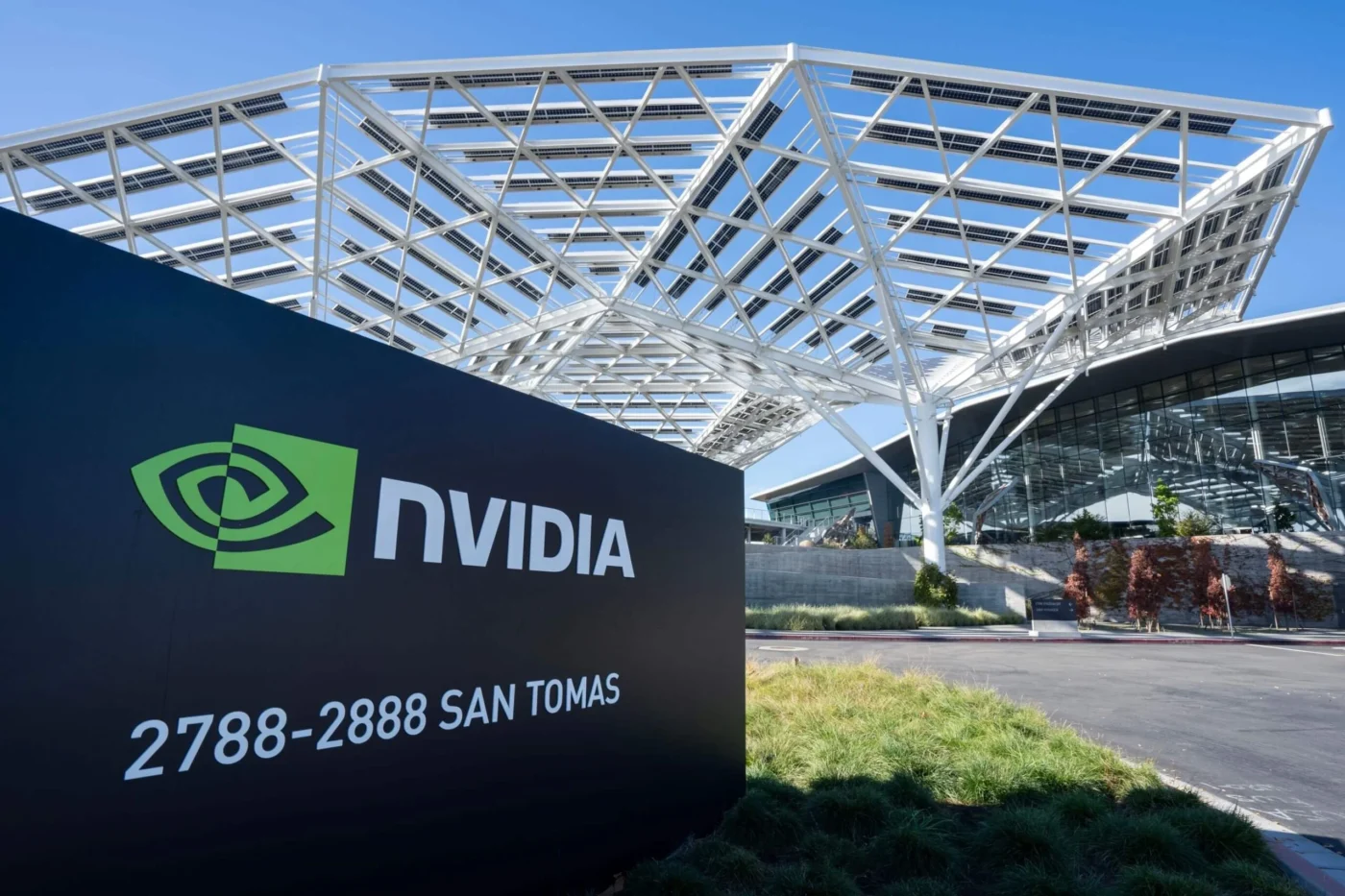
Key Takeaways
- Nvidia’s valuation has surged to approximately $6 trillion on the back of robust artificial intelligence chip sales.
- AMD has recently achieved a $1 trillion market capitalization and is scaling up manufacturing through 2027.
- AMD secured a multibillion-dollar agreement to deliver AI servers to Anthropic.
- AMD plans to acquire World Labs for $8.2 billion, strengthening its position in robotics and simulation technologies.
- Nvidia projects approximately 70% revenue expansion in its upcoming fiscal year as AI investment accelerates.
Two semiconductor giants—Nvidia and AMD—have emerged as dominant forces in the artificial intelligence revolution. Both manufacture processors that enable AI infrastructure, though their growth trajectories follow distinct paths.
Nvidia maintains its position as the substantially larger enterprise. The company’s market capitalization recently approached the $6 trillion threshold.
AMD represents a smaller competitor but demonstrates rapid expansion. The chipmaker recently surpassed $1 trillion in market value.
Nvidia’s Dominance in AI Semiconductors
Nvidia produces graphics processing units that facilitate both the training and deployment of artificial intelligence algorithms. The corporation commands the overwhelming majority of this specialized market.
A significant component of Nvidia’s competitive edge stems from CUDA, its proprietary software ecosystem. Because numerous AI engineers have constructed their applications on this framework, migrating to alternative chip suppliers presents considerable challenges.
Nvidia has disclosed robust demand for its semiconductor offerings. Management forecasted approximately 70% revenue acceleration for the coming fiscal period.
Nvidia stock recently established fresh all-time highs, elevating the company’s total market worth to roughly $5.76 trillion.
Certain market participants have expressed concerns regarding how artificial intelligence enterprises will finance the enormous data infrastructure required to operate these processors. Financial institutions have demonstrated reluctance toward accepting GPUs as collateral for financing, citing concerns about rapid depreciation of hardware value.
Nevertheless, equity research analysts from Morgan Stanley indicated that Nvidia and Broadcom possess superior positioning compared to competing semiconductor manufacturers when navigating power supply constraints impacting data facilities.
AMD’s Expansion Approach
AMD represents Nvidia’s primary rival in the AI processor space. The organization is executing plans to scale manufacturing capacity through 2027.
Advanced Micro Devices, Inc., AMD
AMD Chief Executive Lisa Su announced this week that the enterprise intends to amplify chip availability throughout the next year. AMD is collaborating with manufacturing partners including TSMC, Foxconn, Samsung and SK Hynix to obtain additional production resources.
AMD has secured additional enterprise clients as well. The company reached an agreement to provide tens of billions of dollars in AI server infrastructure to Anthropic and intends to invest as much as $5 billion into the artificial intelligence firm.
AMD is diversifying beyond data center processors. The company disclosed intentions to acquire World Labs, an enterprise established by prominent AI scientist Fei-Fei Li, for $8.2 billion. This transaction positions AMD more prominently within robotics applications and three-dimensional simulation capabilities.
AMD’s market capitalization stands at approximately one-sixth of Nvidia’s current valuation. This disparity suggests substantial upside potential if the company continues capturing market share within the AI semiconductor industry.
AMD continues to lag behind Nvidia in software ecosystem development, profit margins and overall competitive positioning. The organization is pursuing strategies to narrow this performance gap through strategic partnerships and acquisitions.
Investment professionals evaluating these two enterprises encounter distinct considerations. Nvidia represents an established industry leader with extensive customer relationships. AMD represents a challenger actively working to expand its market presence.
Several financial analysts have proposed that investors anticipating sustained AI infrastructure spending across multiple years might consider maintaining positions in both companies instead of selecting one exclusively.
Nvidia continues establishing new stock price records as of this week. AMD, conversely, is concentrating on broadening its supply chain partnerships and customer relationships heading toward 2027.
Get 3 Free Stock Ebooks
Discover top-performing stocks in AI, Crypto, and Technology with expert analysis.
- Top 10 AI Stocks - Leading AI companies
- Top 10 Crypto Stocks - Blockchain leaders
- Top 10 Tech Stocks - Tech giants


