



TLDR
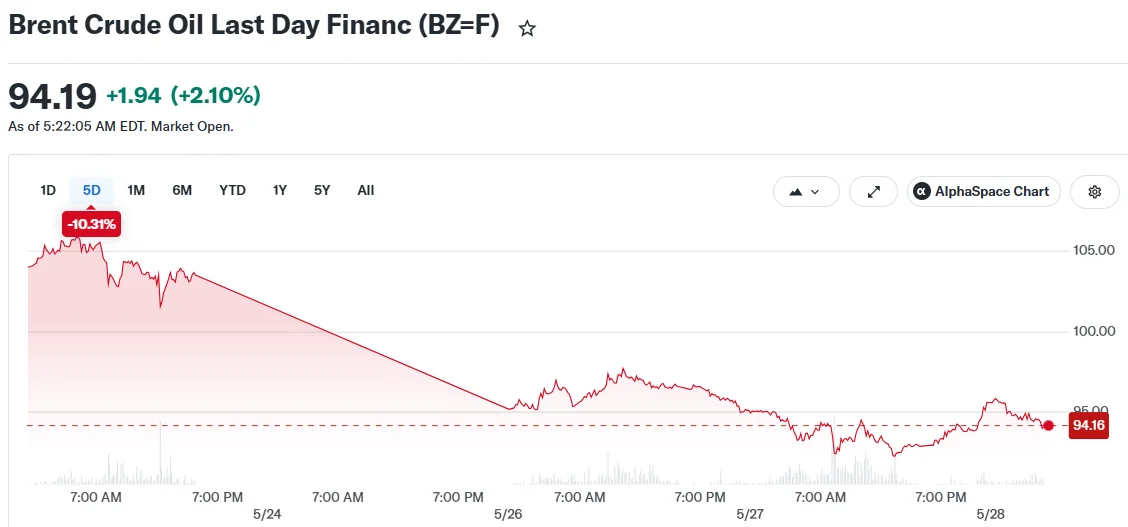
- Brent crude jumped over 2.5% to reach $96.74 per barrel while WTI climbed to $90.95 following renewed military confrontations
- Iran’s Revolutionary Guard Corps launched strikes on a U.S. military facility in Kuwait in response to American attacks on Bandar Abbas
- President Trump rejected claims that Iran would reopen the Strait of Hormuz to commercial traffic within 30 days
- The strategic waterway’s blockade continues to impact approximately 20% of worldwide oil shipments
- Market experts caution that oil markets are entering a critical phase with potential supply chain disruptions looming
Crude oil futures experienced significant upward momentum on Thursday following renewed military confrontations between the United States and Iran, effectively extinguishing market expectations of an imminent diplomatic resolution.
Brent crude futures surged by more than 2.5% to reach $96.74 per barrel during early European market hours. Meanwhile, U.S. West Texas Intermediate contracts climbed to $90.95 per barrel.
The price rally followed announcements from Iran’s Islamic Revolutionary Guard Corps claiming responsibility for strikes against a U.S. military installation in Kuwait. Iranian officials characterized the operation as a direct response to American military action targeting the Iranian coastal city of Bandar Abbas.
Kuwaiti authorities acknowledged defending against incoming missile and drone threats but refrained from officially identifying the attacking party.
These military exchanges represent a significant return to active conflict, contradicting repeated assertions from Washington officials that a ceasefire arrangement remained operational.
President Donald Trump publicly dismissed media reports suggesting Iran had committed to reopening commercial navigation through the Strait of Hormuz within the next month.
Trump further indicated dissatisfaction with the terms of a proposed peace framework, suggesting that a comprehensive agreement remains more distant than financial markets had anticipated.
Oil prices had actually declined on Wednesday as traders positioned for a potential U.S.-Iran settlement. Trump’s statements swiftly reversed that market sentiment.
Hormuz Blockage Keeping Supply Tight
The Strait of Hormuz has remained effectively closed to normal commercial traffic for three months due to the ongoing conflict. This blockade is currently disrupting approximately one-fifth of global petroleum supplies.
While some vessels have successfully navigated the waterway in recent weeks, overall throughput remains substantially below pre-conflict levels.
Trump additionally rejected a diplomatic proposal that would establish joint Iranian-Omani administration of the strategic strait, maintaining that no individual nation should exercise exclusive control over the critical shipping channel.
Analysts from ANZ highlighted that petroleum supplies remain severely constrained while fundamental disagreements between the adversaries continue unresolved.
Yardeni Research analysts issued warnings that the market is nearing a critical inflection point. Their analysis indicates that Iran confronts severe oil storage capacity limitations that may necessitate complete production shutdowns.
They further observed that global petroleum infrastructure is operating with dangerously thin supply buffers, potentially leading to broader impacts on pipeline networks and distribution systems.
Market participants are awaiting the Thursday release of U.S. Energy Information Administration inventory data. Supply disruptions have already resulted in substantial drawdowns from strategic reserves.
Commodity market analysts indicate that volatility levels remain elevated across the sector as geopolitical risk factors have not materially diminished.
The situation continues to evolve rapidly, with Washington and Tehran remaining at an impasse over Iran’s nuclear program and contested control of the strategic waterway.
Get 3 Free Stock Ebooks
Discover top-performing stocks in AI, Crypto, and Technology with expert analysis.
- Top 10 AI Stocks - Leading AI companies
- Top 10 Crypto Stocks - Blockchain leaders
- Top 10 Tech Stocks - Tech giants


