



TLDR
- Crude benchmarks surged over 2% Thursday, building on momentum from Wednesday’s session.
- Brent futures pushed above $105 per barrel while WTI approached $94 per barrel.
- Iranian President addressed the UN, declaring Tehran will not yield to American demands.
- The Strait of Hormuz continues blocked, with Iranian officials insisting preconditions must be satisfied.
- Speculation about a 90-day US diesel export restriction triggered sharp declines in diesel futures Wednesday.
Oil prices extended their upward trajectory on Thursday. The momentum built upon Wednesday’s substantial advance.
Brent crude contracts advanced over 2%, reaching approximately $105.40 per barrel. West Texas Intermediate crude pushed to $93.94 per barrel.
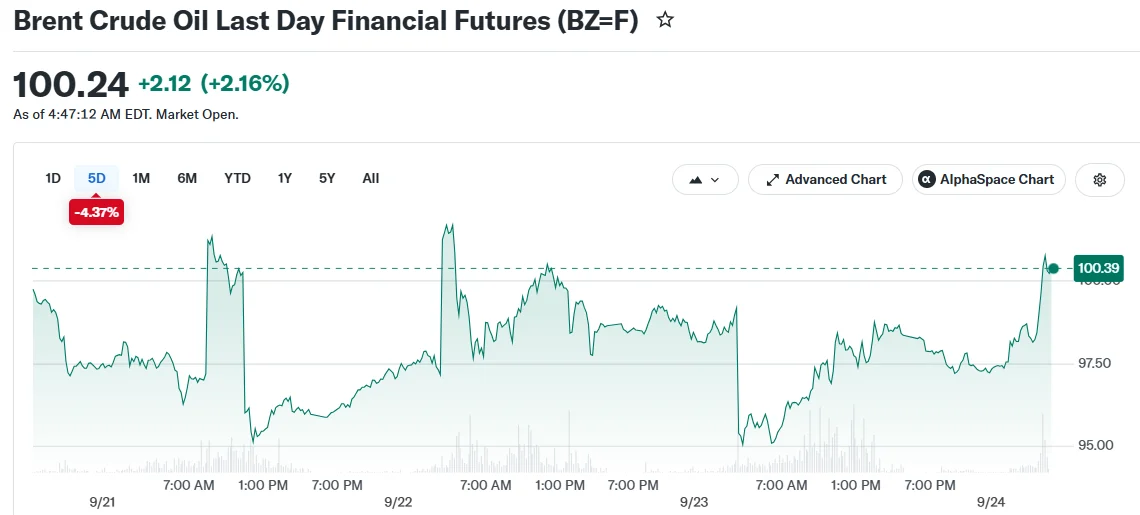
The rally occurred amid stagnant diplomatic efforts between Washington and Tehran. Market participants continue monitoring developments carefully.
Tehran and Washington Locked in Standoff Over Critical Demands
Iranian President Masoud Pezeshkian spoke before the United Nations General Assembly during the week. He declared that Iran would refuse to capitulate to American pressure tactics.
Despite the defiance, he indicated Tehran’s willingness to pursue diplomatic channels. A high-ranking Iranian representative informed Reuters that negotiations must proceed.
The representative confirmed Iran is examining Washington’s counter-proposal to its peace initiative. Tehran demands the United States remove its naval blockade and permit the Strait of Hormuz to resume operations.
The strategic Strait of Hormuz typically facilitates roughly 20% of worldwide oil and natural gas transportation. Operations ceased following combined US-Israeli military action against Iran that commenced in late February.
Mohsen Rezaei, Iran’s security chief, declared during the week that the waterway would remain shut until Tehran’s stipulations are fulfilled.
President Donald Trump issued warnings this week about potential escalation of military operations against Iran absent a negotiated settlement. Secretary of State Marco Rubio acknowledged that achieving an agreement requires patience and significant effort.
Potential Diesel Export Restriction Compounds Market Volatility
Market participants are closely monitoring reports of a prospective US diesel export prohibition. Politico reported the Trump administration was developing plans for a 90-day restriction.
The White House rejected the report’s accuracy. Energy Secretary Chris Wright expressed skepticism about a diesel ban’s effectiveness, despite Trump indicating his willingness to support such a measure.
Ultra-low-sulfur diesel contracts plunged approximately 5% Wednesday following the initial report. Market analysts warned that export restrictions could disrupt international supply chains and escalate prices globally.
According to Energy Information Administration data, US distillate reserves—encompassing diesel and heating oil—decreased by 428,000 barrels during the previous week. Total reserves now stand at 107.4 million barrels.
US crude stockpiles expanded by 3 million barrels last week, reaching 426.4 million barrels. Market forecasters had anticipated a drawdown of approximately 641,000 barrels.
Persian Gulf oil supply demonstrated marginal improvement earlier in the week. Reports indicated Saudi Arabia reinstated operations on its east-west pipeline connecting to the Red Sea, while Iraq boosted export volumes.
However, these positive developments were counterbalanced by Rezaei’s statements confirming the Strait of Hormuz remains closed. Market analysts note Brent crude commands a higher premium versus WTI due to greater vulnerability to Middle Eastern supply disruptions.
By Thursday morning, Brent crude traded around $105.40 per barrel with WTI hovering near $93.94 per barrel. Both benchmarks have posted significant gains compared to earlier weekly levels.
Get 3 Free Stock Ebooks
Discover top-performing stocks in AI, Crypto, and Technology with expert analysis.
- Top 10 AI Stocks - Leading AI companies
- Top 10 Crypto Stocks - Blockchain leaders
- Top 10 Tech Stocks - Tech giants


