



Key Takeaways
- Brent crude futures advanced to $91.50 while WTI reached $85.22, marking three-week peaks
- President Trump declined to renew the Iran ceasefire agreement that lapsed on Monday
- UK maritime officials confirmed a vessel was hit by a projectile while navigating the Strait of Hormuz
- Iranian authorities seized a UAE-connected tanker, citing violations of waterway transit regulations
- Shipping activity through the Strait of Hormuz continues at drastically reduced levels compared to pre-conflict volumes
Crude oil markets rallied to nearly three-week highs on Tuesday as geopolitical friction between Washington and Tehran intensified around the strategically vital Strait of Hormuz.
Brent crude futures advanced 0.7% to settle at $91.50 per barrel, while West Texas Intermediate crude climbed 0.85% to $85.22 per barrel. Both benchmarks reached their strongest positions since July 30.
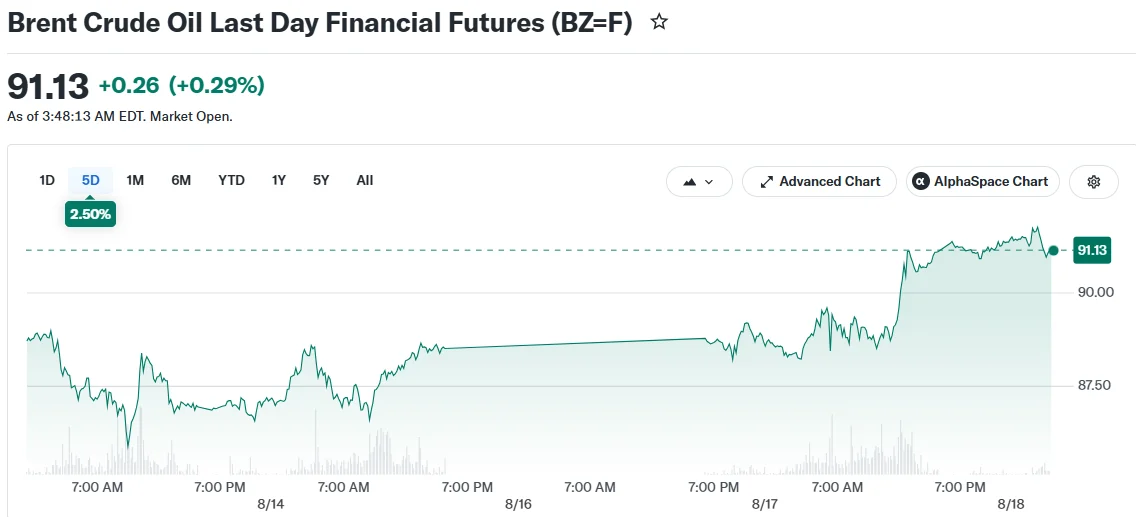
The rally followed President Donald Trump’s announcement that Washington would not prolong a ceasefire arrangement with Iran. The temporary agreement, which took effect in mid-June, officially lapsed on Monday.
Trump reiterated his position that the United States maintains complete control over the Strait of Hormuz, a claim that Iranian officials have consistently rejected.
Maritime Incidents and Vessel Detention Intensify Market Concerns
Oil benchmarks received additional upward momentum following a report from UK Maritime Trade Operations confirming that a commercial vessel sustained damage from an unidentified projectile while sailing outbound through the Strait of Hormuz.
Meanwhile, Iranian state-affiliated media sources confirmed that authorities in Tehran had apprehended a tanker with connections to the United Arab Emirates. Officials stated the vessel had breached regulations governing passage through the strategic waterway.
The Fars News Agency, a state-linked outlet, announced on X that the tanker “has been detained,” referencing Iran’s enforcement of mandatory transit fees for vessels traversing Hormuz. Specific details regarding the vessel’s identity and cargo have not been disclosed.
In the prior trading session, Brent crude closed at $90.87, representing a 2.7% increase, as initial reports of the tanker seizure began circulating.
Oil prices have experienced significant volatility throughout the ongoing conflict, influenced by statements and actions from both Washington and Tehran, with some information proving unreliable. Iranian forces have adopted an increasingly aggressive posture in recent weeks, targeting multiple tankers attempting passage through the strait.
Oman Faces U.S. Threats as Diplomatic Efforts Falter
President Trump issued a stark warning to Oman, threatening to “bomb the s*** out of” the nation if it interferes with U.S. objectives. The statement emerged as Iran and Oman indicated they were engaged in discussions regarding the potential reopening of shipping lanes through the Strait of Hormuz.
Neither government has announced a concrete agreement stemming from these discussions.
Commercial vessel traffic through the Strait of Hormuz continues to operate at severely depressed levels relative to pre-conflict norms. Concerns about potential Iranian military action have deterred shipping companies from routing vessels through the waterway.
Prior to the outbreak of hostilities, approximately 20% of the world’s oil supply transited through the Strait of Hormuz. The effective closure of this route has significantly constrained crude availability in global markets.
According to Washington, diplomatic discussions between the United States and Iran remain active. However, Tehran has challenged this assessment.
Energy market participants are closely monitoring any progress in the Oman-Iran shipping negotiations, as a successful agreement could provide meaningful relief to current supply limitations.
At present, traders are factoring in sustained disruptions with limited prospects for an immediate diplomatic breakthrough.
Get 3 Free Stock Ebooks
Discover top-performing stocks in AI, Crypto, and Technology with expert analysis.
- Top 10 AI Stocks - Leading AI companies
- Top 10 Crypto Stocks - Blockchain leaders
- Top 10 Tech Stocks - Tech giants


