



TLDR
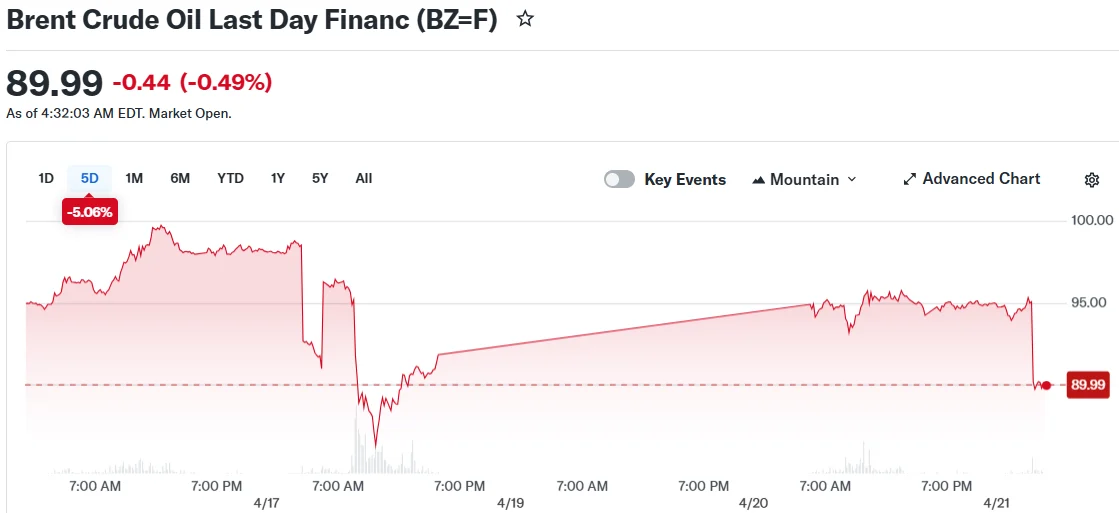
- Brent crude declined more than 1% to $94.44 following a 5.6% Monday rally, as Tehran confirmed plans to send representatives to Pakistan negotiations
- The temporary ceasefire between Washington and Tehran concludes Wednesday, with Trump indicating extension prospects are minimal
- Strait of Hormuz transit remains effectively halted, eliminating approximately 20% of worldwide crude supplies from global markets
- Gulf producers Saudi Arabia and UAE have shifted operations to bypass routes, increasing alternative terminal capacity to 6.5 million barrels daily
- Citigroup projects crude could surge to $110 per barrel should the Hormuz closure persist another 30 days
Crude markets experienced downward pressure Tuesday following reports that Tehran would dispatch a diplomatic team to peace negotiations with Washington scheduled in Islamabad, Pakistan. The development emerged despite Iranian leadership’s public resistance to renewed diplomatic engagement.
Brent crude retreated as much as 1.1% to $94.44 per barrel, reversing portions of Monday’s robust 5.6% advance. West Texas Intermediate similarly declined 0.9% to $86.68 per barrel during Asian trading sessions.
Mohammad Bagher Ghalibaf, Iran’s parliament speaker, declared the nation would refuse negotiations “under the shadow of threats” emanating from Washington. However, according to Wall Street Journal sources, Tehran privately informed regional intermediaries of its intention to dispatch a delegation to Pakistan within days.
The composition and leadership of Iran’s diplomatic team remains undisclosed.
Vice President JD Vance is en route to recommence discussions, anticipated to begin either late Tuesday or early Wednesday morning. President Trump stated Sunday that extending the current ceasefire beyond its Wednesday evening Washington time expiration appears “highly unlikely.”
Trump additionally verified that US naval enforcement operations targeting Iran will continue until a comprehensive peace agreement materializes. American naval forces intercepted an Iranian vessel during the weekend, prompting Tehran to reinstate restrictions across the Strait of Hormuz.
Strait of Hormuz Transit Continues Blockade
The strategically vital Strait of Hormuz has remained essentially impassable since hostilities commenced in late February. Iran temporarily lifted restrictions over the weekend before reimposing the closure.
Merely three vessels made transit attempts through the strait early Tuesday. Under normal circumstances, the waterway facilitates approximately one-fifth of global crude oil supplies.
ANZ analysts observed that the “ongoing uncertainty continues to overshadow any peace agreement” given Iran’s continued hesitancy toward diplomatic reengagement.
Saudi Arabia and the United Arab Emirates have initiated contingency routing to circumvent Hormuz. Operations have shifted to the Yanbu terminal along the Red Sea and Fujairah terminal positioned in the Gulf of Oman. Aggregate loading capacity at these alternative facilities has expanded to 6.5 million barrels daily, compared to 5.0 million before conflict erupted.
What Analysts Are Saying
Citigroup forecasts oil prices potentially climbing to $110 per barrel should Hormuz disruptions extend another 30 days.
Fatih Birol, executive director of the International Energy Agency, cautioned that worldwide energy markets could experience sustained volatility extending up to two years resulting from the ongoing conflict.
Dilin Wu, research strategist at Pepperstone, indicated markets will remain “super sensitive to any headline updates in the next 24 hours.”
Chinese President Xi Jinping advocated for immediate cessation of hostilities and resumption of standard Hormuz operations Monday during a telephone conversation with Saudi Crown Prince Mohammed bin Salman.
As of Tuesday morning, no official confirmation of a second negotiation round between US and Iranian representatives has materialized, while the ceasefire termination deadline remains fixed for Wednesday evening.
Get 3 Free Stock Ebooks
Discover top-performing stocks in AI, Crypto, and Technology with expert analysis.
- Top 10 AI Stocks - Leading AI companies
- Top 10 Crypto Stocks - Blockchain leaders
- Top 10 Tech Stocks - Tech giants


