


Key Takeaways
- The company reported a net loss of $12.5 million, a sharp reversal from last year’s $11.4 million profit
- Total revenue declined 2.4% to $544.1 million, falling short of the $556.8 million analyst consensus
- Entertainment segment revenue plummeted nearly 9% to $332.6 million
- Shares tumbled 12% to $7.38 during after-hours trading on Monday
- Comparable store sales decreased 2.9%, outperforming Wall Street’s projected 3.4% decline
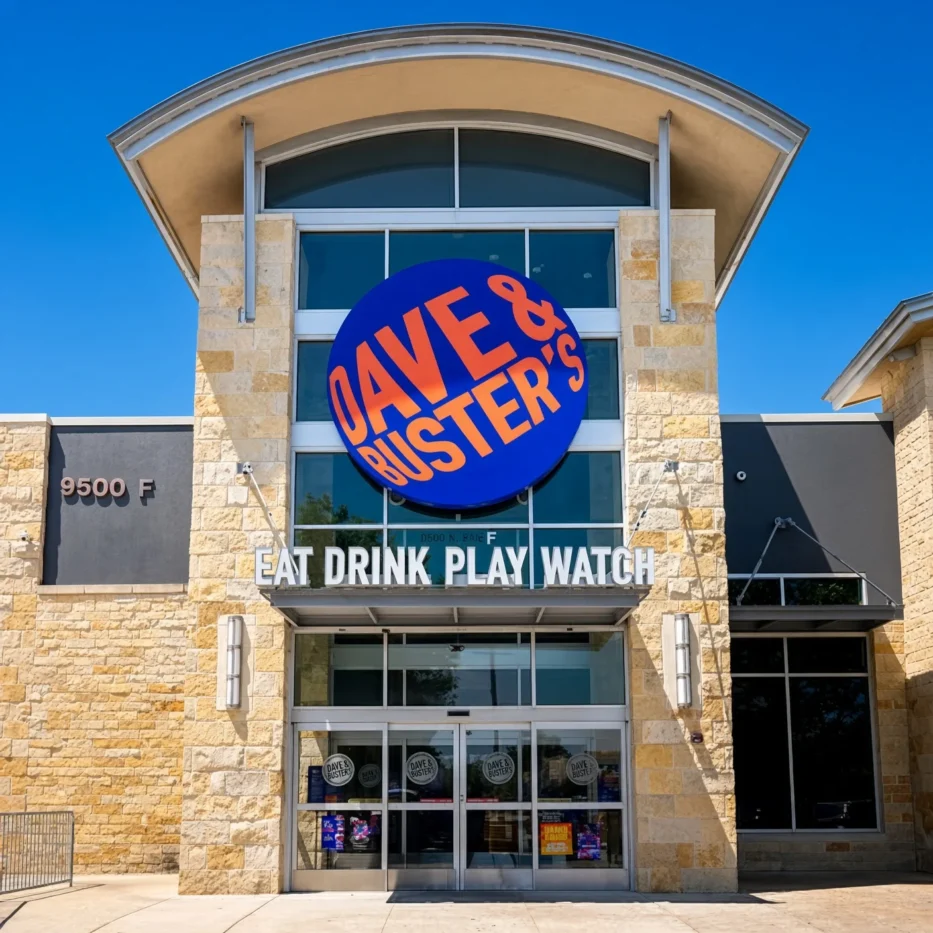
Dave & Buster’s Entertainment delivered disappointing second-quarter results, recording a net loss of $12.5 million, equivalent to $0.36 per diluted share. This marks a significant downturn from the $11.4 million profit, or $0.32 per diluted share, achieved during the corresponding quarter last year. The company’s shares plunged 12% to $7.38 in Monday’s extended trading session.
Dave & Buster’s Entertainment, Inc., PLAY
Total quarterly revenue reached $544.1 million, representing a 2.4% year-over-year decrease and missing the Street’s expectation of $556.8 million. The adjusted loss per share stood at $0.27, significantly underperforming compared to Wall Street’s anticipated earnings of $0.18 per share.
The entertainment segment proved to be the primary weakness, declining nearly 9% to $332.6 million. This marks approximately eight consecutive quarters of year-over-year contractions in the company’s entertainment operations.
Food and beverage sales emerged as a silver lining, posting comparable sales growth of 7.6% for the fifth quarter in a row. Additionally, special events revenue extended its growth streak to seven consecutive quarters.
Comparable store sales decreased 2.9% overall, though this performance exceeded analyst projections of a 3.4% drop. Operational trends showed improvement heading into July, when comparable sales declined only 1.6%, a notable improvement from June’s 5% decrease.
Return to Fundamentals
Newly appointed CEO Darin Harper, who assumed leadership last month, is implementing what he describes as a “back-to-basics” approach. This strategic framework emphasizes occasions, value proposition, and operational consistency across all locations.
During the earnings conference call, Harper admitted that while the company enjoys strong brand recognition, it hasn’t succeeded in becoming the preferred destination for customers planning entertainment outings. “Our value and execution have not been dependable enough,” he stated.
The entertainment chain introduced 10 new games and attractions this year, featuring popular franchises such as The Mandalorian, John Wick, and Stranger Things. Management reported that streamlined game pricing has resulted in gameplay and customer dwell time increases ranging from 16% to 20%.
Dave & Buster’s has also appointed new executives across key positions, including chief marketing officer, chief operations officer, chief technology officer, and chief legal officer. Notably, the marketing leadership position had remained vacant for more than a year.
Emphasis on Cost Reduction
From a financial perspective, adjusted free cash flow improved to positive $19.5 million through the second quarter, a substantial turnaround from the negative $36.5 million recorded in the prior-year period.
Leadership has pinpointed $15 million in cost savings anticipated over the coming 12 months, with opportunities to potentially double that figure. Net capital expenditures decreased to $127.6 million from $155.4 million year-over-year.
The organization intends to maintain fiscal 2026 capital spending under $200 million. At quarter’s end, the company operated 250 company-owned venues, comprising 184 Dave & Buster’s locations and 66 Main Event facilities.
The company has scheduled four additional domestic store openings for the second half of fiscal 2026, followed by five more in fiscal 2027. Six store remodels were completed in fiscal 2026, with two additional renovations on the agenda.
Harper expressed optimism about near-term improvements in comparable store sales, revenue, and EBITDA, while acknowledging ongoing challenges related to customer traffic, affordability perception, and service consistency that require attention.
Get 3 Free Stock Ebooks
Discover top-performing stocks in AI, Crypto, and Technology with expert analysis.
- Top 10 AI Stocks - Leading AI companies
- Top 10 Crypto Stocks - Blockchain leaders
- Top 10 Tech Stocks - Tech giants


