


Key Takeaways
- The greenback retreated modestly from its strongest position in two months following a pause in hostilities between Israel and Iran after diplomatic intervention from Trump.
- Traders are now assigning a 70% probability to a Federal Reserve interest rate increase by year-end, driven by robust employment figures.
- Wednesday’s U.S. inflation data release has become the focal point for currency markets and could shape the dollar’s trajectory.
- The single currency gained ground as traders anticipate Thursday’s European Central Bank policy decision, with a quarter-point increase widely forecasted.
- Indonesia’s central bank delivered an unexpected quarter-point rate increase, propelling the rupiah to its strongest single-session performance in more than twelve months.
The greenback experienced a modest decline on Tuesday after reaching a two-month zenith, as a tenuous pause in military operations between Israel and Iran improved risk appetite throughout international financial markets.
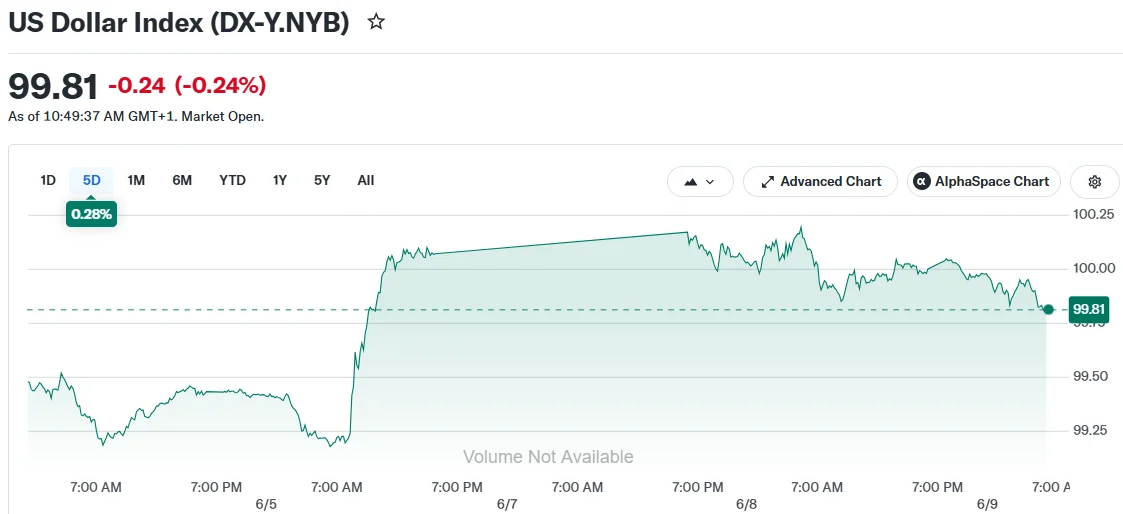
The U.S. Dollar Index decreased 0.1% to settle at 99.93, marginally beneath Monday’s high of 100.21. The retreat followed statements from U.S. President Donald Trump indicating America was approaching a “total victory” declaration regarding the Iranian conflict and projecting declining crude oil valuations.
Notwithstanding the temporary reduction in immediate geopolitical stress, market participants maintained a defensive posture. Iranian officials cautioned that military operations could restart should Israel persist in targeting Hezbollah positions in Lebanon. Additionally, uncertainty surrounding the Strait of Hormuz—a critical conduit for international petroleum shipments—continued to keep market participants vigilant.
Treasury yields maintained elevated positions following last week’s robust U.S. jobs report. The two-year Treasury note remained near a fifteen-month zenith, while the standard ten-year yield persisted above the 4.5% threshold.
Market Expectations for Fed Tightening Intensify
The impressive employment figures prompted markets to assign approximately 70% odds to a Federal Reserve rate increase by December, based on CME FedWatch data. This recalibration in market expectations has emerged as a primary catalyst behind recent dollar appreciation.
Tony Sycamore, market analyst at IG, noted that an inflation reading exceeding forecasts on Wednesday “would undoubtedly add to mounting fears of a Fed rate hike before year-end.” He further suggested that such an outcome would bolster the dollar while creating headwinds for American equity markets.
Wednesday’s inflation figures have emerged as the paramount data release for foreign exchange traders. Producer price statistics will follow one day later on Thursday.
The Australian dollar declined 0.1% to $0.7039, while the New Zealand dollar exchanged hands at $0.5804, both pressured by diminished risk appetite and greenback strength.
European Central Bank and Indonesian Policy Moves Draw Attention
The euro advanced for a consecutive session, trading in a range between $1.1528 and $1.1561. Market participants are focused on Thursday’s European Central Bank gathering, where a 25 basis point tightening is broadly anticipated. Investors will scrutinize ECB communications for indications regarding policymakers’ approach to energy-fueled price pressures.
A subsequent rate adjustment in September is also being priced into markets, as the ECB navigates the challenge of addressing elevated energy expenses while confronting decelerating economic momentum across the European continent.
In an unanticipated policy action, Bank Indonesia elevated its policy rate by 25 basis points on Tuesday, lifting it to 5.50%. The monetary authority moved to bolster the rupiah, which has faced downward pressure amid declining foreign exchange stockpiles and subdued investor interest. The rupiah surged nearly 1% following the announcement, marking its most substantial single-day advance in over a year.
The Japanese yen exhibited minimal movement, maintaining levels above 160 per dollar. Currency market observers regard this threshold as a potential catalyst for official intervention by Japanese monetary authorities.
NAB’s senior FX strategist Rodrigo Catril captured prevailing market sentiment, stating: “We’ve seen the dollar being stronger because of this uncertainty, but also because of strong data in the U.S.”
Get 3 Free Stock Ebooks
Discover top-performing stocks in AI, Crypto, and Technology with expert analysis.
- Top 10 AI Stocks - Leading AI companies
- Top 10 Crypto Stocks - Blockchain leaders
- Top 10 Tech Stocks - Tech giants


