



Key Highlights
- The Dow Jones Industrial Average dropped 0.2% on Friday, marking its third consecutive weekly decline.
- The S&P 500 edged up 0.2%, and the Nasdaq Composite advanced 0.4%.
- The 10-year Treasury yield finished the week hovering just under the 5% threshold.
- This week saw the Federal Reserve implement a 25 basis point rate increase.
- Crude oil retreated below the $100 mark as chip stocks rebounded from mid-week losses.
U.S. equity markets closed Friday’s session with mixed results as market participants digested the implications of elevated interest rates, bond yields approaching 5%, and ongoing inflation concerns.
The Dow Jones Industrial Average slipped approximately 0.2% to settle at 51,682.64.
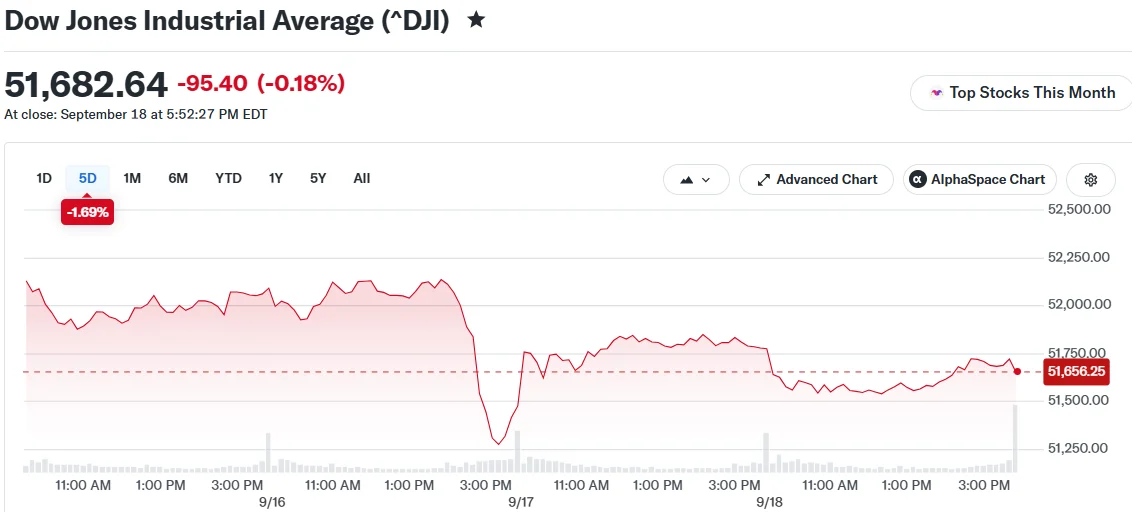
This downturn extended the Dow’s losing streak to three straight weeks. The benchmark index also recorded its most challenging week since March.
The S&P 500 climbed 0.2% on Friday, finishing at 7,650.50, though it still registered a modest weekly decline.
The Nasdaq Composite advanced roughly 0.4%, securing a positive result for the week.
Bond Yields Climb Following Federal Reserve Action
Rising bond yields continued to weigh heavily on equity markets.
The benchmark 10-year Treasury yield concluded the week at 4.995%, stopping just shy of the psychologically significant 5% marker.
The 2-year Treasury yield settled at 4.741%. According to Dow Jones Market Data, this represented its highest 3 p.m. close since July 1, 2024.
The upward movement in yields came after the Federal Reserve’s announcement Wednesday to lift its key interest rate by 25 basis points.
This marked the central bank’s first rate hike in three years.
Market participants are now evaluating the likelihood of additional increases ahead. Data from CME FedWatch indicated a 47.1% chance of another quarter-point hike and a 42.4% probability of cumulative half-point increases extending through December.
Investor attention remains centered on inflation dynamics, particularly as recent energy price spikes have intensified cost pressures for both consumers and businesses.
Jamie Dimon, CEO of JPMorgan Chase, remarked to Yahoo Finance this week that uncertainty persists regarding whether inflation has been adequately contained.
Crude Retreats as Technology Shares Rebound
Oil prices offered some market relief Friday, pulling back below the $100 per barrel threshold after previously surpassing that benchmark.
Energy markets continue to react to potential supply disruptions associated with the conflict in Iran and transportation risks through the Strait of Hormuz.
Technology equities outperformed most other market segments.
Semiconductor shares bounced back from earlier weekly declines. The PHLX Semiconductor Index concluded the week with slight gains.
Chip manufacturers had faced selling pressure following statements from Anthropic and OpenAI advocating for reduced AI development speed due to safety considerations.
Daniel Skelly, a portfolio manager at Morgan Stanley Wealth Management, noted that crude oil fluctuations, elevated bond yields, and the upcoming U.S. midterm elections may continue driving market turbulence in the near term.
Investors will now turn their attention to movements in Treasury yields, energy prices, and Federal Reserve policy expectations heading into the October meeting, following the Dow’s third straight week of losses.
Get 3 Free Stock Ebooks
Discover top-performing stocks in AI, Crypto, and Technology with expert analysis.
- Top 10 AI Stocks - Leading AI companies
- Top 10 Crypto Stocks - Blockchain leaders
- Top 10 Tech Stocks - Tech giants


