



Key Takeaways
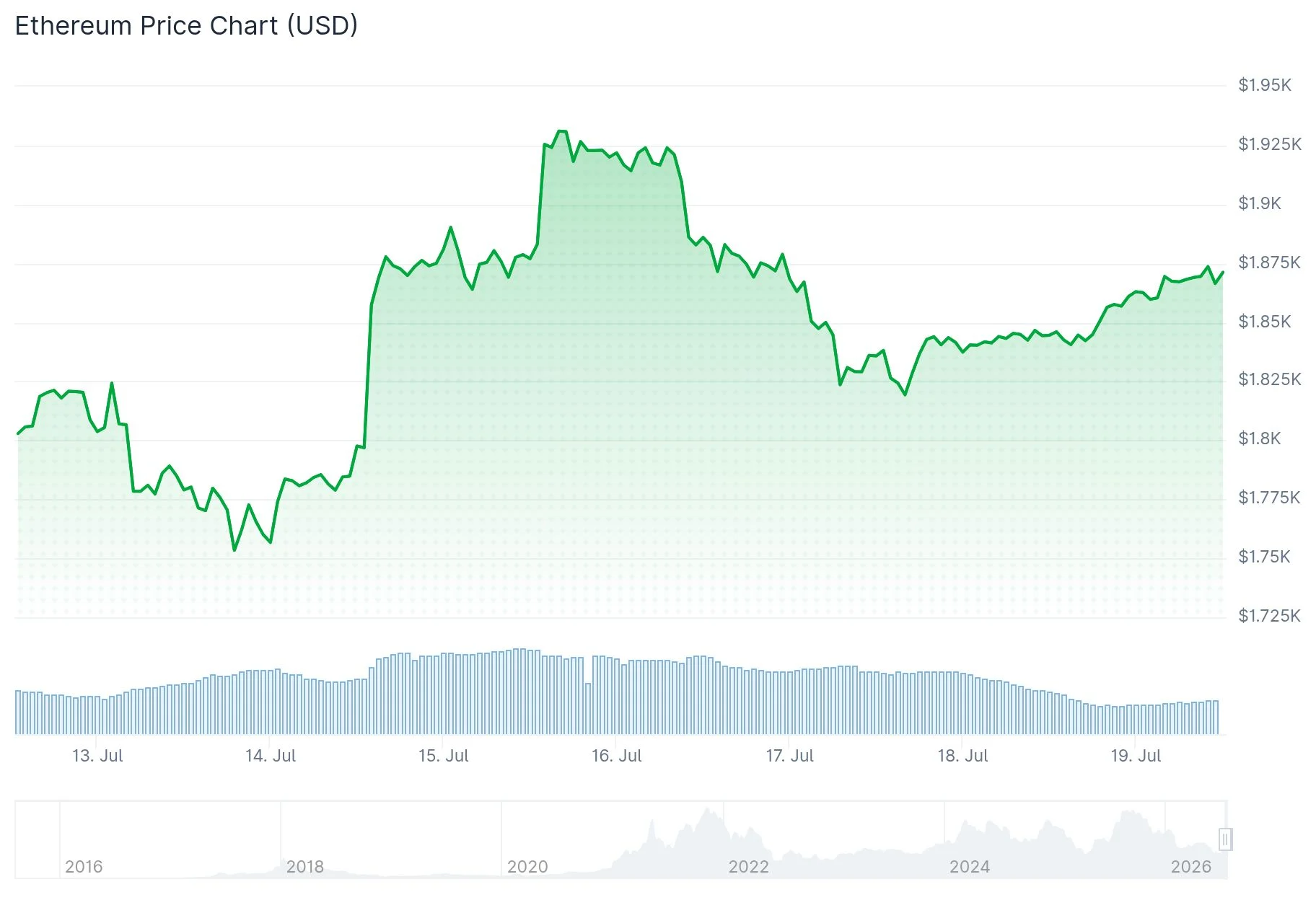
- ETH currently sits around the $1,870 price level
- US-based spot Ethereum ETFs have launched, providing institutional and retail access
- Recent network enhancements have doubled capacity while slashing mainnet transaction costs to under $0.02
- Rival platforms like Solana present formidable competition with superior speed and affordability
- Scaling solutions on layer-2 networks may not directly translate to ETH price appreciation
Within the cryptocurrency landscape, Ethereum maintains its position as the second-largest digital asset following Bitcoin. While Bitcoin serves primarily as a store of value and digital gold, Ethereum functions as the foundational layer powering decentralized applications, DeFi protocols, stablecoin infrastructure, and tokenized real-world assets.
This expansive functionality positions ETH as an attractive long-term holding, though it doesn’t automatically ensure upward price momentum.
The current market price for ETH stands near $1,870.
Network Evolution and Technical Advancements
Research published in 2026 revealed that Ethereum’s latest protocol improvements successfully doubled the network’s transaction processing capacity throughout both its base layer and layer-2 infrastructure. The median cost for mainnet transactions plummeted from above $2 to less than $0.02. Meanwhile, layer-2 transaction fees experienced reductions exceeding 95%.
The implementation of specialized data structures known as “blobs” drove these improvements, dramatically reducing operational costs for Ethereum-compatible rollup solutions including Arbitrum, Base, and Optimism.
July 2024 marked a milestone when spot Ethereum ETFs commenced trading across US markets. This development positioned ETH alongside Bitcoin as accessible investment vehicles through traditional brokerage platforms and tax-advantaged retirement accounts.
Additionally, Ethereum operates on a proof-of-stake consensus mechanism, enabling token holders to generate passive income through network validation. This characteristic gives ETH yield-generating properties that Bitcoin lacks.
Competitive Pressures and Economic Model Questions
The most significant headwind facing Ethereum stems from intensifying blockchain competition. Solana delivers superior transaction speeds and minimal fees within a unified ecosystem, eliminating the complexity of bridging across multiple layer-2 solutions.
Data from 21Shares indicates that Solana accumulated roughly $2.85 billion in total revenue during the twelve-month period from October 2024 through September 2025.
A fundamental concern revolves around economic value accrual. While reduced fees on layer-2 platforms enhance user experience, they simultaneously diminish revenue flowing to Ethereum’s base layer. This creates a scenario where Ethereum could underpin substantial economic activity without corresponding ETH price appreciation.
Industry analysts have additionally identified concerning levels of consolidation among Ethereum block producers, sparking debates about potential centralization vulnerabilities within critical network components.
Historical price action demonstrates that ETH exhibits significant volatility and has periodically lagged Bitcoin’s performance throughout various market phases.

