



Key Takeaways
- EU Energy Commissioner Dan Jorgensen alerted member nations about an impending price crisis driven by the Iran conflict’s disruption of global energy supplies.
- Current gas reserves across the European Union stand at approximately 70%, falling short of seasonal expectations and trailing last year by 12 percentage points.
- With nearly 80% of its gas coming from external sources, Europe remains highly susceptible to supply chain disruptions, particularly through the Strait of Hormuz.
- EU regulations permit countries to reduce their storage requirements from 90% to 80% using existing flexibility provisions.
- Member states received recommendations to implement conservation measures including reducing public building temperatures, banning outdoor heating, and eliminating non-essential public illumination.
European Union authorities are issuing alerts about a potential energy cost crisis looming over the upcoming winter season. These concerns stem from ongoing military operations involving Iran that have severely affected international oil and gas supply chains.
Dan Jorgensen, serving as EU Energy Commissioner, distributed a formal communication to energy ministers throughout member nations. Both Reuters and Bloomberg obtained and reviewed the document’s contents.
“The situation we’re confronting represents a price crisis that’s directly connected to supply disruptions,” Jorgensen stated in his correspondence.
Factors Driving Energy Cost Increases
The European continent depends heavily on international sources for its energy requirements. Roughly 80% of the region’s natural gas consumption comes from imports.
This heavy reliance on external suppliers leaves Europe particularly exposed when international transportation corridors face interruptions. The Strait of Hormuz typically handles approximately one-fifth of global oil and liquefied natural gas shipments.
Current hostilities have essentially shut down this critical passage. The closure has triggered significant price escalations throughout European markets.
Natural gas prices across Europe have surged by more than 100% since military operations against Iran commenced in late February. Earlier this month, prices climbed to levels not witnessed since the end of 2022.
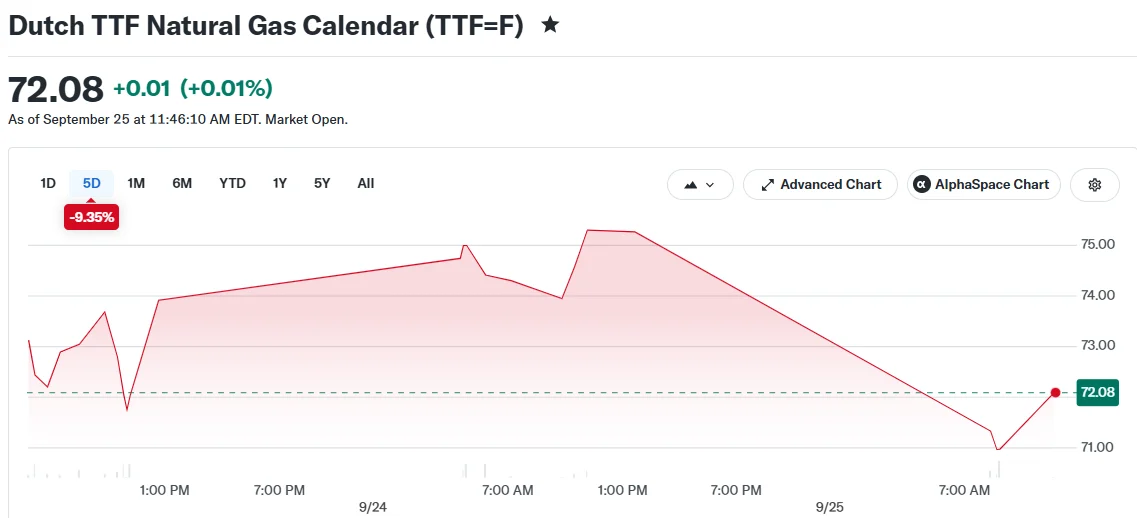
While Europe doesn’t face an immediate supply deficit, the elevated costs are complicating efforts by nations attempting to build adequate reserves ahead of the heating season.
Reserve Capacity Falls Short of Targets
Gas storage facilities across the EU currently hold approximately 70% of their total capacity. This represents a decline of 12 percentage points compared to the equivalent timeframe in the previous year, based on figures from Gas Infrastructure Europe.
These levels also fall below the typical seasonal benchmark of 86%. Elevated short-term prices have made it financially burdensome for nations to continue replenishing their stockpiles throughout the summer period.
Jorgensen acknowledged that the EU finds itself in a more favorable situation than during the 2021 energy emergency. During that period, Russia curtailed gas shipments to Europe, triggering widespread supply challenges.
In the intervening years, Europe has expanded its infrastructure for importing liquefied natural gas. The region has simultaneously increased renewable energy production and achieved reductions in overall gas consumption.
Nonetheless, Jorgensen emphasized the need for governments to intensify their winter preparedness efforts. Heating demands historically surge during the coldest months.
He recommended that nations take advantage of flexibility mechanisms embedded in EU storage regulations. These provisions would permit countries to adjust their filling requirements downward from 90% to 80%.
Such an adjustment could relieve some upward pressure on prices and decrease the financial burden of maintaining full storage capacity.
Jorgensen additionally encouraged governments to maintain gas injection operations into storage facilities where appropriate. He requested that nations implement reductions in gas and electricity consumption for whatever duration proves necessary.
Recommended actions include establishing temperature restrictions in government facilities. Officials also proposed prohibiting outdoor heating installations and shutting off non-critical public lighting systems.
Representatives from the European Commission had not provided a response to inquiries about the letter at the time of publication.
The communication underscores increasing anxiety among EU leadership as the winter season draws closer. Energy ministers throughout the bloc are currently evaluating the proposed recommendations.
Get 3 Free Stock Ebooks
Discover top-performing stocks in AI, Crypto, and Technology with expert analysis.
- Top 10 AI Stocks - Leading AI companies
- Top 10 Crypto Stocks - Blockchain leaders
- Top 10 Tech Stocks - Tech giants


