


Key Highlights
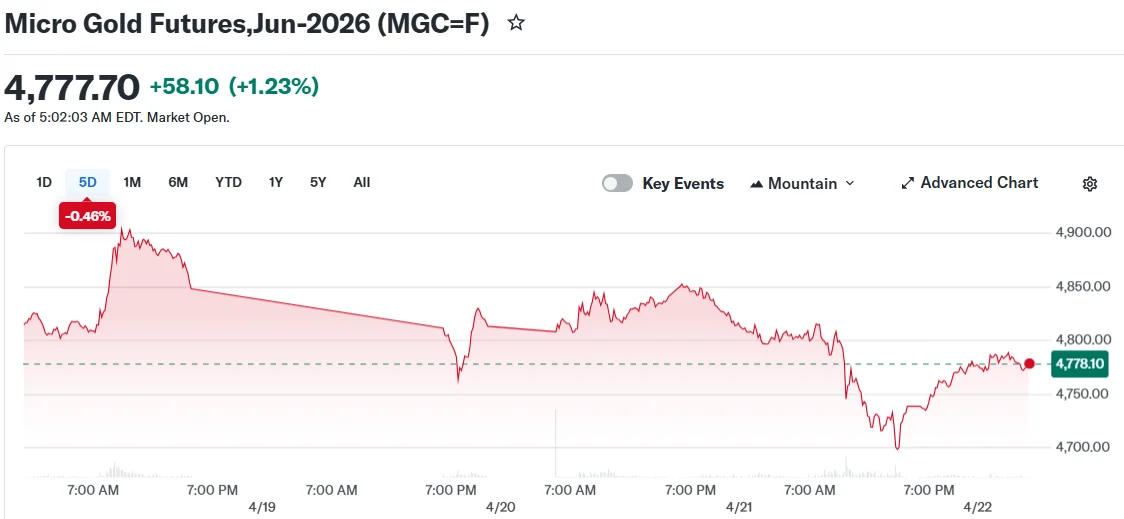
- Gold advanced more than 1%, reaching approximately $4,767 per ounce following a two-session decline
- Trump announced an indefinite extension of the US-Iran ceasefire to facilitate ongoing peace negotiations
- Scheduled diplomatic talks between Washington and Tehran collapsed unexpectedly on Tuesday
- Federal Reserve Chair nominee Kevin Warsh testified he won’t commit to rate reductions
- The precious metal has declined roughly 10% since tensions with Iran escalated in late February
Precious metal prices staged a recovery on Wednesday following consecutive daily losses, advancing more than 1% to approximately $4,767 per ounce. The uptick occurred after President Donald Trump announced an indefinite extension of the ceasefire with Iran, providing additional time for diplomatic negotiations toward a peace agreement.
Spot gold increased 0.9% to reach $4,763.66, while futures contracts gained 1.3% to settle at $4,782.21 per ounce. Silver surged 2.4% to $78.53 per ounce, accompanied by gains in platinum and palladium.
The Middle Eastern situation continues to present significant challenges despite the ceasefire prolongation. The critical Strait of Hormuz waterway remains closed to commercial vessels. Iranian officials have indicated the strategic passage will not reopen while American naval forces maintain their blockade operations.
Iranian authorities characterized the blockade as an “act of war.” Meanwhile, Trump indicated he would postpone additional military operations pending Iran’s submission of a new diplomatic proposal.
Diplomatic discussions scheduled for Tuesday failed to materialize as planned. Vice President JD Vance cancelled his scheduled visit to Islamabad after Iranian representatives confirmed they would not participate in the negotiating sessions.
Federal Reserve Nominee Creates Headwinds for Precious Metals
Gold faced additional downward pressure from statements delivered by Kevin Warsh, Trump’s nominee for Federal Reserve Chairman. During Senate Banking Committee testimony on Tuesday, Warsh explicitly refused to guarantee interest rate cuts.
Warsh, who previously served as a Fed governor, emphasized the central bank’s need to maintain independence from political influence. He indicated that should he receive confirmation, a revised policy framework would be necessary to address ongoing inflationary pressures.
Financial markets interpret Warsh as a hawkish selection, suggesting he would favor maintaining elevated rates rather than pursuing aggressive rate reductions. Elevated interest rates typically negatively impact gold valuations, as the metal generates neither interest income nor dividend payments.
His nomination initially sparked selloffs in gold and other precious metals during late January. The timeline for his confirmation process remains unclear.
Senior Republican legislators have resisted confirming Warsh unless the Trump administration terminates its current investigation of sitting Fed Chair Jerome Powell. Powell is anticipated to continue serving beyond his May 15 term expiration if confirmation proceedings experience delays.
Precious Metal Remains Range-Bound
Gold has experienced approximately a 10% decline since Iranian tensions intensified in late February. During recent trading weeks, valuations have remained confined within a range of roughly $4,700 to $4,900 per ounce.
Market analysts suggest traders have already incorporated the current geopolitical risk level into pricing. Either a significant escalation in hostilities or substantial changes in economic fundamentals would be required to drive prices decisively beyond this established range.
The US dollar weakened 0.3% on Wednesday, making dollar-denominated gold marginally more affordable for international buyers utilizing alternative currencies. Crude oil prices also declined, with Brent crude trading near the $100 per barrel threshold.
Gold’s price action throughout the conflict period has demonstrated greater correlation with risk assets such as equities than with traditional safe-haven instruments, responding to successive developments in the crisis.
Powell is projected to continue serving as Federal Reserve chair beyond the May 15 deadline, particularly if Congressional proceedings delay the Warsh confirmation vote.
Get 3 Free Stock Ebooks
Discover top-performing stocks in AI, Crypto, and Technology with expert analysis.
- Top 10 AI Stocks - Leading AI companies
- Top 10 Crypto Stocks - Blockchain leaders
- Top 10 Tech Stocks - Tech giants


