


TLDR
- Spot gold advanced 0.7% to approximately $4,400 per ounce Wednesday as markets prepared for the U.S. inflation report
- Gold-backed exchange-traded funds recorded their fifth consecutive day of inflows, with holdings reaching a six-week peak
- Geopolitical tensions surrounding potential Strait of Hormuz closure continue fueling energy market instability and bolstering gold demand
- The People’s Bank of China purchased gold for the 21st month running in July, accumulating approximately 640,000 troy ounces
- Technical analysts identify crucial resistance zones between $4,460 and $4,495, with $5,000 representing the next significant milestone
Precious metal valuations advanced Wednesday as market participants adopted a cautious stance before the release of U.S. Consumer Price Index figures, a critical inflation gauge expected to influence Federal Reserve monetary policy direction.
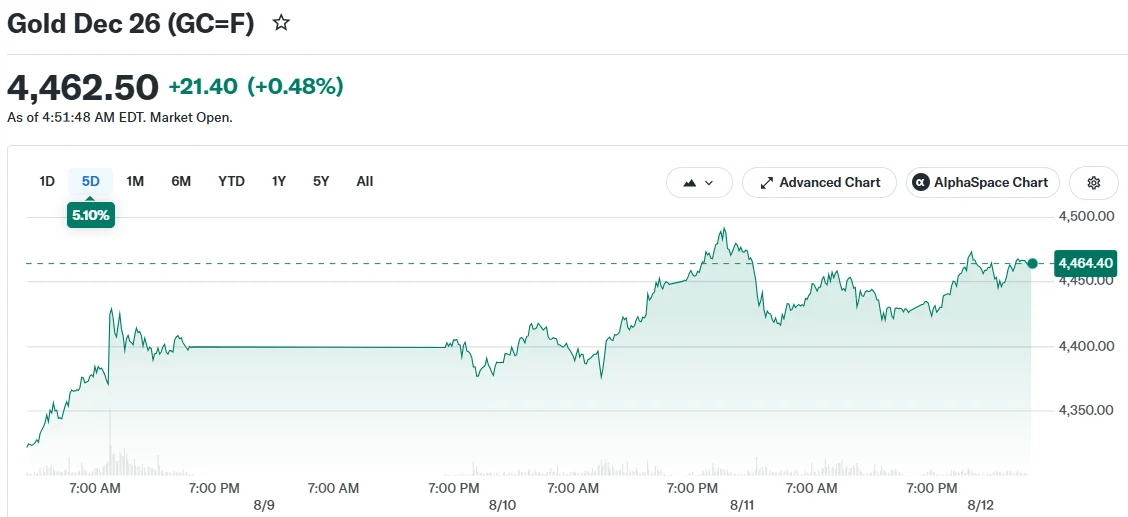
As of approximately 07:22 GMT, spot gold increased 0.7% to $4,400.02 per ounce. Futures contracts for gold gained 0.4% to $4,459.30. Silver posted a 1.8% rally to $65.88 per ounce, while platinum appreciated 0.7% to $1,755.16.
Inflation Report Takes Center Stage
Financial markets are intensely focused on Wednesday’s CPI release. Weaker-than-expected figures might reduce pressure on the Federal Reserve to maintain elevated interest rates, whereas stronger inflation readings could reignite speculation about additional rate increases. Interest rate swap markets currently price in roughly even odds for a 25-basis-point hike in September.
Market strategists at Saxo Bank noted that investors are monitoring whether gold’s advance beyond $4,200 possesses sufficient upward momentum to challenge the 200-day moving average positioned near $4,500. This technical level, combined with resistance around $4,460, represents the immediate challenge for bullion.
Tony Sycamore, a senior market analyst at IG, attributed gold’s recent retreat from $4,435 to investors locking in gains before the CPI announcement, combined with hawkish Federal Reserve rhetoric and climbing energy costs. According to Sycamore, a decisive move above $4,460 and the 200-day moving average at approximately $4,495 would be required to establish a trajectory toward $5,000.
Investment appetite has strengthened noticeably. Exchange-traded fund purchases of gold have continued for five straight trading sessions, elevating aggregate holdings to their highest level in six weeks.
Strait of Hormuz Standoff Heightens Concerns
Persistent tensions concerning the Strait of Hormuz continue injecting uncertainty into markets. Iranian officials have declared the critical waterway will remain blocked until Washington removes its blockade on Iranian ports and provides compensation for recent military operations.
Pakistan’s defense minister indicated that the United States and Iran were nearing an agreement, while intelligence suggested active diplomatic engagement between Oman and Iran. However, Tehran has maintained its demands without compromise.
Multiple incidents targeting maritime vessels in both the Strait of Hormuz and Bab el-Mandeb were confirmed by U.S. and Houthi military sources. A U.S. Navy helicopter engaged a cargo ship in the Gulf of Oman. Additionally, a drone assault targeted a Libyan refinery.
Elevated energy costs resulting from these supply disruptions risk pushing consumer prices higher, potentially encouraging the Fed to maintain restrictive monetary policy. This scenario increases the opportunity cost associated with non-yielding assets like gold.
Beijing’s Persistent Gold Accumulation
China’s central bank expanded its gold reserves for the 21st consecutive month during July, acquiring approximately 640,000 troy ounces and elevating total holdings to 76.08 million ounces. Gold-backed ETFs in China have similarly experienced consistent inflows, signaling sustained institutional appetite.
Producer price index data scheduled for Thursday will provide markets with an additional inflation gauge to evaluate ahead of the Federal Reserve’s upcoming policy meeting.
Get 3 Free Stock Ebooks
Discover top-performing stocks in AI, Crypto, and Technology with expert analysis.
- Top 10 AI Stocks - Leading AI companies
- Top 10 Crypto Stocks - Blockchain leaders
- Top 10 Tech Stocks - Tech giants


