


Key Highlights
- Precious metal declined approximately 2% during Friday’s trading session, marking its third successive weekly decline
- Federal Reserve Chair Kevin Warsh’s hawkish rhetoric strengthened the greenback and pushed Treasury yields upward
- Nearly half of Federal Reserve officials—nine out of 19—anticipate at least one interest rate increase before year-end
- A temporary US-Iran diplomatic breakthrough provided early-week support that quickly evaporated
- Geneva peace negotiations were unexpectedly postponed, creating additional geopolitical uncertainty
The precious metal is experiencing its third consecutive week of declines as anticipation of Federal Reserve monetary tightening and a strengthening US dollar continue to pressure valuations.
Spot gold prices retreated approximately 1.8% to settle at $4,134 per ounce during Friday’s session. Gold futures for US delivery declined 2.2% to reach $4,152. The yellow metal is positioned to shed roughly 2% over the weekly period.
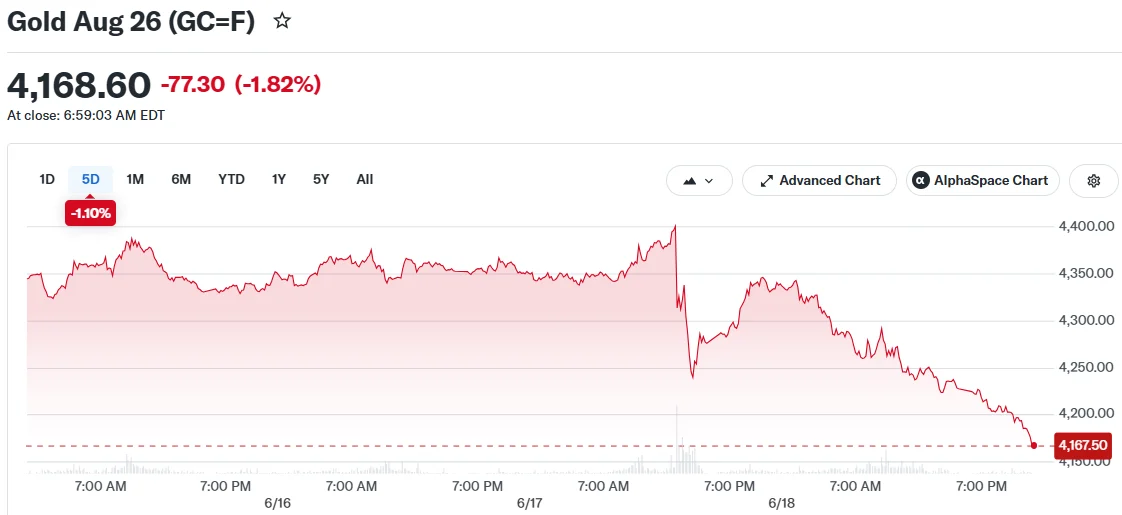
The commodity experienced an initial rally early in the trading week following announcements of a provisional diplomatic agreement between Washington and Tehran. However, these gains completely dissipated following the Federal Reserve’s policy announcement on Wednesday.
Central Bank Rhetoric Reshapes Market Sentiment
Newly appointed Federal Reserve Chairman Kevin Warsh adopted a more hawkish posture during the policy meeting, triggering a surge in Treasury yields and propelling the dollar to its highest valuation since May 2025.
The US Dollar Index jumped 0.8% during Thursday’s trading. An appreciating dollar increases the cost of gold for international purchasers, thereby dampening global demand.
Nine Federal Reserve policymakers among the 19-member committee now project at least one rate adjustment in the latter half of 2025. Derivative markets are currently assigning greater than 80% probability to a rate increase before the calendar year concludes.
Elevated interest rates increase the opportunity cost of maintaining positions in gold, an asset that generates no yield or dividend income. Christopher Wong, a strategist with Oversea-Chinese Banking Corp, noted that gold typically experiences weakness in the period preceding an initial rate hike.
Wong further observed that significant uncertainty exists regarding whether this represents an isolated precautionary adjustment or signals the commencement of a comprehensive tightening campaign. Should it prove to be the former, he suggested gold could stage a recovery.
Diplomatic Breakthrough Provides Insufficient Support
The provisional understanding between the United States and Iran was anticipated to facilitate the resumption of commercial maritime traffic through the Strait of Hormuz. Vessel movements have begun returning to the critical waterway after Washington announced the conclusion of its blockade.
Nonetheless, Swiss authorities confirmed that scheduled negotiations aimed at finalizing a comprehensive peace framework would not proceed as planned on Friday. Reports indicate US Vice President JD Vance called off the Geneva discussions, casting doubt on the sustainability of the current arrangement.
Market observers suggest several months may be required before oil and natural gas shipments through the strait normalize to pre-crisis levels. Crude prices bounced back Friday after experiencing sharp declines earlier in the week, reigniting concerns about inflationary pressures.
Silver declined 2.5% to reach $64.09 per ounce. Platinum dropped 1.4% to $1,674. Copper contracts also experienced losses across both London Metal Exchange and US trading venues.
The Bloomberg Dollar Spot Index advanced 0.9% over the weekly timeframe, intensifying downward pressure throughout commodity markets.
The near-term trajectory for gold will likely hinge on whether the Federal Reserve executes its anticipated rate adjustment and how diplomatic efforts between Washington and Tehran evolve in coming weeks.
Get 3 Free Stock Ebooks
Discover top-performing stocks in AI, Crypto, and Technology with expert analysis.
- Top 10 AI Stocks - Leading AI companies
- Top 10 Crypto Stocks - Blockchain leaders
- Top 10 Tech Stocks - Tech giants


