


Key Highlights
- Precious metal reached a two-month peak around $4,450 before declining 0.5% to $4,388 on Thursday
- July’s Consumer Price Index increased 0.1%, in line with forecasts, reducing immediate rate increase concerns
- Probability of a Fed rate hike in September fell to 38-40% from 46% following the inflation report
- Geopolitical tensions involving U.S.-Iran relations and Strait of Hormuz constraints maintain inflationary pressures
- The yellow metal surpassed its 100-day moving average for the first time since April, signaling technical strength
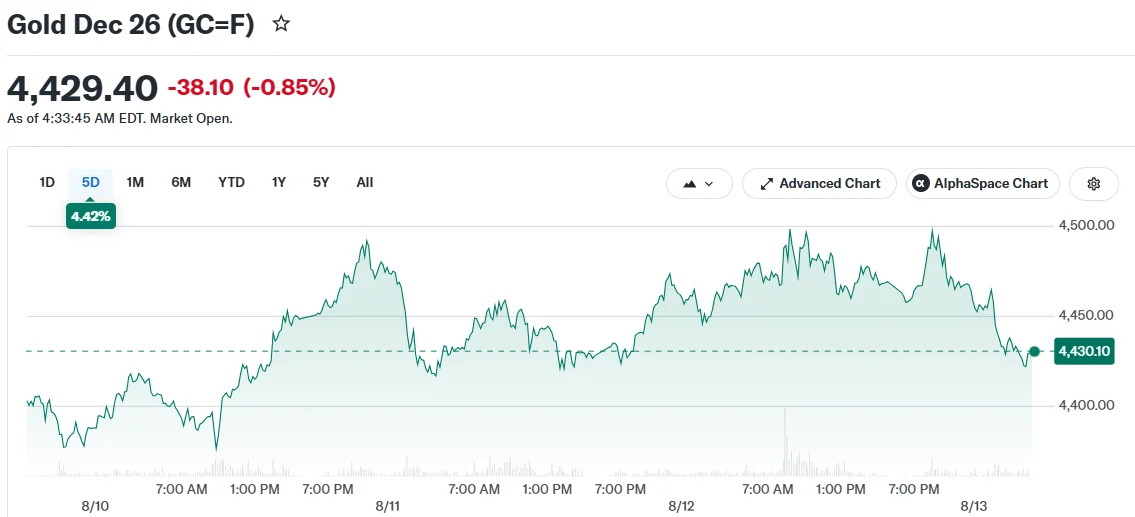
The precious metal touched its strongest level in more than eight weeks on Wednesday before losing momentum. Spot gold advanced to approximately $4,450 per ounce, supported by tame U.S. inflation figures, before declining 0.5% to $4,388.64 during early Thursday sessions. Futures contracts similarly retreated 0.5% to $4,446.12.
Other precious metals mirrored gold’s downward movement. Silver decreased 0.4% to $65.08 per ounce, while platinum declined 0.6% to $1,746.71.
The decline emerged as market participants secured gains surrounding the Consumer Price Index release. U.S. consumer prices advanced a modest 0.1% in July compared to June, aligning with analyst predictions. This figure indicated that the energy disruption related to U.S.-Iran tensions had not yet substantially elevated inflation.
Market Recalibrates Fed Rate Hike Odds Following Inflation Data
The moderate inflation reading reduced market expectations for a Federal Reserve interest rate increase at its upcoming September policy meeting. Based on CME FedWatch data, markets assigned a 38-40% likelihood of a September rate hike following the report, declining from 46% prior to the release.
The central bank maintained its benchmark rate at 3.50%-3.75% during its July gathering. Three committee members supported raising rates, revealing some internal disagreement.
Market participants are now focused on Thursday’s Producer Price Index release for additional inflation insights. More employment and pricing data will emerge before the September policy decision.
Fed Chair Kevin Warsh is scheduled to deliver remarks at the Jackson Hole economic symposium later this month. Investors will scrutinize his comments for clues regarding the Fed’s perspective on the inflation-growth tradeoff.
Rising interest rates typically weigh on gold since the commodity generates no yield. When rate increase expectations diminish, gold generally gains support.
Strait of Hormuz Tensions Sustain Energy Market Uncertainty
While the CPI data showed moderation, energy-related risks remain present. The Strait of Hormuz continues experiencing constraints connected to escalating U.S.-Iran tensions. Oil prices were positioned for weekly gains as market watchers monitored continuing diplomatic discussions between Washington and Tehran.
Should energy costs climb further, inflationary pressures could intensify later, potentially altering the Federal Reserve’s policy trajectory.
The U.S. Dollar Index held steady near 99.96 throughout Thursday’s session, providing minimal directional catalyst for gold. Earlier this week, declining Treasury yields and dollar weakness had boosted gold’s advance, though those trends subsequently reversed.
Demand from China has been instrumental in gold’s broader upward trend. The People’s Bank of China maintained its gold acquisition program, while investor interest rebounded following an earlier correction.
Gold also breached its 100-day moving average this week for the first time since April. IG analysts highlighted that the next significant resistance level is positioned near $4,450, with the 200-day moving average around $4,499 representing an additional technical obstacle.
Despite the recent pullback, gold remains up approximately 3% for the week.
Get 3 Free Stock Ebooks
Discover top-performing stocks in AI, Crypto, and Technology with expert analysis.
- Top 10 AI Stocks - Leading AI companies
- Top 10 Crypto Stocks - Blockchain leaders
- Top 10 Tech Stocks - Tech giants


