



Key Highlights
- Gold surged more than 1%, recovering above the $4,100 threshold following a three-session decline
- Fresh military confrontations between the United States and Iran sparked renewed safe-haven buying
- Federal Reserve meeting minutes revealed division among officials regarding future interest rate decisions
- Rising energy costs are intensifying inflation concerns, potentially prolonging elevated interest rates
- The resilient U.S. dollar and hawkish Federal Reserve tone continue to limit gold’s upward momentum
Precious metal prices staged an impressive recovery on Thursday, advancing more than 1% following three consecutive sessions of declines. Spot gold increased 1.14% to reach $4,123.91 per ounce, while futures contracts for gold rose 1.25% to settle at $4,132.95 per ounce.
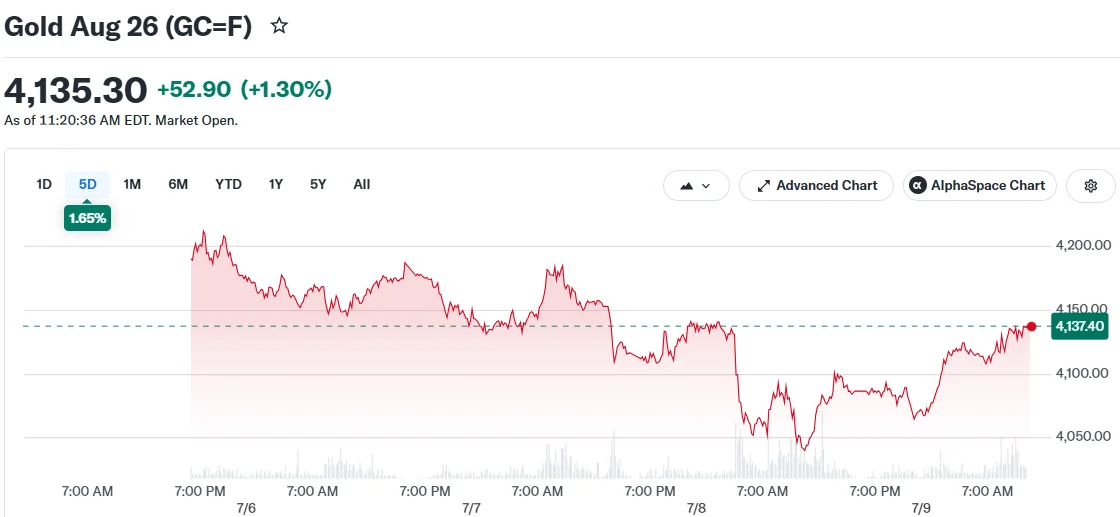
The resurgence occurred as market participants returned to gold’s traditional safe-haven properties amid renewed military confrontations between Washington and Tehran.
Middle East Military Tensions Boost Precious Metal Appeal
The United States initiated additional military operations against Iran on Thursday, coming just hours after President Donald Trump announced the breakdown of ceasefire negotiations with Iranian leadership. The regional conflict has been intensifying since hostilities erupted in late February.
Tehran’s armed forces retaliated with strikes targeting what they identified as U.S. military installations in Kuwait and Bahrain. The Islamic Revolutionary Guards Corps issued warnings of additional attacks on American military assets throughout the Gulf region should Washington persist with its military operations.
This recent escalation has created turbulence across energy markets. Iranian assaults on vessels attempting to navigate through the Strait of Hormuz have driven crude oil prices upward, subsequently heightening concerns about energy-related inflationary pressures.
Higher oil prices complicate the Federal Reserve’s ability to implement interest rate reductions. This creates a challenging environment for gold, as declining rates typically support the non-interest-bearing asset while elevated rates diminish its attractiveness.
“Any surge in energy prices will strengthen market expectations that the Federal Reserve may maintain interest rates at elevated levels for an extended period to address persistent inflation,” noted analysts at ANZ in their research commentary.
Federal Reserve Meeting Minutes Reveal Policy Uncertainty
The release of Federal Reserve minutes from June’s policy meeting provided markets with additional considerations. Central bank officials demonstrated disagreement regarding the necessity of additional interest rate increases, offering some encouragement to gold investors.
The prospect that rate increases might be suspended later this year contributed to improved sentiment surrounding bullion. Reduced borrowing costs decrease the opportunity cost associated with holding gold, which generates no yield.
However, the same meeting minutes also indicated that Fed policymakers are becoming increasingly worried about entrenched inflation. U.S. inflationary pressures have consistently exceeded the central bank’s 2% objective since the onset of the Iran conflict.
“The minutes confirm that the possibility of a September interest rate increase remains firmly on the table,” stated Thomas Ryan from Capital Economics.
The U.S. dollar remained relatively unchanged at 100.98 on Thursday but continues hovering near 13-month peak levels achieved in June. A robust dollar typically increases gold’s cost for international buyers using alternative currencies, which generally constrains demand.
Gold had experienced downward pressure earlier in the week as the dollar gained strength on inflation anxieties connected to the regional conflict. Thursday’s rally lifted gold back above the $4,100 threshold after Wednesday’s downturn pushed it beneath that psychological level.
Get 3 Free Stock Ebooks
Discover top-performing stocks in AI, Crypto, and Technology with expert analysis.
- Top 10 AI Stocks - Leading AI companies
- Top 10 Crypto Stocks - Blockchain leaders
- Top 10 Tech Stocks - Tech giants


