



Key Takeaways
- Precious metal declined more than 1% on Monday, approaching $4,000 per ounce following renewed military exchanges between the US and Iran
- Washington and Tehran have committed to suspending hostilities and will convene for diplomatic discussions in Doha this Tuesday
- The yellow metal has surrendered approximately 23% of its value since joint US-Israeli military operations against Iran commenced in late February
- Derivative markets indicate over 30% probability of Federal Reserve rate increases before 2026 concludes
- Critical employment statistics scheduled for release this week may shape the central bank’s policy direction
Renewed military confrontations between Washington and Tehran during the weekend drove precious metal valuations downward on Monday, bringing the commodity close to the $4,000 threshold as inflationary pressures re-emerged in financial markets.
Spot bullion decreased 1.1% to $4,043.62 per ounce during early Asian trading sessions. Futures contracts for gold retreated 1% to $4,056.77.
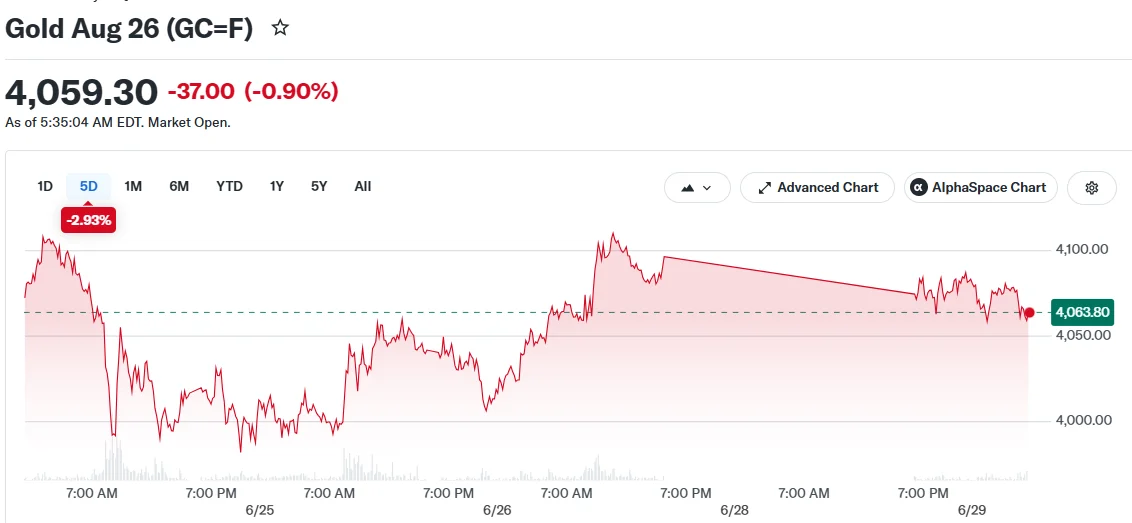
The United States and Iran engaged in military operations across the Persian Gulf throughout the weekend, undermining a temporary cessation of hostilities that had previously stabilized energy commodity markets. A vessel transporting Qatari petroleum was damaged during these confrontations, interfering with maritime traffic through the Strait of Hormuz.
Notwithstanding the escalating tensions, both nations have committed to cease military operations. Diplomatic representatives are scheduled to convene in Doha on Tuesday, as reported by Axios through confidential government sources.
Bullion Weakens Under Rate Expectations and Dollar Strength
Gold has experienced sustained downward momentum for several months. The precious metal has depreciated roughly 23% since coordinated US-Israeli strikes against Iranian targets began in late February.
Elevated energy commodity valuations stemming from the regional conflict have accelerated inflationary trends, prompting market participants to anticipate prolonged restrictive monetary policies from central banking institutions. This dynamic has particularly disadvantaged gold, which generates no income for holders.
Derivative market pricing currently reflects greater than 30% likelihood of Federal Reserve rate increases materializing before the conclusion of 2026, based on CME Fedwatch analytics.
A robust American currency combined with elevated Treasury bond yields have compounded downward pressure. The Federal Reserve’s June policy meeting conveyed a restrictive stance, while recent inflation measurements registered elevated levels, though consistent with analyst projections.
The central bank’s preferred inflation metric, the personal consumption expenditures price index, advanced 0.4% during May. Government bond yields experienced modest declines following that data release.
Additional precious metals similarly declined on Monday. Silver retreated 1.8% to $58.11 per ounce. Platinum decreased 0.4% to $1,612.20.
Employment Report Poised to Dominate Market Attention This Week
Market participants are monitoring numerous economic indicators scheduled for release this week to assess future monetary policy trajectories.
Japanese manufacturing output figures, Chinese purchasing managers surveys, and European inflation measurements are all anticipated.
However, the primary focus remains the United States nonfarm payrolls report covering June. Resilient labor market conditions would provide the Federal Reserve additional justification for implementing rate increases.
Any indication that employment growth maintains momentum could accelerate gold’s decline, as elevated borrowing costs amplify the opportunity cost of maintaining non-income-producing assets such as bullion.
The diplomatic negotiations scheduled in Doha on Tuesday will also command significant attention. A sustainable peace agreement could alleviate energy price pressures and diminish inflationary expectations, fundamentally altering the trajectory for gold.
Currently, the metal remains confined near multi-month lows, suspended between geopolitical instability and the probability of ascending interest rates.
Get 3 Free Stock Ebooks
Discover top-performing stocks in AI, Crypto, and Technology with expert analysis.
- Top 10 AI Stocks - Leading AI companies
- Top 10 Crypto Stocks - Blockchain leaders
- Top 10 Tech Stocks - Tech giants


