


Key Highlights
- LayerZero introduced ATLAS, an integrated trading and settlement platform on the Zero blockchain
- The platform merges trade execution, clearing, settlement, and risk oversight into a unified framework
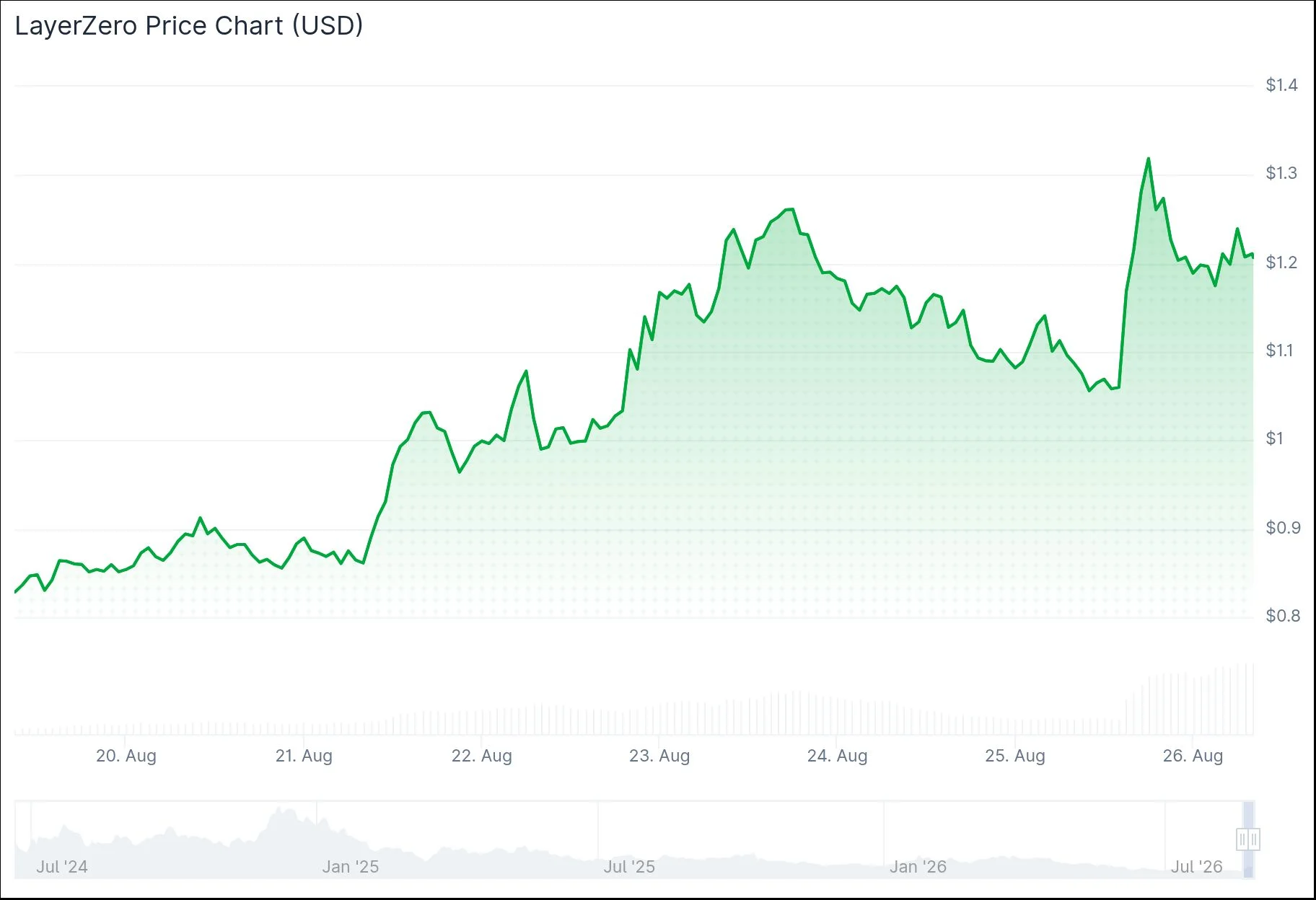
- ZRO experienced a 30%+ price increase post-announcement, reaching approximately $1.26
- Token buyback and burn mechanism will consume 75% of net fees after venue rebates
- Strategic partners include Citadel Securities, DTCC, ICE, ARK Invest, and Google Cloud
LayerZero has rolled out ATLAS, a comprehensive trading and settlement framework operating on its Zero blockchain infrastructure. The reveal triggered a significant rally in the ZRO token, which climbed over 30% from approximately $1 to reach $1.26.
ATLAS represents Aggregated Trading, Liquidity and Settlement. The platform functions as core infrastructure for exchanges, brokerage firms, and financial service providers — integrating order matching, clearing, settlement processes, and risk controls within a single ecosystem.
LayerZero characterizes ATLAS as operating in “headless exchange” mode. This architecture means there’s no direct consumer application. Instead, trading platforms connect to ATLAS infrastructure while maintaining their proprietary user interfaces and customer relationships.
Two distinct deployment models are available. Open ATLAS targets cryptocurrency applications and prediction market platforms. Institutional ATLAS enables financial organizations to establish custom compliance frameworks governing participant access and trading parameters.
The platform is designed to facilitate trading across multiple asset classes, including cryptocurrency spot markets, perpetual futures contracts, equities, fixed income securities, commodities, and prediction markets.
How ZRO Powers the ATLAS Ecosystem
The ZRO token plays a fundamental role within the ATLAS architecture. It functions as both the staking asset for Zero blockchain security through delegated proof-of-stake consensus and as the native gas token for network transactions.
Trading venues can stake ZRO tokens to unlock enhanced fee rebate structures. The premium tier demands staking quantities equivalent to 1% of ZRO’s total token supply.
Once venue rebates are distributed, the remaining fee pool splits 25% to market creators and 75% toward ZRO token buybacks and burns, creating deflationary pressure on circulating supply.
Partnership Ecosystem and Context
LayerZero revealed the Zero blockchain initiative in February with backing from prominent institutions including Citadel Securities, DTCC, Intercontinental Exchange, ARK Invest, and Google Cloud.
Jack Melnick, who transitioned to LayerZero from Berachain to oversee Zero and ATLAS strategy, drew parallels to how custodial banking institutions developed trading capabilities atop settlement infrastructure.
Security Setbacks and Recovery
The ATLAS introduction follows a challenging chapter for LayerZero’s primary operations. This past April, malicious actors exploited vulnerabilities to extract roughly 116,500 rsETH tokens valued at approximately $292 million from Kelp DAO’s LayerZero-based bridge.
In response to the breach, multiple protocols migrated their cross-chain infrastructure from LayerZero to Chainlink alternatives.
Despite these setbacks, LayerZero reports its OFT Standard has processed over $290 billion in cross-chain transaction volume spanning more than 160 blockchain networks.
The ATLAS platform is scheduled for full deployment in late 2026.

