



Key Highlights
- QNT surged approximately 350% across seven days following The Clearing House partnership announcement for tokenized deposit infrastructure.
- The collaboration encompasses 25 leading US financial institutions and forms part of an on-chain payment system scheduled for 2027 launch.
- Futures open interest for QNT reached an all-time peak of $158.80 million as market participants increased leveraged exposure.
- Price charts display a “Golden Cross” formation, with QNT approaching its highest valuation in four years above $250.
- Market analyst Ted Pillows highlights QNT integration with Murex MX.3 platform and involvement in the European Central Bank’s Digital Euro trials.
Quant (QNT) has captured significant attention across cryptocurrency markets over the past week. The digital asset skyrocketed nearly 350% following confirmation of a strategic collaboration with The Clearing House, one of America’s most prominent payment processing organizations.
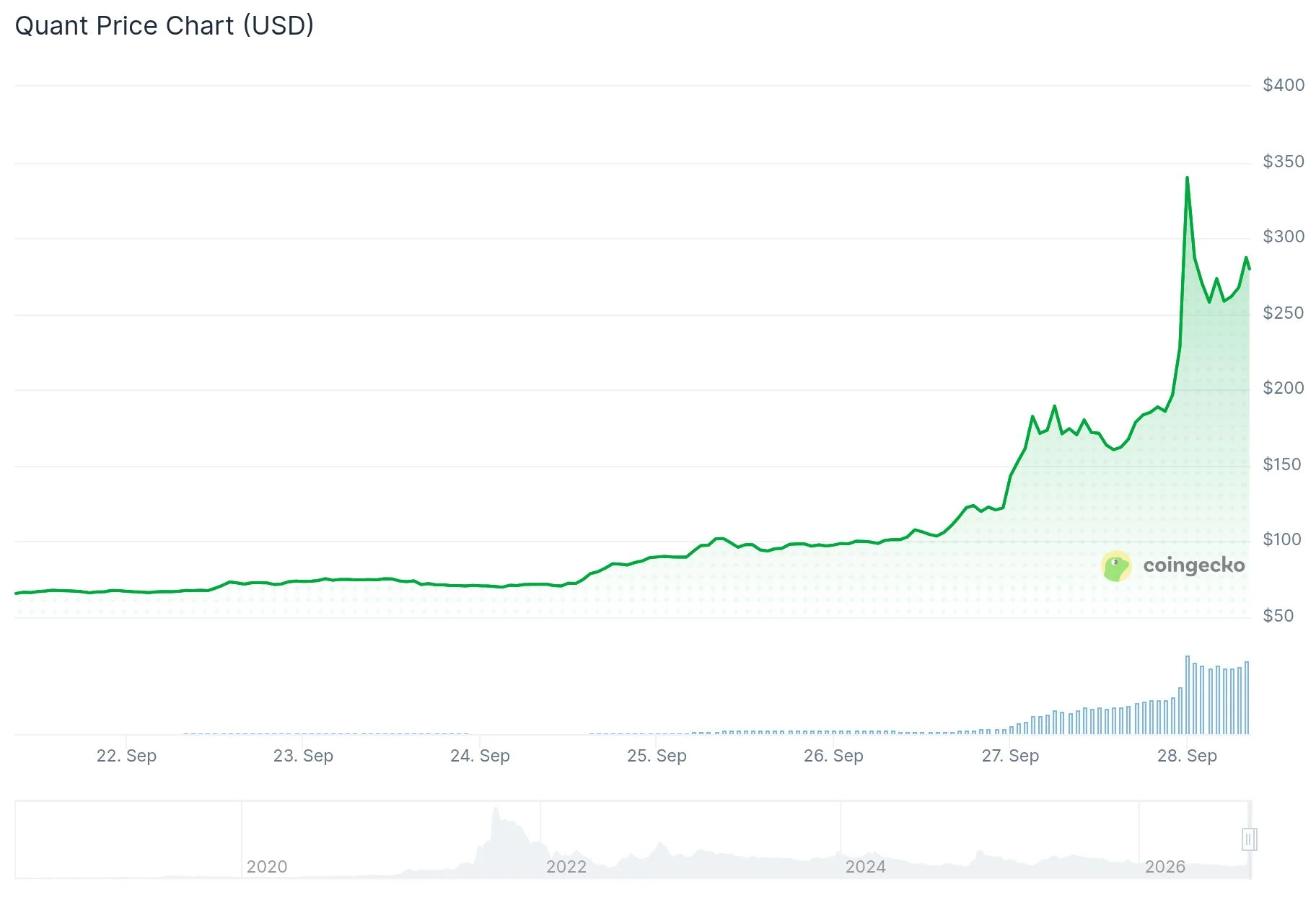
Trading around $254 on Monday, QNT pulled back modestly after experiencing explosive gains throughout the previous week. The token climbed dramatically from approximately $65 to peak near $373 across a seven-day period.
Market momentum accelerated when The Clearing House revealed on September 24 its selection of Quant to drive its On-Chain Money Initiative. The company will provide interoperability infrastructure and transaction processing capabilities for the payment network.
The platform aims to facilitate clearing and settlement processes for tokenized bank deposits. Integration with established payment systems including RTP and CHIPS is planned. Financial institutions can expect network access during the first half of 2027.
The Clearing House handles substantial transaction volumes on a daily basis. Combined network activity exceeds $2 trillion each day, with CHIPS alone processing approximately $2.014 trillion daily throughout 2025. While Quant won’t directly transfer these funds, its technology will operate within this critical financial infrastructure.
Derivatives Markets See Explosive Growth
Investor enthusiasm for QNT intensified rapidly as prices climbed. Open interest in QNT futures contracts hit an unprecedented $158.80 million, indicating substantial increases in leveraged positions.
Simultaneously, funding rates shifted into negative territory at -0.0136%. This metric implies certain market participants anticipate potential price corrections following the rapid appreciation.
Market commentator Ted Pillows provided additional perspective on the price movement through social media posts. He noted QNT’s integration within Murex MX.3, a platform utilized by 65 of the planet’s 100 largest banking institutions. Pillows also highlighted the European Central Bank’s selection of Quant for Digital Euro experimentation. According to his analysis, QNT has escaped a five-year bearish pattern, with continued strength potentially driving prices 2x higher from present levels.
Technical Analysis Reveals Bullish Structure
QNT maintains trading positions significantly above its 50-, 100-, and 200-week exponential moving averages, which range from $87 to $102. This configuration establishes a substantial support foundation beneath current valuations.
The 50-week moving average recently surpassed the 200-week average. This technical formation, commonly referred to as a Golden Cross, typically signals the emergence of sustained upward price trends.
Weekly chart analysis shows the Relative Strength Index at 80, indicating deeply overbought conditions. Meanwhile, the MACD indicator confirms an accelerating uptrend with strengthening bullish momentum.
Key support zones are positioned near $255, $228, and $171.70, derived from Fibonacci retracement analysis. Breaking above the recent peak of $373 could potentially lead toward the token’s record high of $430, established in September 2021.
This American banking agreement builds upon Quant’s previous achievements in the United Kingdom, where it joined institutions including Barclays, HSBC, and Lloyds for a tokenized sterling deposit initiative. That prior collaboration established groundwork for expansion into United States banking infrastructure.

