



Key Highlights
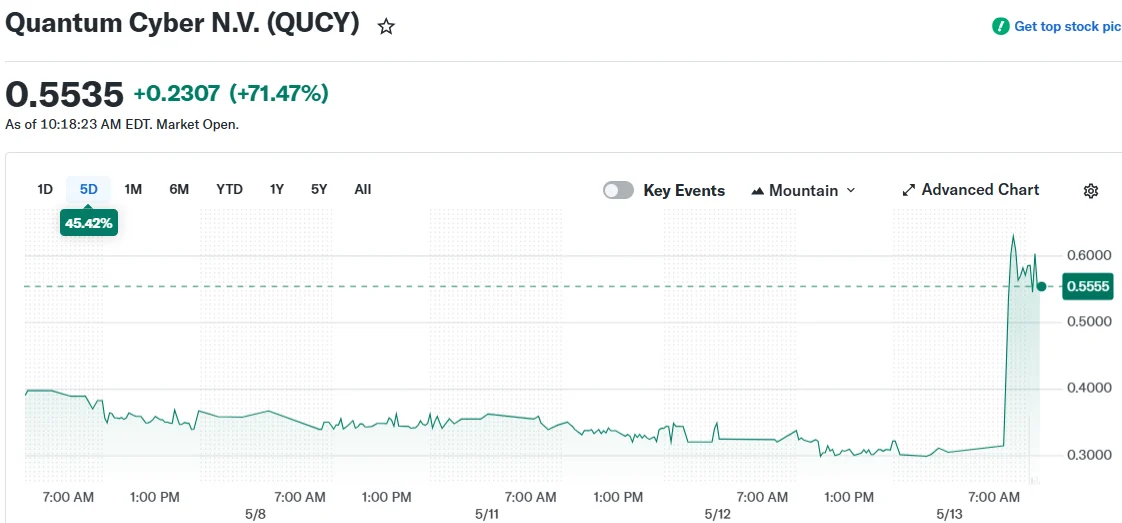
- Shares of Quantum Cyber (QUCY) jumped more than 73% following the announcement of an exclusive IP licensing deal with BP United Inc. for advanced drone systems
- QUCY secured exclusive rights to BP United’s complete drone technology suite, featuring an autonomous sky defense platform capable of operations beyond 25 kilometers
- Pentagon plans include approximately $55 billion allocated toward drone and autonomous combat systems in the FY2027 budget, a massive jump from roughly $225 million previously
- Currently trading at $0.32 per share, QUCY maintains a $4 million market capitalization with trailing twelve-month revenues of only $540,000
- Management indicates forthcoming announcements regarding additional technology partnerships, patent applications, and quantum antenna innovations
Quantum Cyber (QUCY) represents a microcap company positioning itself aggressively in the autonomous warfare sector. Shares skyrocketed over 73% Tuesday following news that the firm secured an exclusive IP License Agreement with BP United Inc., a Florida-based developer specializing in autonomous unmanned aerial systems.
Through this arrangement, Quantum Cyber obtains exclusive access to BP United’s comprehensive drone technology assets. Central to the portfolio is an autonomous sky defense platform engineered for operations exceeding 25-kilometer ranges.
This system operates with complete autonomy across all flight phases — including launch, navigation, and recovery — and supports surveillance operations, interdiction missions, and payload deployment. All communications utilize encrypted protocols for security.
Additionally, the agreement mandates that BP United establish a commercial supply partnership to manufacture and deliver these autonomous platforms.
Pentagon Budget Surge Creates Opportunity
The timing of this transaction coincides with a substantial transformation in U.S. military expenditure priorities. The current administration has requested approximately $55 billion dedicated to drone and autonomous combat technologies within the fiscal 2027 budget proposal. This represents a dramatic escalation from the previous year’s allocation of roughly $225 million — marking the most significant annual increase in drone procurement throughout American military history.
Chief Executive Officer David Lazar directly referenced this budgetary shift. “The Trump administration has elevated autonomous warfare to national priority status, and that $55 billion allocation represents the market validation we’ve been anticipating,” he stated.
Chief Financial Officer Bill Caragol emphasized the strategic structure of the agreement, noting it provides the company simultaneous access to intellectual property and manufacturing capabilities. He characterized it as a “potentially scalable route from platform production to revenue realization.”
Quantum Cyber describes its strategic vision as creating a “System-of-Systems” architecture — integrating drone combat capabilities, counter-unmanned aircraft systems, autonomous mine clearance, command-and-control infrastructure, and quantum-enhanced defense technologies within a single publicly-traded platform.
The organization leverages combat-proven technologies from Israeli and Ukrainian theaters combined with American capital market resources to execute this integration strategy.
Significant Challenges Remain
The dramatic stock movement requires important perspective. QUCY currently trades at merely $0.32 per share with a total market capitalization hovering around $4 million. Revenue generation over the trailing twelve months reached only $540,000, while the company continues consuming capital reserves.
Prior to Tuesday’s surge, the stock had plummeted 87% over the preceding twelve-month period.
Quantum Cyber previously operated under the name Mainz Biomed. The company executed a comprehensive rebrand and modified its Nasdaq ticker symbol to QUCY, reflecting its strategic pivot toward defense and autonomous technologies. Leadership changes include the recent appointment of Robert P. Liscouski as Board Chairman.
CEO David Lazar has demonstrated commitment through a personal $6 million investment via private placement, with $3 million deployed in a recent funding round.
Further developments appear imminent. Management has indicated plans to submit additional patent applications while expanding technological capabilities, particularly in quantum antenna systems.
Get 3 Free Stock Ebooks
Discover top-performing stocks in AI, Crypto, and Technology with expert analysis.
- Top 10 AI Stocks - Leading AI companies
- Top 10 Crypto Stocks - Blockchain leaders
- Top 10 Tech Stocks - Tech giants


