


Key Takeaways
- The Nancy Grace Roman Space Telescope is scheduled for launch on August 30 using SpaceX’s Falcon Heavy rocket from Kennedy Space Center, Florida.
- Roman features a field of view 100 times greater than Hubble’s and will investigate dark matter, dark energy, and survey more than one billion galaxies.
- The telescope will reach an orbital position approximately 930,000 miles from Earth at the L2 Lagrange point and has an operational lifespan of up to a decade.
- Major defense contractors L3Harris Technologies, BAE Systems, and Teledyne Technologies delivered critical hardware for the mission.
- SpaceX anticipates space segment revenues climbing from $4.5 billion in 2026 to $6.3 billion in 2027, with overall company revenue approaching $100 billion.
NASA is preparing to deploy one of its most advanced orbital observatories to date, creating significant opportunities for multiple aerospace and defense sector companies involved in the project.
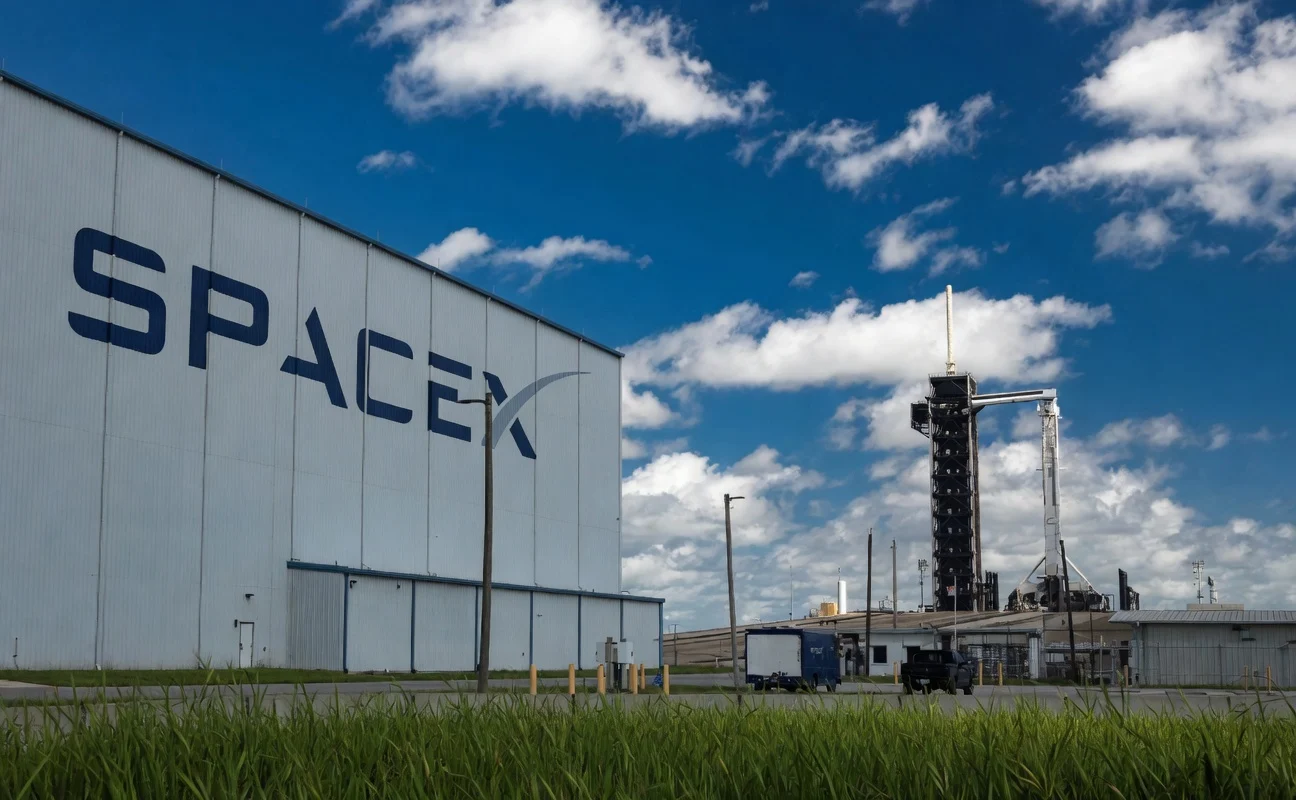
The Nancy Grace Roman Space Telescope is slated for launch on August 30 using SpaceX’s Falcon Heavy launch vehicle. The launch window opens no earlier than 7:26 a.m. Eastern Time from Launch Complex 39A at Florida’s Kennedy Space Center.
Named in honor of NASA’s pioneering chief astronomer Nancy Grace Roman, often referred to as the “mother of the Hubble Space Telescope,” the observatory commemorates her legacy following her death in 2018 at 93 years old.
Measuring 42 feet in length and over 14 feet in width, the Roman telescope will journey to a gravitationally balanced location approximately 930,000 miles from our planet, positioned at the second Lagrange point between the sun and Earth.
The observatory houses two primary scientific instruments: a wide-field 300-megapixel near-infrared imaging camera and an advanced coronagraph capable of blocking stellar light to enable visualization of dim exoplanets in proximity to their host stars.
Roman’s Advantages Over Hubble
The imaging camera aboard Roman provides a field of view that dwarfs Hubble’s by a factor of 100. Within a five-year operational period, Roman is projected to survey more than 50 times the celestial area that Hubble documented throughout its 30-year tenure.
Primary scientific objectives encompass studying dark matter and dark energy, conducting a comprehensive census of over one billion galaxies, and potentially identifying up to 100,000 previously unknown exoplanets. NASA has committed to making all collected data publicly accessible to the global scientific community.
While Roman is designed for a five-year primary mission, its engineering specifications support operations extending up to ten years. Initial imagery is anticipated before 2026 concludes, with comprehensive scientific operations expected to accelerate through early 2027.
Defense Industry Companies Involved in the Mission
Multiple corporations contributed essential technology to the Roman telescope. L3Harris Technologies delivered components and engineering services for the optical assembly system. BAE Systems manufactured instrumentation hardware, while Teledyne Technologies produced the infrared sensor arrays.
L3Harris recorded approximately $6 billion in space systems revenue during the first six months of 2026, representing a 15% year-over-year increase. For Teledyne, the aerospace and digital imaging divisions combined accounted for roughly 70% of second-quarter revenues.
SpaceX, serving as the launch provider for the telescope, maintains its commanding position in the commercial launch sector. The company is on track to execute approximately half of all orbital launches in 2026, a year projected to witness more than 320 global launches.
Revenue from SpaceX’s space operations segment is forecast at $6.3 billion for 2027, representing growth from $4.5 billion in 2026. Overall company revenues are estimated to approach $100 billion.
Financial analysts project that SpaceX’s artificial intelligence-related revenue streams could reach $575 billion by 2031, with the majority anticipated to originate from orbital data center operations, up substantially from $65 billion in 2027.
Get 3 Free Stock Ebooks
Discover top-performing stocks in AI, Crypto, and Technology with expert analysis.
- Top 10 AI Stocks - Leading AI companies
- Top 10 Crypto Stocks - Blockchain leaders
- Top 10 Tech Stocks - Tech giants


