



Key Takeaways
- Equity futures showed modest gains Friday morning following Wall Street’s most significant decline in nearly a month
- Treasury yields remain elevated with the 10-year at 4.70% and 30-year touching 5.25%, weighing on growth stocks
- Walmart stock plunged 9.2% following disappointing sales figures and cautious consumer spending outlook
- Brent crude oil prices holding firm above $93 per barrel, fueling persistent inflation worries
- Market attention turns to Jackson Hole symposium and Nvidia’s upcoming earnings report
Equity index futures posted modest advances Friday morning, attempting to recover from Thursday’s sharp selloff that sent the Dow Jones Industrial Average, S&P 500, and Nasdaq Composite all lower.
Dow and S&P 500 futures contracts advanced approximately 0.2%, while Nasdaq-100 futures showed stronger momentum with gains near 0.4%.
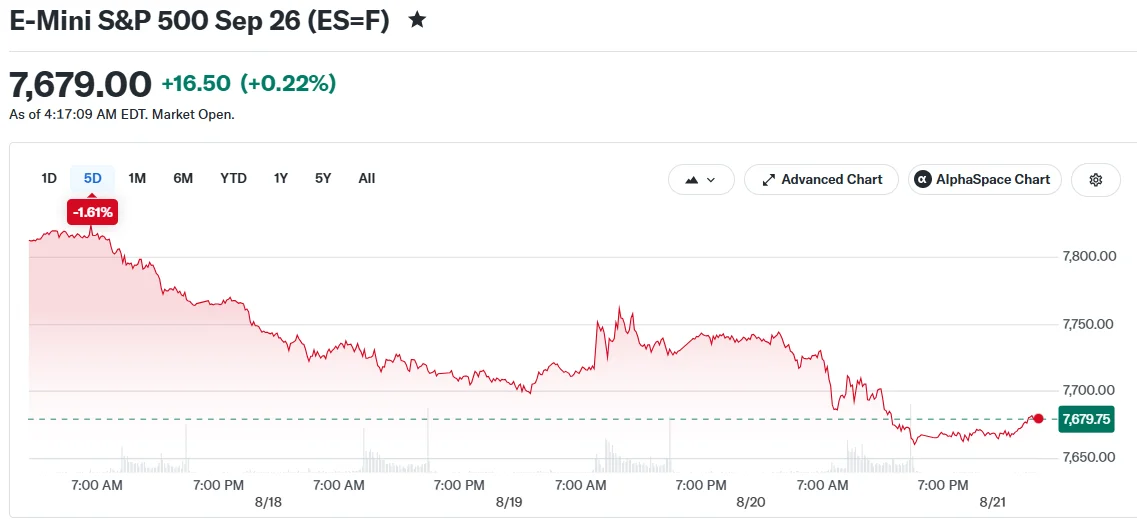
The previous session marked the most severe downturn for major indices in nearly three weeks. The Dow surrendered 1.3%, while the S&P 500 declined 0.9% and the Nasdaq gave up 1%.
Bond Market Volatility Persists
The primary source of market anxiety remains stubbornly high Treasury yields. The benchmark 10-year note yield advanced to approximately 4.70%, while the 30-year bond yield touched 5.25%.
Elevated yields increase financing costs across the economy and diminish the relative attractiveness of equities, particularly growth-oriented technology shares. Tech stocks bore the brunt of Thursday’s market weakness.
Treasury Secretary Scott Bessent unveiled an expansion of the government’s bond buyback program beyond the current $4 billion per-issue threshold. The administration’s stated objective was to demonstrate that current yield levels misrepresent economic fundamentals.
The market response proved skeptical. Yields rebounded swiftly to elevated levels, with participants viewing the intervention as insufficient to meaningfully alter the trajectory.
Retail Giant’s Warning Pressures Consumer Sector
Walmart delivered quarterly sales results below analyst expectations and issued cautionary guidance regarding the impact of elevated fuel prices on consumer purchasing power.
The retail giant’s shares tumbled 9.2% Thursday, triggering broader weakness across consumer discretionary names. Amazon, Home Depot, and American Express all registered notable declines.
Deere and Company provided a rare positive note among major names. The agricultural equipment manufacturer’s shares surged 7% following an upward revision to its annual profit guidance floor.
Energy markets contributed additional complexity to the investment landscape. Brent crude oil prices maintained levels above $93 per barrel, supported by escalating geopolitical tensions involving the United States and Iran.
President Trump issued warnings this week of substantial economic penalties against nations maintaining trade relationships with Iran, drawing particular attention to China’s substantial petroleum imports from the Middle East.
Treasury Secretary Bessent has scheduled a Monday press briefing to outline the administration’s comprehensive strategy for implementing economic isolation measures against Iran.
Market participants are directing attention toward the Federal Reserve’s annual Jackson Hole Economic Symposium, slated for August 27 through 29.
Nvidia’s upcoming second quarter financial results will command significant attention from investors, particularly following this week’s pronounced weakness in artificial intelligence and broader technology equities.
Prior to that release, S&P Global will publish its Purchasing Managers’ Index data, offering fresh insights into manufacturing and services sector health.
BJ’s Wholesale Club quarterly earnings are also scheduled for release, potentially providing additional evidence regarding the consumer spending trends that emerged this week.
Get 3 Free Stock Ebooks
Discover top-performing stocks in AI, Crypto, and Technology with expert analysis.
- Top 10 AI Stocks - Leading AI companies
- Top 10 Crypto Stocks - Blockchain leaders
- Top 10 Tech Stocks - Tech giants


