



Quick Summary
- U.S. equity futures advanced Thursday morning, extending Wednesday’s record-setting session for the S&P 500 and Nasdaq
- Tehran is reviewing a peace proposal from Washington, with a formal answer potentially arriving Thursday
- Crude oil prices dropped beneath $100 per barrel amid optimism about Strait of Hormuz access
- Arm exceeded earnings forecasts but experienced volatile premarket trading due to semiconductor supply worries
- Initial unemployment claims registered lower than anticipated before Friday’s critical employment data
American equity futures posted modest gains Thursday morning, positioning the S&P 500 and Nasdaq to extend their momentum following record-breaking closes during the prior session.
Futures tied to the S&P 500 advanced roughly 0.2%, while Nasdaq 100 futures increased 0.1%, and Dow Jones futures climbed 0.3% during premarket activity.
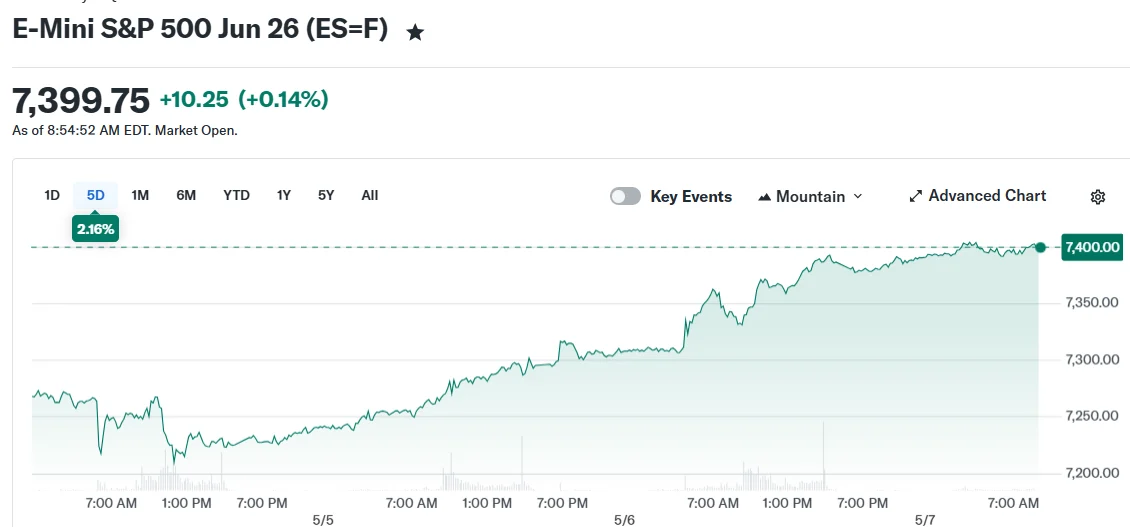
The upward movement occurred as market participants monitored Iran’s anticipated formal reply to a peace proposal from the United States. According to CNN, Iranian officials were assessing the agreement and might deliver their response as early as Thursday.
Earlier this week, President Trump informed the press that “very good talks over the past 48 hours” had taken place, which contributed to Wednesday’s record market performance.
Oil prices retreated on expectations that the Strait of Hormuz might reopen. Brent crude futures declined 2% to $99.21 per barrel, while West Texas Intermediate decreased 2.2% to $93.02 per barrel.
The decline in energy prices alleviated inflation worries and bolstered gold, which continued its recent upward trend.
The U.S. dollar weakened 0.2% versus a basket of major currencies. The yield on the 10-year Treasury note edged down 1 basis point to 4.34%.
Technology Earnings Sustain Market Momentum
Arm delivered robust quarterly results following Wednesday’s market close, surpassing Wall Street projections and providing encouraging guidance for the upcoming quarter. Nevertheless, the company’s shares experienced significant volatility during premarket hours amid concerns regarding semiconductor supply limitations.
McDonald’s first quarter performance exceeded expectations as customers gravitated toward budget-friendly menu options. Shake Shack and Papa John’s were also scheduled to announce results before Thursday’s opening bell.
An equity strategist at Hargreaves Lansdown observed that approximately 80% of S&P 500 constituents have completed their earnings reports, revealing widespread profit expansion beyond artificial intelligence-related industries.
“Strength has been broad, from the obvious AI-linked areas like energy, materials and industrials, through to consumer names, utilities and healthcare,” the analyst said.
Employment Data Takes Center Stage
Thursday’s Challenger report examining April workforce reductions revealed that the technology sector experienced the most significant impact, with artificial intelligence mentioned as a contributing element.
Weekly initial jobless claims registered below forecasts, providing markets with a modest confidence boost ahead of Friday’s release.
Market attention now shifts entirely to Friday’s nonfarm payrolls data, which will offer deeper insights into labor market resilience as consumer sentiment displays indications of weakening.
Wall Street maintained a cautious stance Thursday, with no fresh developments from Middle East negotiations confirmed during early trading hours.
The Dow Jones Industrial Average emerged from correction territory Wednesday, joining the S&P 500 and Nasdaq at or approaching all-time peaks.
Get 3 Free Stock Ebooks
Discover top-performing stocks in AI, Crypto, and Technology with expert analysis.
- Top 10 AI Stocks - Leading AI companies
- Top 10 Crypto Stocks - Blockchain leaders
- Top 10 Tech Stocks - Tech giants


