


Key Takeaways
- Equity futures declined Tuesday amid escalating geopolitical tensions and heightened Federal Reserve tightening expectations
- Crude oil prices surged toward $90 per barrel following renewed US-Iran military confrontations
- Market expectations for a September Fed rate increase jumped to 64.4% following Chair Warsh’s Jackson Hole remarks
- The benchmark 10-year Treasury note yield advanced to 4.75%, intensifying headwinds for equities
- Critical economic releases this week include Tuesday’s JOLTS data and Friday’s employment report
US equity markets began September under considerable pressure. Futures contracts traded in negative territory Tuesday morning as market participants weighed surging crude prices, elevated bond yields, and mounting expectations that the Federal Reserve will deliver another rate increase.
Futures tied to the Dow Jones Industrial Average retreated 0.7%, while those linked to the S&P 500 declined approximately 0.3%. Nasdaq-100 futures fell 0.1%. The losses extended Monday’s session, which saw all three benchmark indices finish in the red.
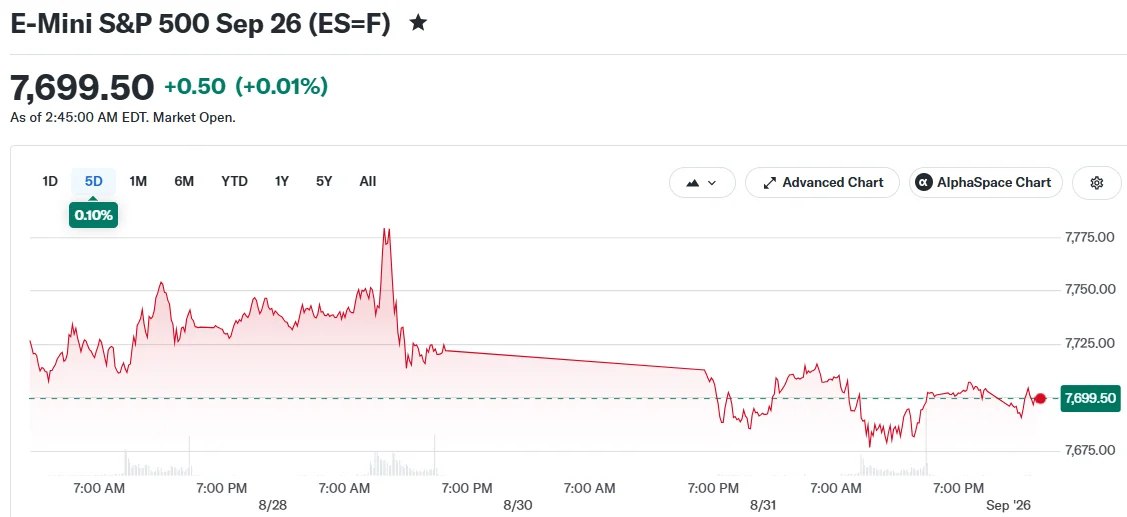
Notwithstanding the challenging start to the month, equities concluded August with impressive double-digit gains for the year. A resurgence in technology sector performance fueled those advances following a difficult July.
Middle East Hostilities Elevate Energy Prices
Escalating friction between Washington and Tehran represents a primary source of current market anxiety. The adversaries reignited military engagements on Sunday—the first such incidents in a month—propelling energy prices sharply upward.
Brent crude contracts are changing hands near the $90 per barrel threshold. The critical Strait of Hormuz shipping channel remains severely restricted, with maritime traffic operating at only a small percentage of typical volumes.
The US government additionally tightened economic penalties against Iran last week. These measures have diminished prospects for imminent diplomatic resolution in the region.
Elevated oil prices contribute directly to inflationary pressures. This dynamic amplifies expectations that the Federal Reserve may need to maintain its restrictive policy stance.
Market Prices In Higher Rate Hike Likelihood Following Chair’s Remarks
Trading activity now reflects a 64.4% probability the Fed will implement a 25 basis point rate increase at next month’s policy meeting. This represents a substantial increase from the 42.7% probability assigned just seven days earlier, per CME FedWatch data.
The recalibration followed Chair Kevin Warsh’s address at Friday’s Jackson Hole symposium. Warsh emphasized the central bank’s unwavering dedication to achieving its 2% inflation objective, though he declined to signal explicitly whether a rate adjustment is imminent.
The 10-year Treasury note yield climbed to 4.75%, sustaining headwinds for risk assets. Higher yields elevate financing costs and can compress equity valuations.
The coming days feature several important economic indicators that may generate additional market volatility. Tuesday’s JOLTS job openings data arrives first, with Friday’s comprehensive employment report following. Manufacturing surveys from S&P Global and the Institute for Supply Management are also scheduled for release.
Quarterly results from Dell and Palo Alto Networks will provide insight into enterprise technology investment and cloud infrastructure demand.
September traditionally ranks as the most challenging month for US equity performance, reinforcing the defensive posture already evident among market participants.
Get 3 Free Stock Ebooks
Discover top-performing stocks in AI, Crypto, and Technology with expert analysis.
- Top 10 AI Stocks - Leading AI companies
- Top 10 Crypto Stocks - Blockchain leaders
- Top 10 Tech Stocks - Tech giants


