


Working out how to pay for a VPN privately starts with an uncomfortable fact: no VPN payment is truly anonymous VPN payment while you still hand over an email address at signup.
But the payment methods are not equal. Some leave a full paper trail, some break most of it, and one leaves almost nothing.
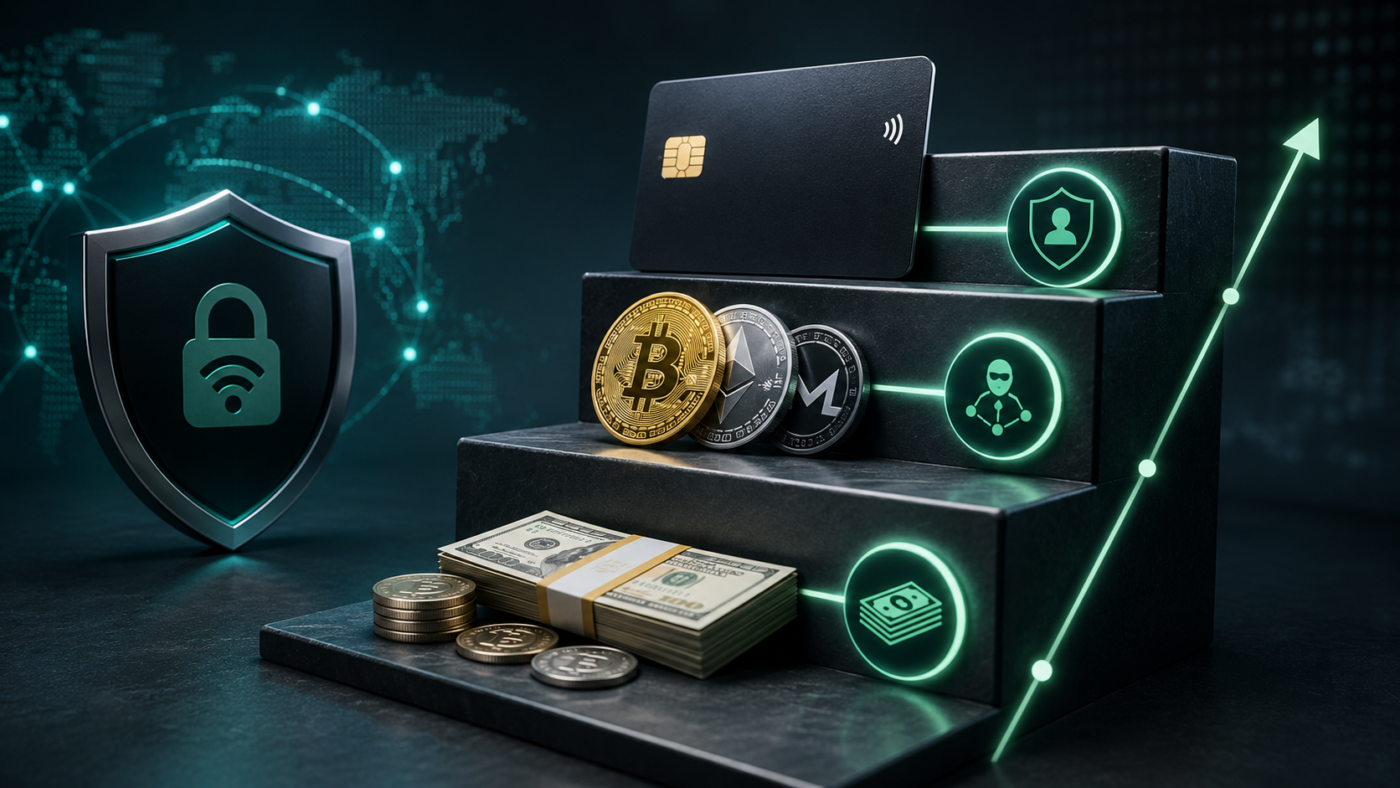
Think of it as a ladder. A card sits at the bottom, cash by mail sits at the top, and crypto sits in the middle with a meaningful gap between its own levels. Where you need to stand depends on what you are actually trying to hide, and from whom.
Here is each level, what it does and does not conceal, and which providers sit where.
Why Anonymous Is the Wrong Word
Start with the honest baseline, because most VPN marketing overstates it. Paying privately is not the same as being anonymous.
When you sign up for almost any VPN, two things happen regardless of how you pay. You provide an email address, and you connect from your real IP address at least once before the VPN is active. Those two facts exist even if you pay in the most untraceable way possible.
So the realistic goal of private VPN payment methods is not anonymity. It is reducing how many parties can link the payment to your identity: your bank, the VPN, a payment processor, and anyone who later examines their records. The ladder below is about removing links, one at a time.
Level 1: Card and PayPal
The default, and the bottom of the ladder. Fast, familiar, and the least private option there is.
- Who sees it: your bank or card issuer records the VPN purchase, and the VPN has your name and billing details
- What it links: your legal identity directly to the VPN subscription
- Who defaults to it: NordVPN, Surfshark, ExpressVPN and most mainstream VPNs treat card and PayPal as the primary path
There is nothing wrong with a card if privacy is not your concern. But it ties your real name to the service at both ends, which is exactly what the higher levels start to undo.
Level 2: Crypto Through a Payment Processor
The first real step up, and where VPN crypto payment privacy actually begins. Paying in crypto through a third-party processor breaks the direct bank link, which is the single biggest improvement on this ladder.
- Who sees it: the processor handles the transaction, and may apply its own identity checks on larger amounts
- What it links: your wallet to the processor, and the processor to the VPN, but not your bank to the subscription
- Who offers it: most VPNs that accept crypto at all, including NordVPN and Surfshark, route it through a gateway like CoinGate
This is a genuine privacy gain over a card. The limitation is the middleman: the processor sits between you and the VPN, sees the transaction, and can be subject to its own compliance rules.
Level 3: Direct Crypto Payment
A step higher, because it removes the processor from the middle. When a VPN accepts crypto directly and names the coins it takes, there is one fewer party in the chain.
- Who sees it: the VPN itself, with no separate processor holding a copy of the transaction
- What it links: your wallet to the VPN, and nothing else
- Who offers it: a small group, including GnuVPN
GnuVPN crypto payment sits on this level. It takes USDT on TRC20, TRX, Bitcoin and Litecoin as named options, and a GnuVPN TRC20 transfer settles in seconds for under a dollar without passing through a third-party gateway.
That places it above the entire card-defaulting mainstream and above processor-routed crypto, with one fewer record of the payment in existence.
Stablecoin on TRON does carry a traceable on-chain record, so this is not the top of the ladder. It is a clear step above where most of the market sits.
Level 4: Monero
Higher still, because a Monero VPN payment breaks the chain-analysis link that Bitcoin and USDT leave open. Its transactions hide the sender, receiver and amount by design.
- Who sees it: the VPN receives payment, but the blockchain does not reveal the sender or amount
- What it links: very little, since the coin itself resists tracing
- Who offers it: Mullvad and IVPN take Monero directly
If your concern is later analysis of the blockchain, Monero is the meaningful upgrade. GnuVPN does not offer it, and that is a fair mark against it for the privacy maximalist. For that specific requirement, Mullvad or IVPN is the answer.
Level 5: Cash by Mail
The top of the ladder. A VPN cash payment is the only method that leaves no digital trail at all. You put physical cash in an envelope and post it.
- Who sees it: no bank, no processor, no blockchain, only the postal system
- What it links: nothing digital, provided you did not sign up with identifying details
- Who offers it: Mullvad, most famously, which pairs it with a numbered account and no email requirement
Cash by mail is the genuine anonymity option, and it belongs at the top honestly. It is also the least convenient by a wide margin: it is slow, it can get lost, and refunds usually do not apply. Anonymity has a cost, and here the cost is convenience.
Which Level Is Right for You
Most people do not need the top of the ladder, and choosing by threat model beats chasing maximum anonymity you will not use.
If you want to pay for VPN without a card so your bank statement never lists it, Level 2 or 3 solves it, and direct crypto at Level 3 does it with one fewer party in the chain.
To defeat later blockchain analysis, Level 4 and Monero are the real answer. If you need to leave no digital trace whatsoever, only Level 5 and cash will do, and you pay for it in convenience.
For the common case, wanting privacy from your bank and a clean subscription without a processor in the middle, direct crypto is the practical sweet spot. That is the level GnuVPN occupies, above the mainstream and below the maximalists.
FAQ
What is the most private way to pay for a VPN?
Cash sent by mail, offered by Mullvad, leaves no digital trail at all and sits at the top of the privacy ladder. Monero is the most private digital method. Direct crypto payment, such as GnuVPN’s USDT-TRC20, is the practical middle ground that removes both your bank and a payment processor from the chain.
Is paying with crypto anonymous?
No, but it is more private than a card. Crypto removes the direct bank link, and paying a VPN directly instead of through a processor removes another party. But most coins leave a traceable on-chain record, and you still provide an email at signup, so it is private, not anonymous.
Does GnuVPN accept direct crypto payment?
Yes. GnuVPN crypto payment covers USDT on TRC20, TRON, Bitcoin and Litecoin as named options, settled directly without a third-party processor. That places it a step above VPNs that route crypto through a gateway, though below Monero-accepting providers for pure anonymity.
Can I pay for a VPN without a card?
Yes, on several levels. You can pay in crypto through a processor, in crypto directly with a provider like GnuVPN, in Monero with Mullvad or IVPN, or in physical cash by mail with Mullvad. Each removes the card, and the higher options remove more of the trail.
Why does GnuVPN not offer Monero?
GnuVPN accepts four coins: USDT-TRC20, TRX, Bitcoin, and Litecoin, focused on fast, low-fee settlement instead of maximum anonymity. For Monero specifically, Mullvad and IVPN are the providers to look at. GnuVPN’s position is the direct-crypto level, which is more private than the mainstream and short of the anonymity maximalists.
Disclaimer: This article is provided for informational purposes only. It is not offered or intended to be used as legal, tax, investment, financial, or other advice.
Disclaimer: This is a Press Release provided by a third party who is responsible for the content. Please conduct your own research before taking any action based on the content.

