


Key Takeaways
- Uniswap community will vote on two critical governance proposals from July 19 through July 26
- First proposal introduces v4 protocol fee activation spanning seven blockchain networks
- Second proposal enables fee collection for v2 and v3 deployments on Robinhood Chain
- All generated fees will contribute to the active UNI token burn protocol
- Within just ten days of going live, Robinhood Chain recorded over $6 billion in total Uniswap swap activity
The Uniswap decentralized exchange is preparing for a pair of governance decisions that may substantially increase the rate at which UNI tokens are permanently removed from circulation. The voting window begins on July 19 and concludes on July 26.
The initial proposal seeks to implement protocol fee collection on designated Uniswap v4 liquidity pools. The scope encompasses Ethereum, Arbitrum, Base, BNB Chain, Polygon, Optimism, and Robinhood Chain. This marks the inaugural governance vote concerning v4 fee activation.
The companion proposal, introduced by Uniswap’s creator Hayden Adams, aims to enable fee collection for v2 and v3 protocols operating on Robinhood Chain. All three protocol iterations were deployed to the network during its July 1 launch date.
As an Ethereum Layer 2 solution constructed using Arbitrum’s underlying technology, Robinhood Chain achieved a remarkable milestone. Its Uniswap implementations processed more than $6 billion in aggregate swap volume by July 10—a stunning achievement within merely ten days of operation.
Market analyst BATMAN, active on X under the handle @CryptosBatman, drew attention to UNI’s positive trajectory on July 13. He emphasized that UNI serves as the dominant automated market maker powering Robinhood Chain, thereby generating additional protocol revenue. His technical analysis revealed breakout patterns, with a retest level identified as an attractive entry point.
Each proposal channels collected fee revenue through Uniswap’s TokenJar infrastructure. Under this system, searchers can claim accrued fee assets by submitting an equivalent value in UNI tokens. The submitted UNI is subsequently transferred to a designated burn address for permanent removal. Fee collections originating from alternative chains are bridged to Ethereum mainnet prior to destruction.
Adams stated on X: “Based on current volumes, especially Robinhood, we expect the impact on UNI burn to be substantial.”
Understanding v4 Fee Architecture
Implementing fee collection on v4 necessitated developing novel infrastructure components. While v2 and v3 operate with predetermined fee percentages, v4 pools leverage hooks and adaptive fee structures that can fluctuate with each block.
The current proposal establishes a V4FeePolicy contract responsible for fee calculation alongside a V4FeeAdapter that enforces governance parameters. Pools are organized into designated “families” with fees determined through rule-based algorithms rather than individual pool configuration.
An additional v4 voting round addressing five supplementary chains—Celo, Soneium, Worldchain, X Layer, and Zora—will proceed independently. Uniswap’s GovernorBravo smart contract architecture restricts individual proposals to a maximum of ten onchain operations.
UNI Token Burns Leading Up to the Vote
The UNI burn framework debuted as a component of the comprehensive “UNIfication” governance reform approved in December 2025 with overwhelming 99.9% community approval. That historic decision enabled fee collection across v2 and v3 pools on Ethereum mainnet while immediately burning 100 million UNI from the protocol treasury.
The initiative has subsequently expanded across 11 blockchain networks. Last month witnessed a historic single-day burn of 186,000 UNI tokens.
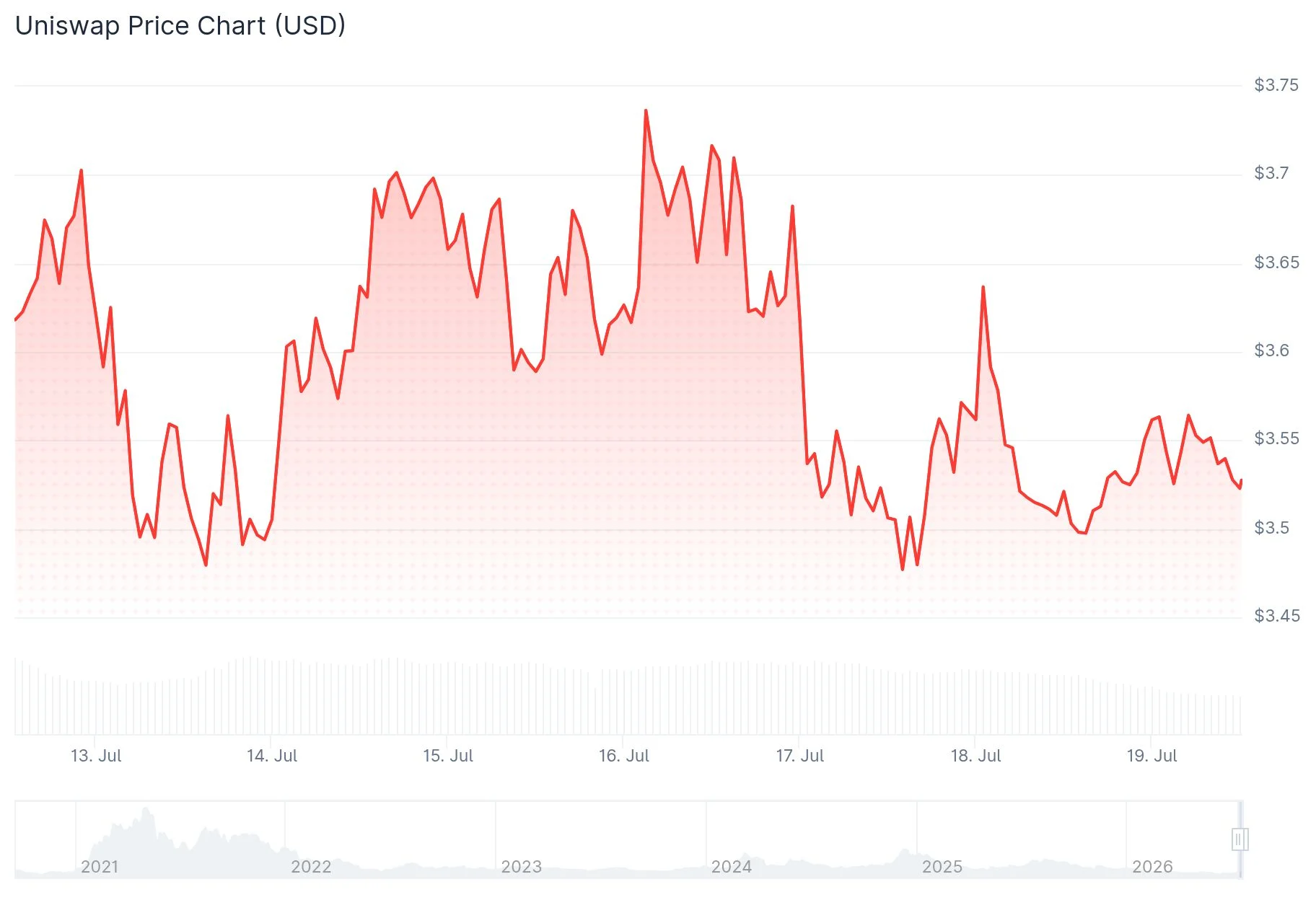
UNI is presently trading near the $3.50 price level.

