


TLDR
- The greenback maintained strength near eight-week highs fueled by escalating Middle East conflict and robust economic indicators
- Military strikes by Iran targeting Kuwait and American operations near the Strait of Hormuz undermined an already precarious truce
- Japan’s currency traded close to 160 versus the dollar, approaching levels that may prompt official market intervention
- Digital currency Bitcoin declined 2.8% to reach $63,119 while Ether touched four-month lows at $1,786
- Traders are positioning ahead of Friday’s critical US employment data for insight into monetary policy direction
The American currency maintained its position near an eight-week peak on Thursday as renewed hostilities in the Gulf region drove crude oil valuations upward and diminished investor enthusiasm for higher-risk holdings. Bitcoin alongside Ether both retreated to four-month nadirs as market participants sought refuge in more secure instruments.
Middle East Violence Bolsters Greenback Strength
Missile attacks launched by Iran against Kuwait inflicted damage to aviation infrastructure and left dozens wounded on Wednesday. American armed forces simultaneously executed operations in the vicinity of the Strait of Hormuz. These developments placed additional strain on an already fragile cessation of hostilities and generated widespread market uncertainty.
US officials announced that Israel and Lebanon had reached consensus on ceasefire implementation terms, though the accord’s viability hinges on Hezbollah ending aggressive operations. Continued military activity in neighboring areas maintained elevated trader wariness.
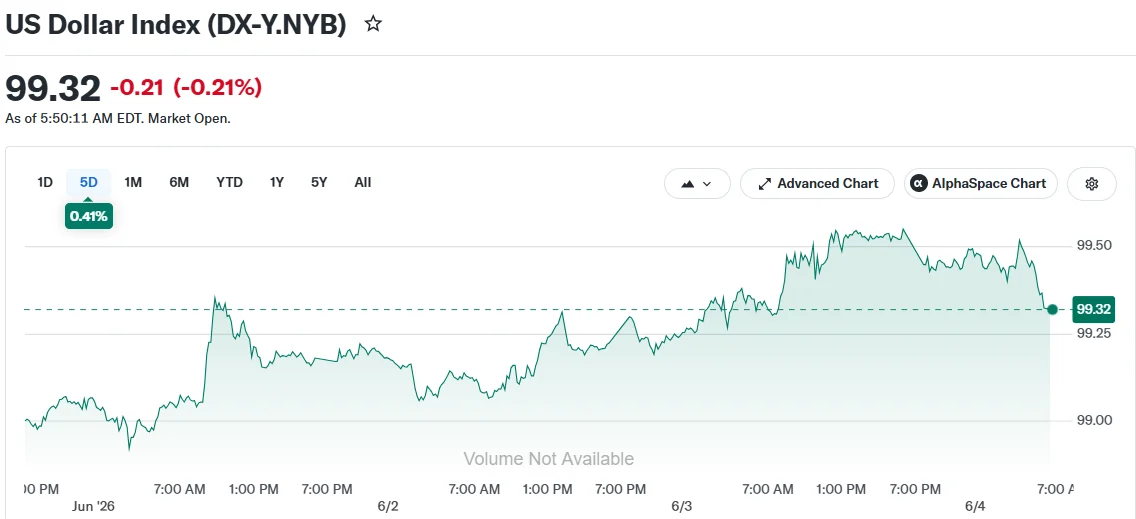
The US Dollar Index climbed to 99.47, marking its most elevated reading since early April. The European common currency remained stable around $1.1604 while sterling exchanged hands at $1.3424, with both showing minimal movement.
“The USD’s safe haven status appears to be strengthening again,” said Sim Moh Siong, FX strategist at OCBC. He added there is “no strong case for a bearish USD” and expects the dollar to stay firm but range-bound.
Robust American economic readings provided additional support. Payroll services firm ADP disclosed that businesses created 122,000 new positions during May. The ISM services gauge advanced to 54.5 from the previous month’s 53.6 reading. The pricing component within that survey surged to levels unseen in nearly four years.
Those inflation figures strengthened convictions that the Federal Reserve will maintain current borrowing costs unchanged through much of the coming year. Financial markets reduced probability assessments for imminent policy easing.
Attention now centers on Friday’s comprehensive employment report for additional clarity regarding central bank trajectory.
Japanese Currency Approaches Critical Threshold
Japan’s currency traded at 159.91 against the dollar, marginally beneath the 160 threshold that market observers generally regard as a catalyst for official government market operations. The yen momentarily breached 160 on Wednesday, eliciting cautionary statements from Japanese officials.
Central bank chief Kazuo Ueda indicated that authorities might need to contemplate borrowing cost increases should inflationary pressures outweigh economic slowdown concerns. Barclays researchers characterized the commentary as sufficiently aggressive to justify a rate adjustment at the upcoming June policy session.
ING currency specialists observed that June historically represents a challenging period for the yen and anticipated continued market probing of dollar-yen appreciation.
Digital Assets Face Pressure
Bitcoin retreated 2.8% to settle at $63,119, establishing a four-month minimum. Ether descended to $1,786, similarly marking its weakest performance in four months. Risk-averse positioning triggered by geopolitical uncertainty pressured cryptocurrency valuations alongside other speculative investment categories.
The Australian currency maintained stability at $0.7132 while New Zealand’s dollar advanced 0.2% to $0.5872, recovering from a one-week trough.
Get 3 Free Stock Ebooks
Discover top-performing stocks in AI, Crypto, and Technology with expert analysis.
- Top 10 AI Stocks - Leading AI companies
- Top 10 Crypto Stocks - Blockchain leaders
- Top 10 Tech Stocks - Tech giants


