


Key Highlights
- The greenback index remained close to a two-month peak on Tuesday, poised for its strongest monthly performance since June with a 1.9% advance.
- European currencies languished near multi-month lows following dovish signals from ECB officials on inflation management.
- Benchmark Treasury yields surged to fresh peaks, with 10-year notes reaching levels unseen since 2007 and 30-year bonds hitting 2004 highs.
- Australia’s central bank lifted its benchmark rate to 4.60%, marking a 15-year peak in its fourth increase of the year.
- Market participants await critical US economic releases including Wednesday’s PCE inflation data and Friday’s employment report.
The American currency strengthened on Tuesday, maintaining its position near a two-month high. The greenback found support from ascending oil markets and elevated Treasury yields.
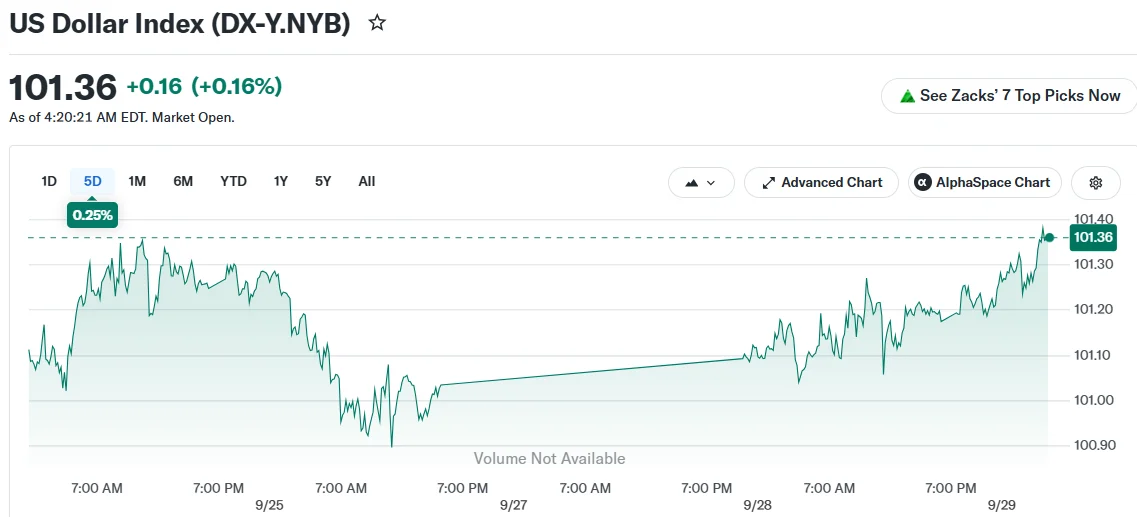
The benchmark dollar index, measuring the US currency against six major rivals, registered at 101.27. The gauge is tracking toward a monthly advance of approximately 1.8% to 1.9%, representing its strongest performance since mid-year.
The single European currency hovered around $1.1360, lingering near its weakest position in three months. The decline followed dovish commentary from European Central Bank leadership suggesting a measured approach to tackling elevated inflation.
Sterling also experienced downward pressure, declining 0.1% to reach $1.3242. This positioned the British currency near its lowest level versus the dollar in three months.
Crude markets also gained momentum. Brent futures climbed above $107 per barrel as expectations dimmed for resolving the Iranian conflict. President Donald Trump’s rejection of Tehran’s ceasefire proposal intensified geopolitical tensions.
Concurrently, a sharp decline in US government bond prices drove yields to fresh multi-year peaks. Benchmark 10-year Treasury yields touched their loftiest levels since 2007. Meanwhile, 30-year yields advanced to heights not witnessed since 2004.
The two-year yield, typically sensitive to Federal Reserve policy shifts, also climbed. It edged nearer to the psychologically significant 5% threshold.
“I think the US dollar is just going to keep growing a little bit higher,” said Joseph Capurso, head of foreign exchange at the Commonwealth Bank of Australia. He added that stronger US economic data could keep pushing interest rates, and the dollar, upward.
Market Pricing Increases for Fed Tightening
Trading desks have turned their attention to two critical upcoming data releases. Wednesday brings the personal consumption expenditures price index, while Friday delivers the nonfarm payrolls report.
Both publications are anticipated to bolster arguments for additional Federal Reserve tightening. Current market pricing assigns greater than 70% probability to a rate increase by late October. This represents a substantial jump from the 57% odds calculated just seven days prior.
Pacific Rim Currency Developments
The Reserve Bank of Australia delivered a rate increase to 4.60% on Tuesday, reaching a 15-year peak. The unanimous decision represents the fourth tightening action in the current calendar year.
Policymakers cited persistently elevated inflation pressures, with core measures registering 3.6%. Rising energy expenses and deteriorating productivity were identified as additional concern areas.
The Aussie dollar momentarily spiked to $0.7029 following the rate announcement before surrendering those gains. It subsequently retreated 0.4% to $0.6989, slipping beneath the psychologically important $0.70 threshold.
Japan’s currency depreciated to approximately 157.4 against the dollar. This reversal erased much of Monday’s appreciation, which followed cautionary remarks from Japan’s senior currency diplomat, Atsushi Mimura.
Mimura emphasized that financial markets should heed a “very clear” coordinated message from Japanese and American authorities regarding yen depreciation. Japan’s Prime Minister Sanae Takaichi and Finance Minister Satsuki Katayama echoed these sentiments.
Katayama and US Treasury Secretary Scott Bessent conducted a telephone conversation last Friday. They reached consensus that the yen faces undervaluation and committed to enhanced coordination on foreign exchange policy.
In other developments, the New Zealand dollar fluctuated near $0.5675. The offshore yuan maintained stability at 6.71 per dollar following last week’s bilateral US-China summit, while both the South Korean won and Singapore dollar exhibited minimal movement.
Get 3 Free Stock Ebooks
Discover top-performing stocks in AI, Crypto, and Technology with expert analysis.
- Top 10 AI Stocks - Leading AI companies
- Top 10 Crypto Stocks - Blockchain leaders
- Top 10 Tech Stocks - Tech giants


