



Key Takeaways
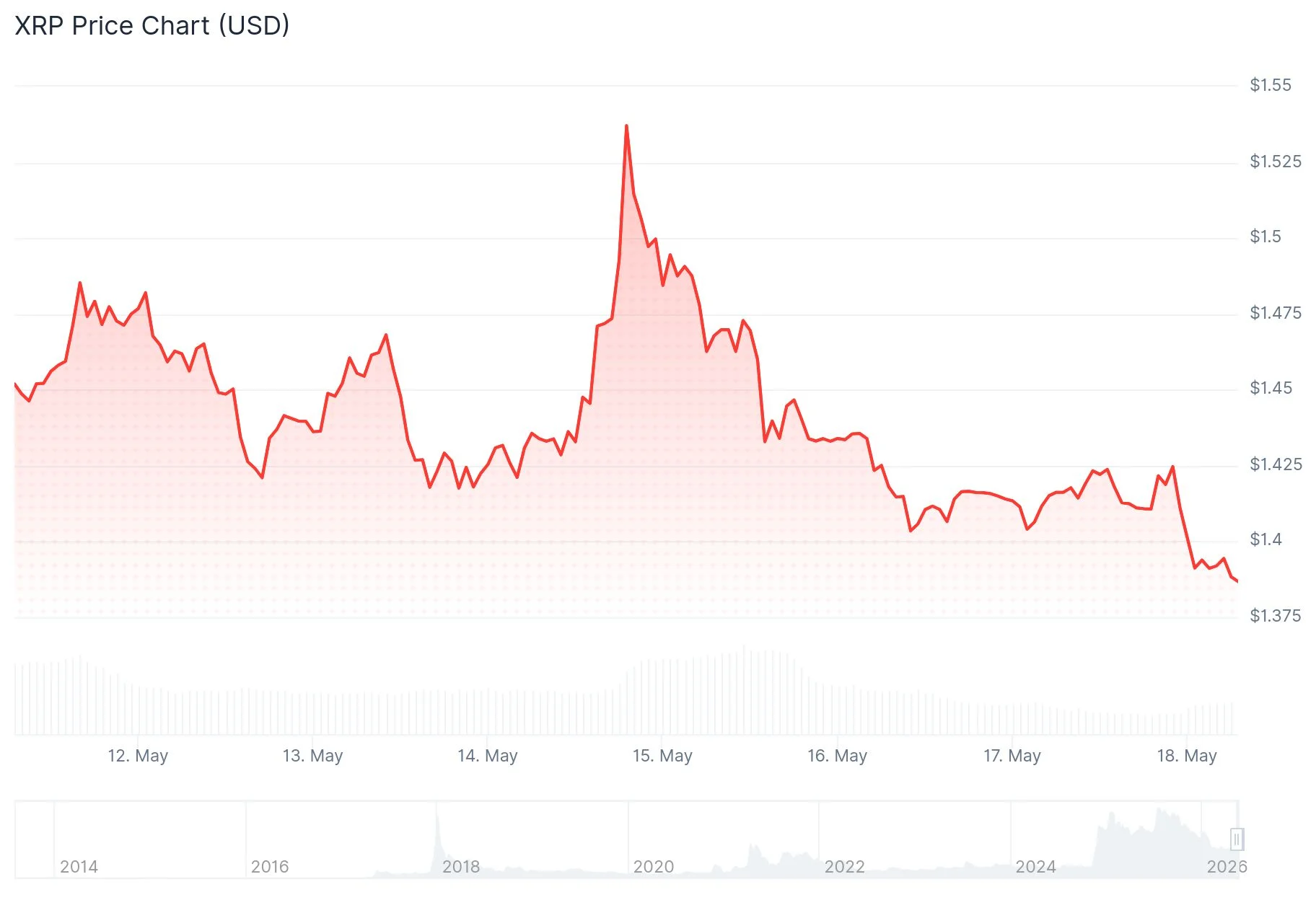
- XRP is currently valued at approximately $1.40 with its market capitalization hovering near $87 billion
- XRPL recorded $1.1 billion in net real-world asset capital inflows during a 30-day period, contrasting with outflows seen on Ethereum and Solana
- Real-world assets on XRPL are nearing $3.6 billion in total value, still trailing Ethereum’s $17 billion but experiencing faster growth
- XRP token holders receive limited direct advantages from ledger activity because of negligible fee burn mechanisms
- Using probability-weighted calculations, analysts forecast XRP could reach approximately $5.80 by 2031
XRP is currently hovering around the $1.40 mark, supported by a market capitalization approaching $87 billion and approximately 61.8 billion tokens in circulation. Recent attention has centered on the XRP Ledger’s real-world asset engagement rather than short-term price fluctuations of the token itself.
During the 30-day window concluding on May 13, XRPL documented $1.1 billion in net inflows for tokenized real-world assets. During this identical timeframe, both Ethereum and Solana experienced capital withdrawals exceeding hundreds of millions from their respective RWA segments.
Tokenization involves creating blockchain-based digital representations of traditional assets such as bonds, commodities, or stocks to enable accelerated settlement and transparent tracking. XRPL’s aggregate RWA valuation is nearing $3.6 billion, remaining considerably behind Ethereum’s $17 billion but demonstrating accelerated expansion.
A significant factor driving institutional preference for XRPL is its native integration of regulatory compliance mechanisms including KYC and AML capabilities directly within the protocol layer. Ethereum necessitates integrating comparable functionality through external service providers, introducing complexity that concerns conservative institutional asset managers.
How Does XRPL Expansion Impact XRP Token Holders?
Notwithstanding the ledger’s impressive inflows, XRP coin holders experience minimal direct advantages. Every XRPL transaction requires a minuscule XRP fee that gets permanently destroyed. However, since XRP’s 2012 inception, cumulative fee burns have totaled merely about 14 million tokens — approximately 0.014% of the total supply.
This dynamic indicates that billions in transaction volume can traverse the ledger without substantially decreasing XRP’s circulating supply or exerting upward price pressure. Ledger activity and token valuation represent distinct phenomena.
Market analyst Javon Marks shared on X that XRP is “still holding broken out against Bitcoin” and possesses potential to surpass it by nearly 800%. He established a price objective exceeding $15, characterizing the projection as “more and more feasible.” Marks referenced historical breakout formations that he believes validate this forecast.
Expert Perspectives on Five-Year Price Trajectories
Independent research outlines three potential scenarios for XRP leading into 2031. The baseline scenario positions pricing between $4 and $6, presuming consistent expansion aligned with broader cryptocurrency market trends. The optimistic scenario of $10 to $15 depends on XRP achieving widespread adoption as a settlement mechanism across payment networks and tokenized financial systems. The pessimistic scenario, ranging from $0.70 to $1.20, reflects circumstances where financial institutions gravitate toward stablecoins or proprietary blockchain solutions.
Calculating a probability-weighted mean across these three projections yields approximately $5.80.
Critical factors under analytical scrutiny include ETF availability for institutional capital deployment, regulatory framework development in primary jurisdictions, tangible expansion in XRP Ledger transaction volumes, and competitive pressures from Ethereum, Solana, and stablecoin-based payment infrastructure.
XRP is currently exchanging hands near $1.40, reflecting approximately 2.11% decline over the past 24 hours, while the ledger’s 30-day RWA inflow metric of $1.1 billion maintains substantial interest among institutional market participants.

