



Key Takeaways
- Japanese currency faces its steepest weekly decline since May, plunging to 40-year lows versus the greenback
- The USD/JPY exchange rate maintains levels around 163.90, while Japan’s consumer prices climbed to 1.7% in June
- U.S. officials have urged the Bank of Japan to accelerate interest rate increases
- Crude oil surpassing the $100 threshold has rekindled inflationary pressures, strengthening the dollar
- Escalating geopolitical risks in the Middle East intensify currency pressure, with Trump warning of potential military strikes on Iran and Houthi forces
Japan’s currency is experiencing its most significant weekly decline since May, tumbling to unprecedented levels against the American dollar not witnessed in approximately four decades. During Friday’s early Asian market hours, the USD/JPY currency pair was exchanging hands near the 163.90 mark.
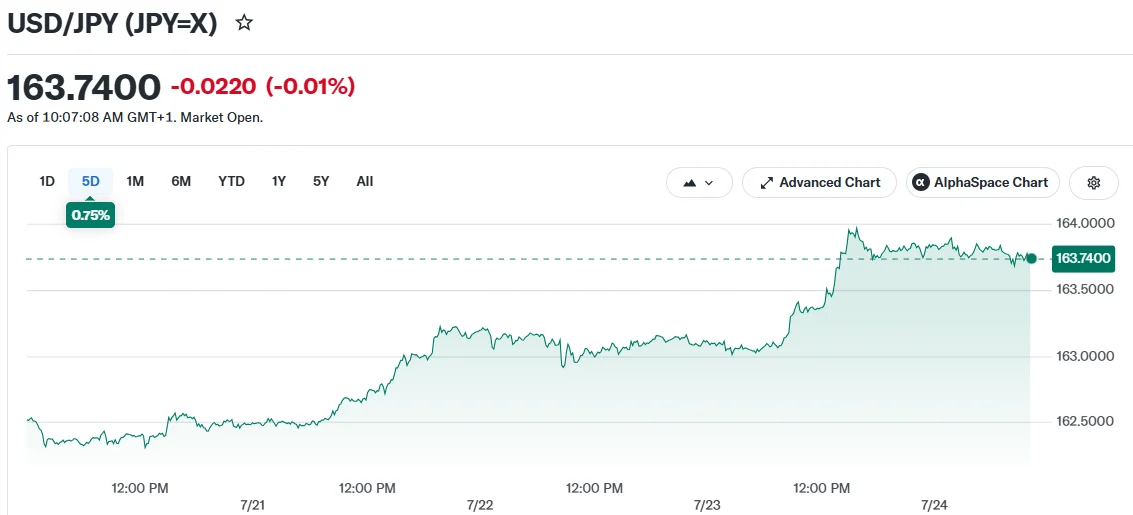
Japanese officials have attempted to stabilize currency markets through verbal intervention, yet these measures have proven largely ineffective in halting the yen’s descent. This week, Finance Minister Satsuki Katayama issued stern warnings that government authorities stood prepared to implement “appropriate and bold action,” though market participants remained largely unmoved by such rhetoric.
Market experts suggest that even physical currency market intervention would merely postpone the underlying issue. Without more aggressive monetary tightening from the Bank of Japan, the currency’s depreciation trajectory appears set to persist.
On Thursday, the United States Treasury Department intensified pressure on Japanese policymakers, declaring that excessive foreign exchange volatility remained unwelcome and explicitly urging the Bank of Japan to implement policy adjustments.
The American currency is tracking toward a weekly appreciation of approximately 0.9%, representing its most robust weekly advance since May. The U.S. dollar index registered slight weakness on Friday, last trading at 101.35.
Rising Prices and Energy Costs Bolster Dollar Strength
Japan’s nationwide consumer price index accelerated to 1.7% on an annual basis in June, advancing from the previous month’s 1.5% reading. Core inflationary measures similarly edged higher to 1.6%, marking their first monthly increase since March.
These inflation statistics emerged just days ahead of the Bank of Japan’s upcoming policy deliberation, where interest rates are universally anticipated to remain unchanged. Financial markets displayed minimal response to the pricing data.
Across the Pacific, an encouraging June inflation report temporarily sparked optimism that pricing pressures might be moderating. However, oil prices breaching the $100-per-barrel threshold this week—for the first time in nearly eight weeks—dramatically altered market sentiment.
Federal Reserve Chair Kevin Warsh has explicitly communicated that the central bank remains committed to its 2% inflation objective. Investment professionals are monitoring developments carefully, emphasizing that a single favorable inflation reading proves insufficient to alter the Fed’s policy trajectory.
Geopolitical Instability Compounds Market Volatility
Heightened geopolitical uncertainty is simultaneously influencing currency movements. President Trump announced this week that the United States would hold Iranian authorities accountable for Houthi militant attacks targeting vessels in the Red Sea corridor, while cautioning of impending “major military punishment.”
Such geopolitical instability characteristically bolsters demand for the dollar as investors seek safe-haven assets, applying additional downward force on the Japanese currency.
The European common currency registered modest gains of 0.1% to reach $1.1388 on Friday. The European Central Bank maintained current interest rate levels while signaling openness to potential tightening in September. Market participants are currently assigning roughly a 30% probability to such action.
The British pound appreciated 0.15% to $1.3335. The 30-year United States Treasury yield maintained levels above 5%, while the 2-year maturity yield remained anchored at 4.34%—its most elevated reading since February 2025.
Year-to-date in 2026, the yen has surrendered nearly 5% of its value, matching the performance of Norwegian and Swedish currencies, while significantly underperforming the Swiss franc which has declined just over 3%.
Get 3 Free Stock Ebooks
Discover top-performing stocks in AI, Crypto, and Technology with expert analysis.
- Top 10 AI Stocks - Leading AI companies
- Top 10 Crypto Stocks - Blockchain leaders
- Top 10 Tech Stocks - Tech giants


