


TLDR
- Zcash holders approved $8.39 million in retroactive grants, funding 17 of 37 proposals in the Q3 2026 round.
- Researcher Taylor Hornby received $1.5 million for finding the critical Orchard counterfeiting bug.
- Voter turnout reached about 2.18 million ZEC, up from roughly 500,608 ZEC in Q1.
- ZEC trades near $1,407, below its September high of about $1,700, as momentum cools.
- A whale withdrew 2,000 ZEC from Binance, bringing its main wallet to about $66.19 million.
Zcash (ZEC) is trading near $1,407 after holders approved $8.39 million in retroactive grants. The vote funded 17 of 37 proposals in the Q3 2026 round.
The approved grants covered 93.1% of the $9.01 million requested. The largest single vote involved about 2.18 million ZEC, or 10.4% of the coin’s 21 million maximum supply.
Zcash co-founder Zooko Wilcox posted on Oct. 1 that the grants rewarded people who worked on the network during this year’s security crisis. He said the vote showed Zcash’s coinholder-directed funding system is “capture-resistant.”
$1.5 Million for Orchard Bug Discovery
Two of the largest approvals were $750,000 grants tied to researcher Taylor Hornby. One covered the original bug bounty, and a second community nomination brought his total to $1.5 million.
Hornby found a counterfeiting flaw in Orchard on May 29. He used traditional security methods along with Anthropic’s Opus 4.8 model during the review.
The bug could have let an attacker create fake ZEC inside the shielded pool without leaving a clear onchain trace. Hornby reported it right away to Zcash Open Development Lab engineers.
The network temporarily disabled Orchard transactions, then activated NU6.2 with a fixed circuit. The Zcash Foundation found no evidence of unauthorized coin creation.
Security work took most of the other large grants. Coinholders approved $1.95 million for ZODL’s core protocol development and $1.203 million for ValarGroup’s Ironwood work.
Another $738,942 went to formal verification of the Ironwood circuit, and $599,000 covered external audits.
Voting turnout rose sharply. About 2.18 million ZEC took part in the largest Q3 vote, compared with roughly 500,608 ZEC in Q1.
The next grant round opens for proposals from Oct. 30 through Nov. 13. Voting is set for Dec. 17 through Dec. 29.
ZEC Price Cools After September Rally
ZEC traded between $1,382 and $1,458 over the past 24 hours, according to CoinGecko. The price remains below the $1,600 to $1,700 area reached during September’s rally.
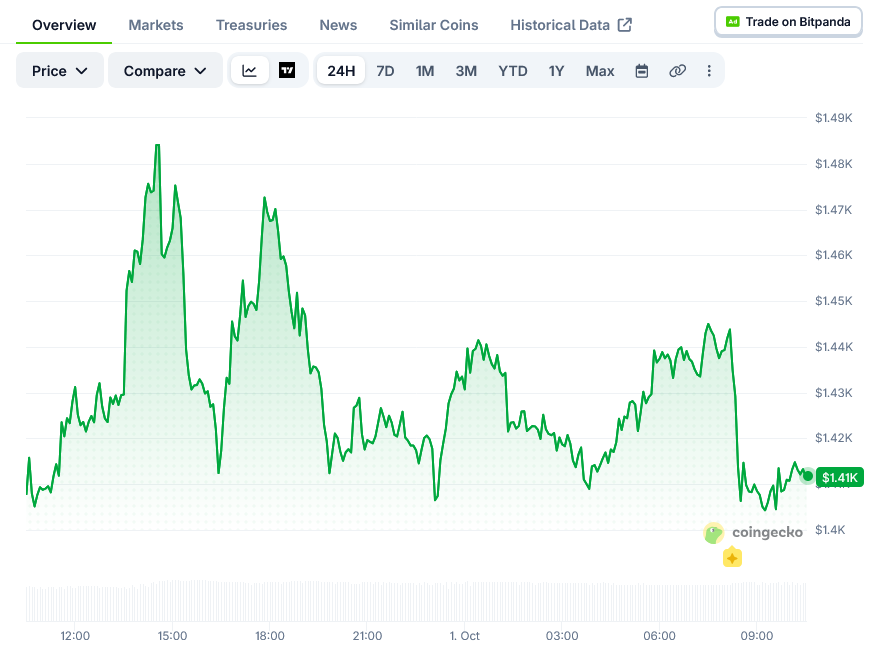
The 14-day RSI sits at 55.45, below its moving average near 64.49. This shows momentum has cooled, though RSI is still above the neutral 50 level.
The MACD line is around 120.13, below the signal line near 153.14. The negative histogram points to fading bullish momentum in the short term.
Trader that1618guy noted that ZEC is testing its daily 21-day EMA for the first time since August. The coin climbed from above $400 to about $1,700 before the pullback. The analyst flagged the 55-day EMA near $1,100 as a deeper level to watch.
Open interest on one major derivatives exchange fell as the price dropped, showing traders cut exposure.
Onchain Lens reported that a whale withdrew 2,000 ZEC, worth about $2.82 million, from Binance. The coins were moved into a main wallet now holding roughly $66.19 million in ZEC.
The $1,400 level is the nearest support for buyers. A move back toward $1,500 to $1,600 would bring ZEC into the zone where sellers appeared in September.

