


Key Highlights
- ZEC climbed 23% to approximately $1,369 while Bitcoin and leading cryptocurrencies posted gains
- Federal Reserve increased interest rates by 0.25%, which markets interpreted as a sign of measured policy tightening
- Approximately 2.4 million ZEC tokens participated in the NU7 governance ballot, with 99.9% supporting accelerated 25-second block intervals
- A decisive 98.9% of participants voted to maintain Zcash’s Bitcoin-inspired halving mechanism
- Matt Huang from Paradigm disclosed his firm’s ZEC position and characterized it as “a private complement to Bitcoin”
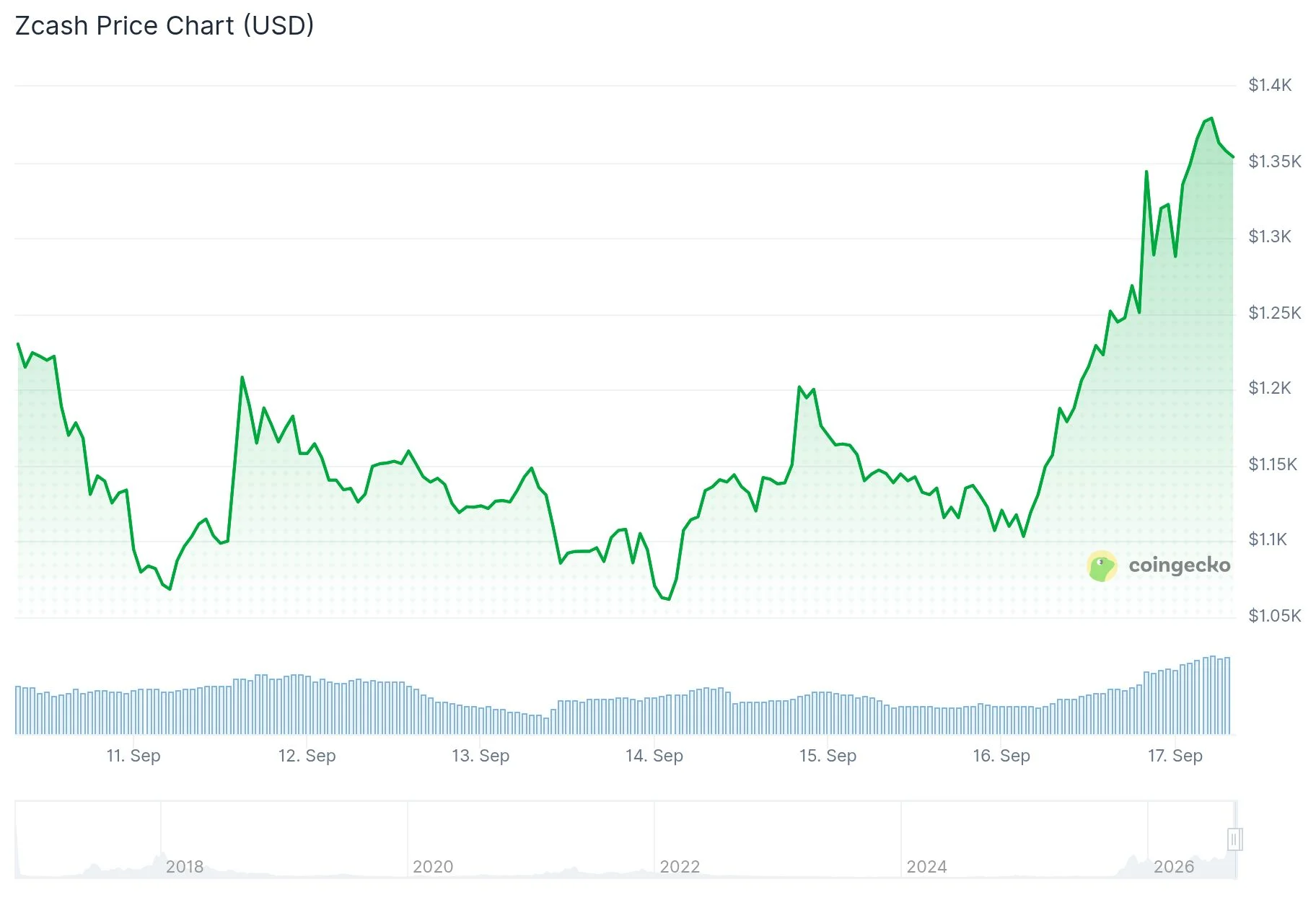
Zcash (ZEC) experienced a notable 23% surge within a 24-hour window, reaching approximately $1,369 and outperforming the majority of digital assets. In comparison, Bitcoin recorded a modest increase of under 1% to roughly $76,258, while Solana appreciated nearly 3% during the identical timeframe.
Cryptocurrency markets trended upward after the Federal Reserve announced a 0.25% increase to its benchmark rate, pushing the range to 3.75%-4%. According to Jeff Ko, chief analyst at ViaBTC, the rate adjustment was “largely priced in” by market participants and did not indicate an aggressive monetary tightening strategy.
The Federal Reserve’s median forecast positioned the policy rate at 4.1% through the end of 2026 and 2027, implying the possibility of only one additional increase this year. Following the Fed’s statement, S&P 500 futures climbed 0.6% while Nasdaq 100 futures advanced 0.7%.
Paradigm co-founder Matt Huang amplified the ZEC rally momentum by revealing on X that his investment firm maintains a ZEC position. Huang characterized Zcash as “a private complement to Bitcoin” and expressed support for ongoing developer funding, though he recommended integrating coin-holder voting with alternative governance mechanisms.
Community Vote Shows Overwhelming Support for Protocol Changes
The ZEC price surge coincided with the completion of Zcash’s NU7 community governance ballot. Participation reached nearly 2.4 million ZEC from an eligible pool of approximately 3.6 million tokens, significantly exceeding the 1 million ZEC participation requirement.
An overwhelming 99.9% of voting tokens supported decreasing block generation time from 75 seconds to 25 seconds. Accelerated block times enable faster transaction finality and enhanced network efficiency.
Regarding emission policy, 98.9% of participants voted to preserve the Bitcoin-modeled halving framework. Block rewards will continue reducing at predetermined intervals rather than following a gradual decline model.
Market analyst Crypto Patel highlighted a potential concern on X, observing bearish momentum divergence in ZEC near the $1,300 all-time high resistance area. Patel identified $800 as an initial support threshold and $500 as a significant demand region, adding that a sustained break above $1,300 would negate the bearish scenario.
Hardware Wallet Support and Implementation Timeline
Zcash Labs revealed it secured funding to integrate shielded pool functionality with Ledger hardware wallets. This development would enable users to maintain ZEC privacy while utilizing established hardware wallet technology.
The NU7 governance results don’t automatically activate network changes. Approved modifications must undergo testing and development phases before mainnet deployment.
CoinGecko reported on X that ZEC momentarily exceeded a $23 billion market capitalization after the vote conclusion, attributing the price action to the governance decision and the continuation of its Bitcoin-aligned halving structure.
The 99.3% of participants who supported expedited NU7 deployment also consented to excluding features not ready by September 30 rather than postponing the entire network upgrade.

