


The AI chip market grew fast in 2026, and a small group of companies earns most of the money. NVIDIA still leads by a wide margin. AMD, Broadcom and the large cloud companies are taking a bigger part of the spending.
This article draws on four sources: Presenc AI, SQ Magazine, MarketsandMarkets and Zylos. Each one measures the market in its own way, so some numbers do not match. We name the source and time period for each figure.
Each company also reports on its own fiscal calendar. Figures for NVIDIA, AMD and Broadcom cover different quarters, so they should not be added together.
Key figures at a glance:
- NVIDIA data center revenue in Q1 fiscal 2027: $75.2 billion, up 92% year over year
- AMD data center revenue in Q2 2026: $6.7 billion, up 107%
- Broadcom AI semiconductor revenue in Q2 fiscal 2026: $10.8 billion, up 143%
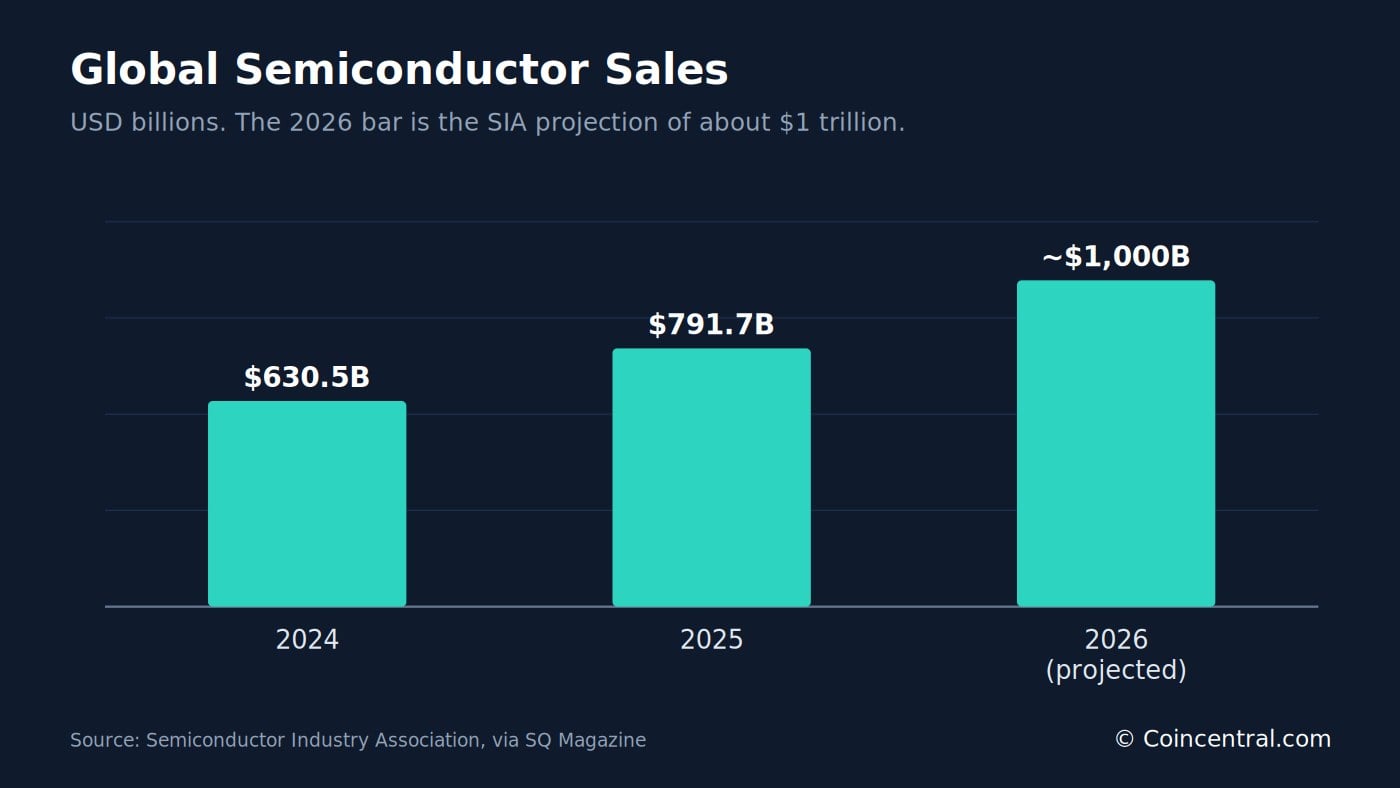
- Global chip sales in 2025: $791.7 billion, up 25.6%
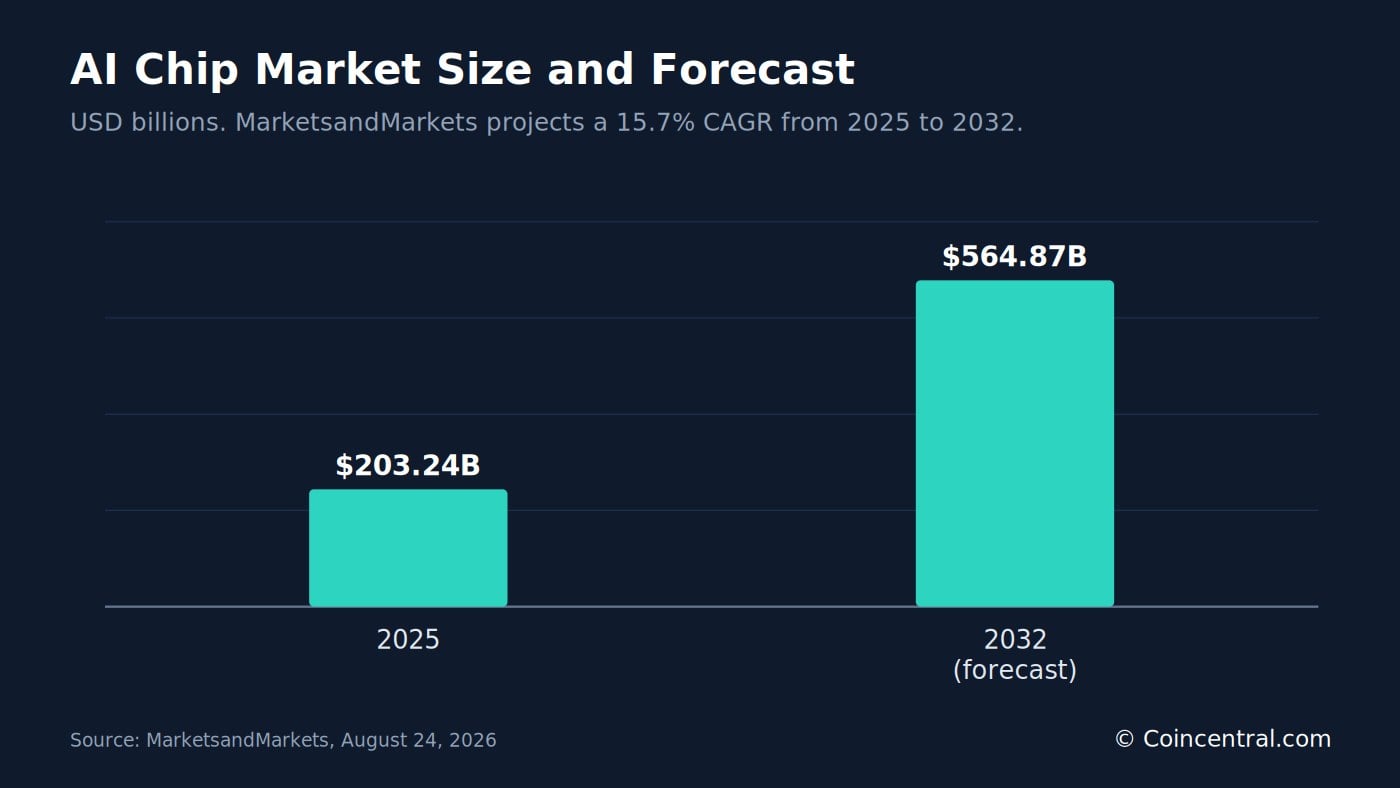
- AI chip market forecast for 2032: $564.87 billion
Global Chip Sales Set the Backdrop
The Semiconductor Industry Association (SIA) reported global chip sales of $791.7 billion in 2025. That is up 25.6% from $630.5 billion in 2024 and a record for a full year. SIA projects sales will reach about $1 trillion in 2026.
Fourth quarter 2025 sales alone were $236.6 billion. That was 37.1% higher than the fourth quarter of 2024 and 13.6% higher than the third quarter of 2025.
Logic chips, the group that includes AI accelerators, grew 39.9% to $301.9 billion in 2025. They are now the largest product category by sales. Memory products grew 34.8% to $223.1 billion.
Logic grew faster than the wider industry. SQ Magazine reads this as a sign that AI accelerators took most of the added spending.
By region, Asia Pacific All Others grew 45.0% in 2025, the fastest of the five regions SIA tracks. Sales in the Americas rose 30.5%.
| Metric | 2024 (implied) | 2025 | Change |
|---|---|---|---|
| Global semiconductor sales | $630.5 billion | $791.7 billion | +25.6% |
| Logic chips | About $216 billion | $301.9 billion | +39.9% |
| Memory products | About $165 billion | $223.1 billion | +34.8% |
| Fourth quarter sales | About $172.6 billion | $236.6 billion | +37.1% |
Source: Semiconductor Industry Association, February 6, 2026, via SQ Magazine. Implied 2024 values for logic, memory and the quarter are worked out from the reported growth rates.
AI Chip Market Size and Forecast to 2032
MarketsandMarkets released a report on August 24, 2026. It puts the global AI chip market at $203.24 billion in 2025 and expects it to reach $564.87 billion by 2032. That is a compound annual growth rate of 15.7%.
This figure uses a wider definition than a count of accelerators alone. It includes compute, memory and network products. For that reason it should not be compared directly with the SIA total for all chips.
North America is the largest region, with an estimated 36.4% share in 2025. Asia Pacific is expected to grow fastest. China is expected to post the highest growth rate of any single country in the region.
Inference held the largest share by function and is expected to grow fastest. Generative AI is expected to lead by technology. Network products are expected to grow 26.7% a year, the fastest of any offering.
| Segment | Leader or fastest grower |
|---|---|
| Largest region | North America (36.4% share in 2025) |
| Fastest-growing region | Asia Pacific |
| Largest compute type | GPU |
| Fastest-growing compute type | CPU |
| Leading memory type | HBM |
| Fastest-growing offering | Network (26.7% CAGR) |
| Largest function | Inference |
| Leading technology | Generative AI |
Source: MarketsandMarkets, August 24, 2026.
The report also lists limits on growth. These include high power use, higher cooling costs, a shortage of skilled workers and supply chain problems. Limited material supply and production capacity can delay deliveries and raise costs.
NVIDIA: Data Center Revenue and Guidance
NVIDIA reported first quarter fiscal 2027 results on May 20, 2026. Total revenue was a record $81.6 billion. That is up 85% from a year earlier and 20% from the prior quarter.
Data center revenue was $75.2 billion, up 92% year over year. Compute brought in $60.4 billion, up 77%. Networking reached $14.8 billion, up 199%.
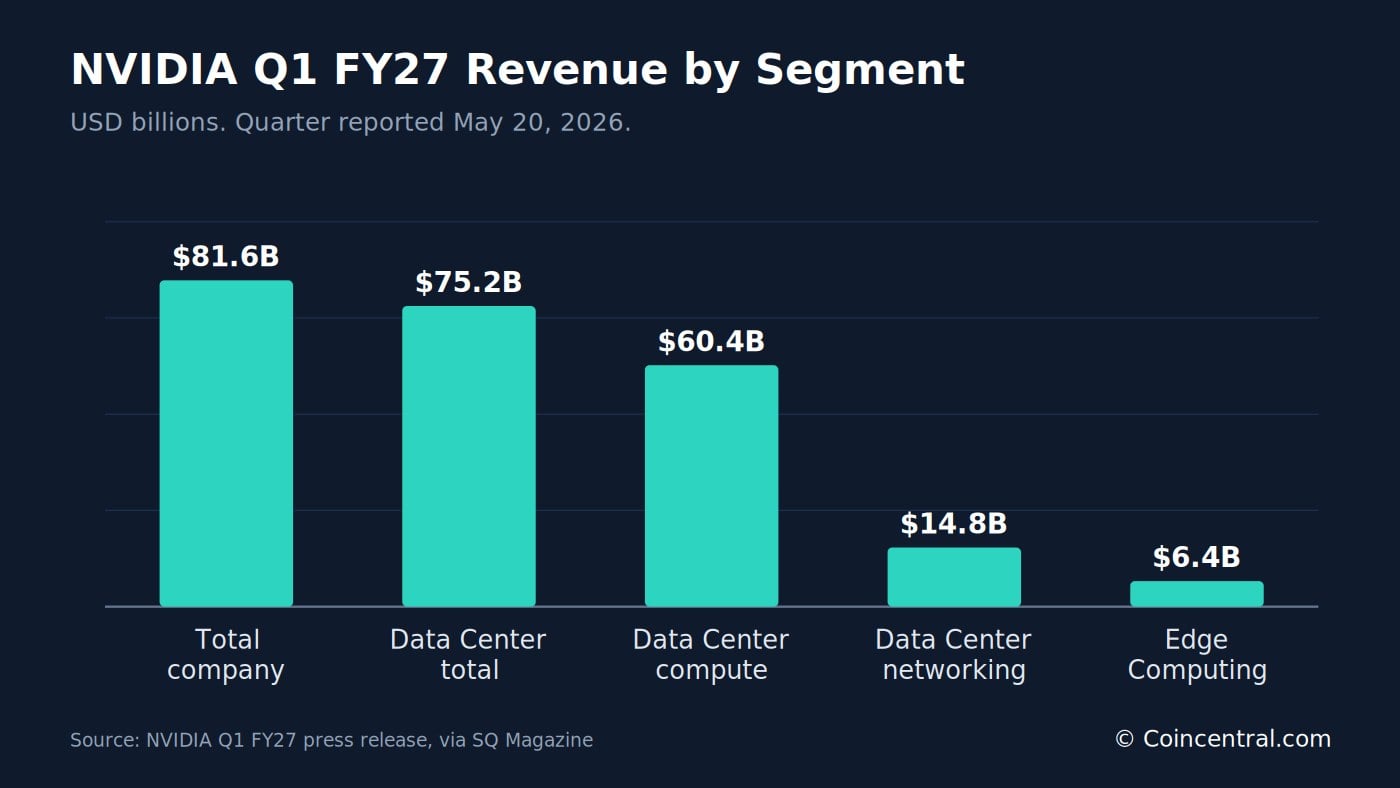
Edge Computing, NVIDIA’s other new platform, posted $6.4 billion, up 29%. SQ Magazine says the new split between Data Center and Edge Computing is the first major change in segment reporting since 2019.
GAAP gross margin was 74.9%, compared with 60.5% a year earlier. NVIDIA also returned about $20.0 billion to shareholders through buybacks and dividends in the quarter.
| Segment | Q1 FY27 revenue | Year-over-year change |
|---|---|---|
| Total company | $81.6 billion | +85% |
| Data Center total | $75.2 billion | +92% |
| Data Center compute | $60.4 billion | +77% |
| Data Center networking | $14.8 billion | +199% |
| Edge Computing | $6.4 billion | +29% |
Source: NVIDIA Q1 FY27 press release, May 20, 2026, via SQ Magazine.
For the second quarter of fiscal 2027, NVIDIA guided revenue to $91.0 billion, plus or minus 2%. The outlook assumes no data center compute revenue from China.
NVIDIA also told shareholders it can see more than $1 trillion in Blackwell and Rubin revenue from the start of 2025 through 2027. SQ Magazine points out that this is management’s own view and not a signed order book.
On products, Presenc AI lists the H100 and H200 as mature, and the B200 and GB200 NVL72 as ramping with limited supply at the top end. Zylos reports that the Rubin platform entered full production in early 2026, with partner products due in the second half. NVIDIA claims Rubin cuts inference token cost 10 times compared with Blackwell.
AMD: Instinct GPUs and a Growing Data Center Business
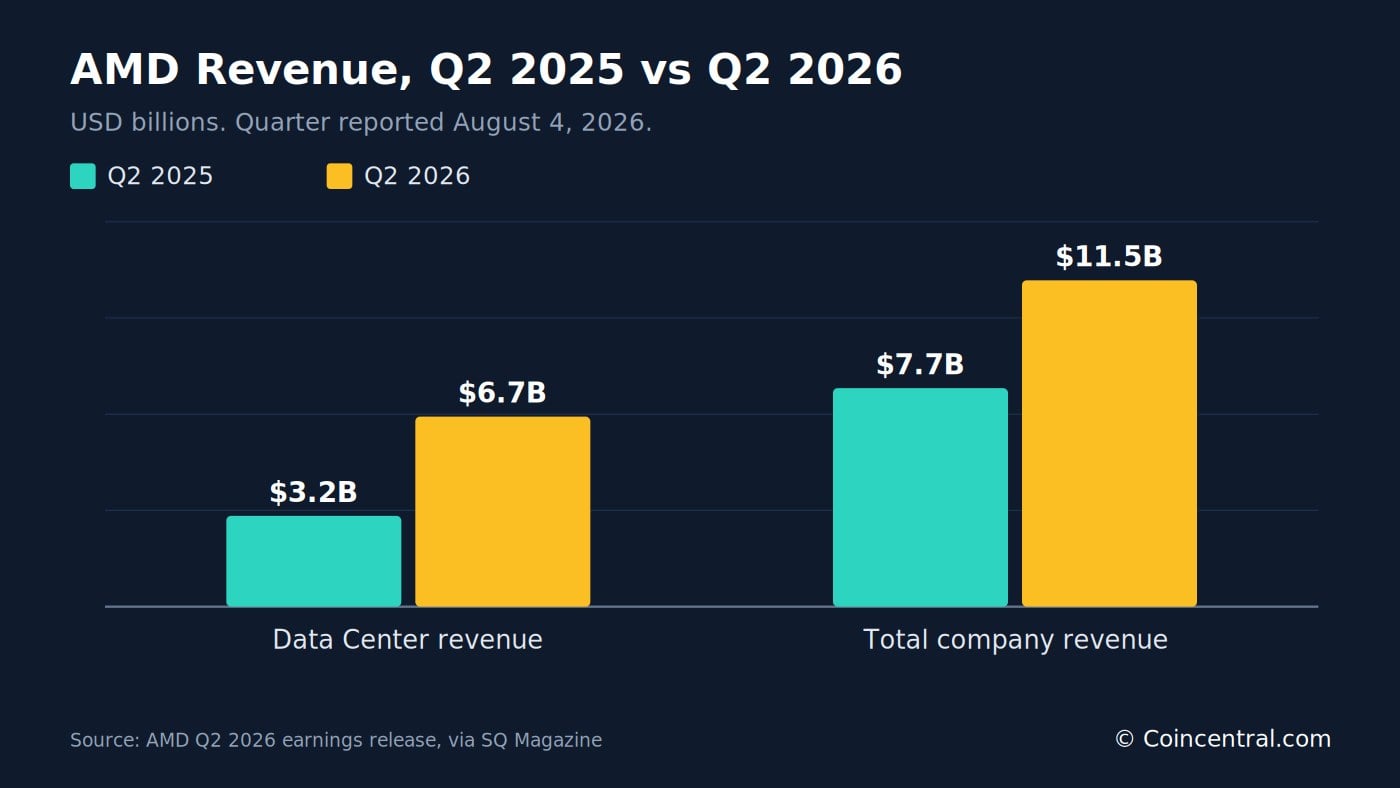
AMD reported second quarter 2026 results on August 4, 2026. Revenue was a record $11.5 billion, up 50% from $7.7 billion a year earlier.
Data center revenue was $6.7 billion, up 107% from $3.2 billion. The segment made up 58% of company revenue. AMD credits demand for its EPYC processors and Instinct GPUs.
Data center operating income was $2.1 billion. A year earlier the segment lost $155 million at the operating level.
| AMD metric | Q2 2025 | Q2 2026 | Change |
|---|---|---|---|
| Data center revenue | $3.2 billion | $6.7 billion | +107% |
| Data center operating income | -$0.155 billion | $2.1 billion | Loss to profit |
| Data center share of revenue | Not stated | 58% | n/a |
| Total company revenue | $7.7 billion | $11.5 billion | +50% |
Source: AMD Q2 2026 earnings release, August 4, 2026, via SQ Magazine.
Presenc AI estimates AMD holds about 5% to 7% of data center AI accelerator revenue in 2026, up from about 2% in 2024. It names Microsoft and Meta as the largest buyers of the MI300X and MI325X.
Zylos reports that the MI400 series launches in 2026, led by the MI455X. AMD’s Helios rack holds up to 72 of those GPUs. In October 2025, AMD announced a deal with OpenAI for 6 gigawatts of GPUs, with the first 1 gigawatt site using MI450 chips starting in 2026.
Broadcom: Custom Chips for Cloud Companies
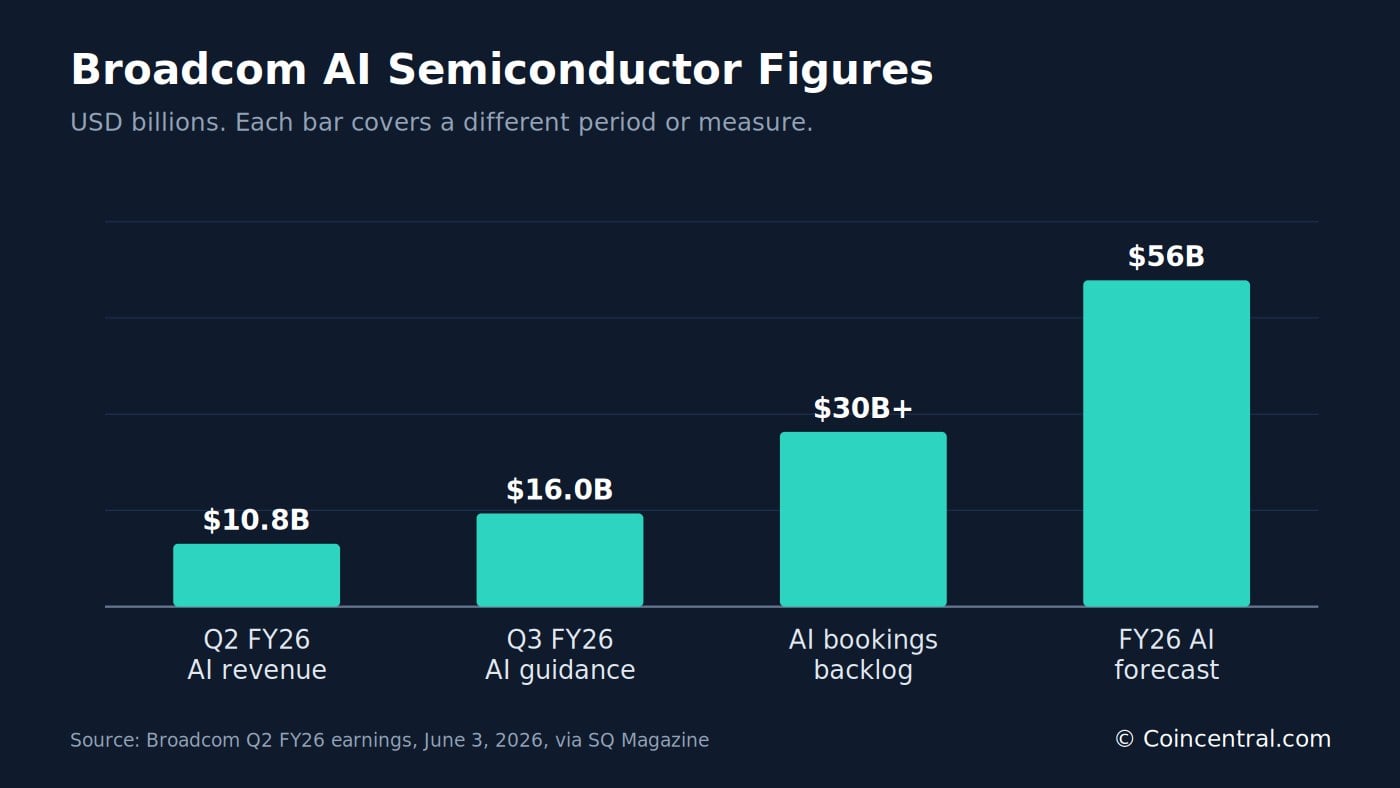
Broadcom designs custom AI chips, often called XPUs, for large cloud and AI firms. On June 3, 2026 it reported Q2 fiscal 2026 AI semiconductor revenue of $10.8 billion, up 143% year over year.
Total semiconductor solutions revenue was $15 billion, up 79%. Company revenue was $22.2 billion, up 48%.
Broadcom has six core custom chip customers. They include Google, Anthropic, Meta and OpenAI. Networking made up almost 40% of AI revenue in the quarter.
AI bookings were above $30 billion, against $10.8 billion shipped. That is a book-to-bill ratio of about 2.8 to 1.
| Broadcom measure | Figure |
|---|---|
| Q2 FY26 AI semiconductor revenue | $10.8 billion (+143%) |
| Q2 FY26 semiconductor solutions revenue | $15 billion (+79%) |
| Q2 FY26 total revenue | $22.2 billion (+48%) |
| AI bookings backlog | Above $30 billion |
| Q3 FY26 AI revenue guidance | $16.0 billion (over +200%) |
| Full-year FY26 AI revenue forecast | $56 billion (about +180%) |
| FY27 AI revenue guidance | More than $100 billion |
Source: Broadcom Q2 FY26 earnings, June 3, 2026, via SQ Magazine.
Broadcom expects Q3 AI revenue to reach $16.0 billion. It forecasts $56 billion in AI chip revenue for fiscal 2026 and more than $100 billion for fiscal 2027. Zylos adds that Broadcom and Marvell are winning large contracts from OpenAI, Meta and Google.
AI Chip Market Share by Vendor
Market share depends on how it is measured. Presenc AI estimates NVIDIA holds 80% to 85% of data center AI accelerator revenue in 2026. That is down from about 92% in 2023.
SQ Magazine takes a different approach. It compares three reported revenue lines: NVIDIA data center at 81%, Broadcom AI semiconductors at 12% and AMD data center at 7% of the combined total. SQ Magazine warns that the periods and scope differ, so this is not a true market share.
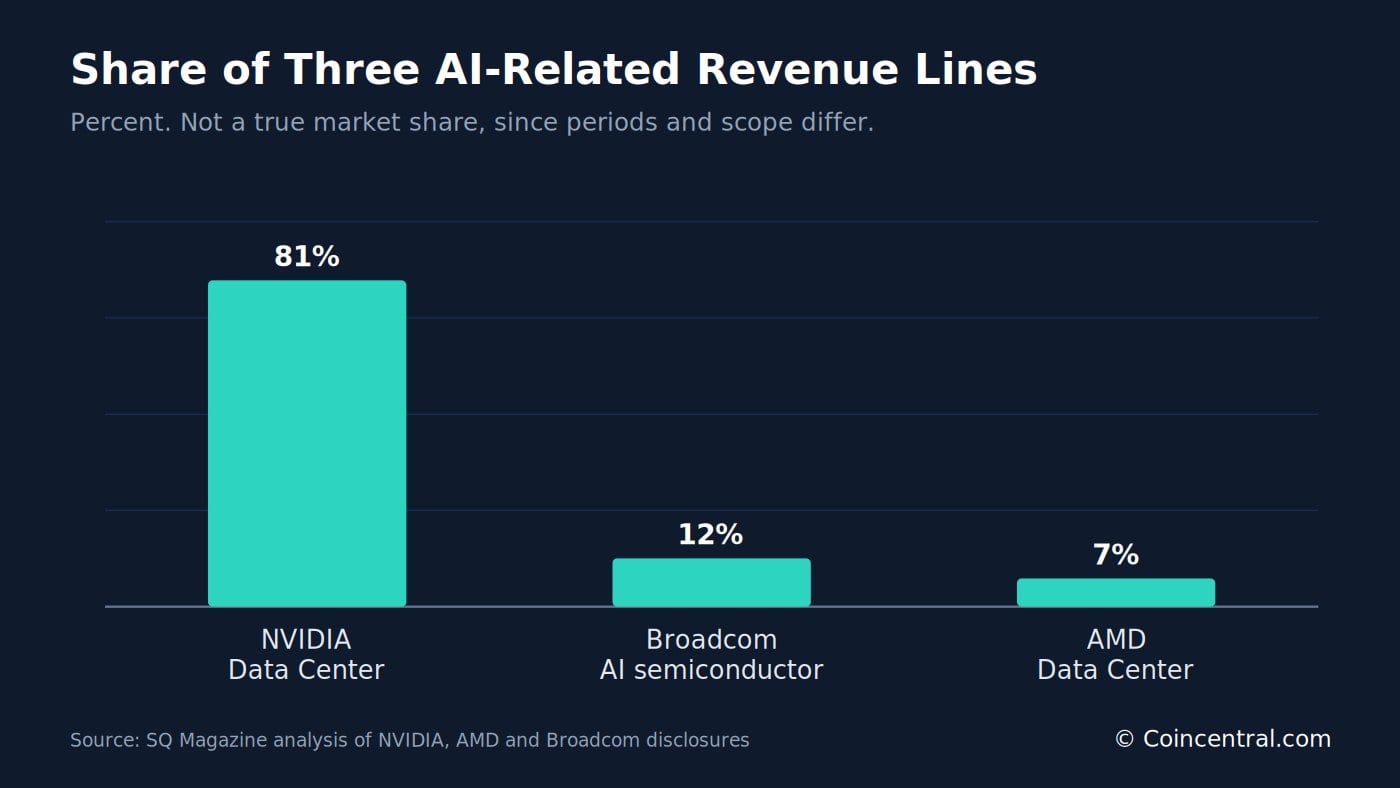
No company publishes a market share for merchant AI chips. Custom chips from Google, Amazon and Meta sit outside GPU share data. Broadcom’s customer base captures part of that activity.
| Vendor | Estimated revenue share, 2026 | Trend |
|---|---|---|
| NVIDIA | About 80% to 85% | Down from about 92% in 2023 |
| AMD | About 5% to 7% | Up from about 2% |
| Google TPU | About 6% to 8% | Up modestly |
| AWS Trainium and Inferentia | About 2% to 3% | Up from about 1% |
| Intel Gaudi 3 | About 1% to 2% | Modest growth |
| Cerebras, Groq, Etched, Tenstorrent | About 1% | Small but growing |
| Other, including Huawei Ascend | About 2% to 3% | Mostly in China |
Source: Presenc AI, May 2026. Estimates built from company disclosures and analyst reports. Google TPU share is by deployed compute, so the rows do not sum cleanly.
Presenc AI names three forces shaping the market. NVIDIA’s CUDA software keeps many workloads on its chips. Large cloud firms build their own silicon to cut costs.
Inference work also moves to other hardware more easily than training does. That is one reason alternatives to NVIDIA gain ground there first.
Inference, Custom Chips and a Shifting Mix
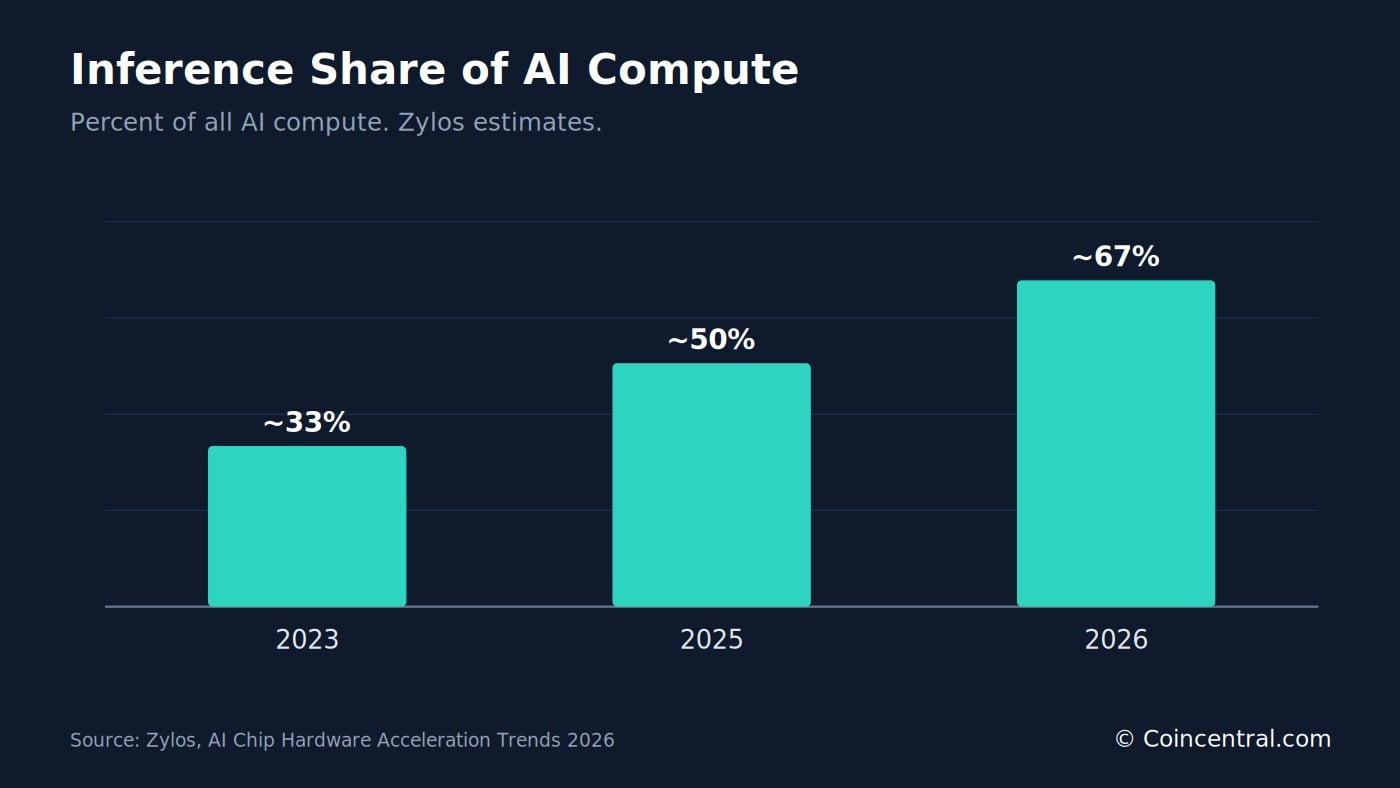
Zylos estimates that inference now makes up about two-thirds of AI compute in 2026. That is up from about one-third in 2023 and half in 2025. It puts the market for inference-focused chips at over $50 billion.
Zylos also expects cloud providers’ in-house ASICs to grow 44.6% in 2026, against 16.1% for GPUs. It projects ASIC share of the inference market rising from 15% in 2024 to 40% in 2026.
The inference chip field is also consolidating. Zylos reports that NVIDIA acquired Groq for $20 billion and Intel acquired SambaNova. Cerebras completed its IPO in early 2026.
Google’s TPU line is a large part of the custom chip story. Zylos expects about 1.6 million TPU v6 shipments in 2026. It also reports that Anthropic plans to use up to one million TPUs, bringing over a gigawatt of capacity online in 2026.
| Measure | ASICs | GPUs |
|---|---|---|
| Expected 2026 growth (cloud in-house ASICs vs GPUs) | 44.6% | 16.1% |
| Share of inference market | 15% in 2024, 40% in 2026 (projected) | Not stated |
Source: Zylos, AI Chip Hardware Acceleration Trends 2026. These are estimates and projections.
Zylos adds a cost point. On-premises systems can become cheaper than cloud once cloud costs reach 60% to 70% of an equivalent on-premises setup. This applies mainly to steady, high-volume inference work.
TSMC and the Foundry Bottleneck
Most advanced AI accelerators are made in Taiwan by TSMC. In the first quarter of 2026, TSMC reported revenue of $35.90 billion, up 40.6% from a year earlier. Gross margin was 66.2%, up from 62.3% in the fourth quarter of 2025.
High-performance computing made up 61% of revenue, the largest of its six platforms. Advanced nodes, meaning 7nm and below, were 74% of wafer revenue.
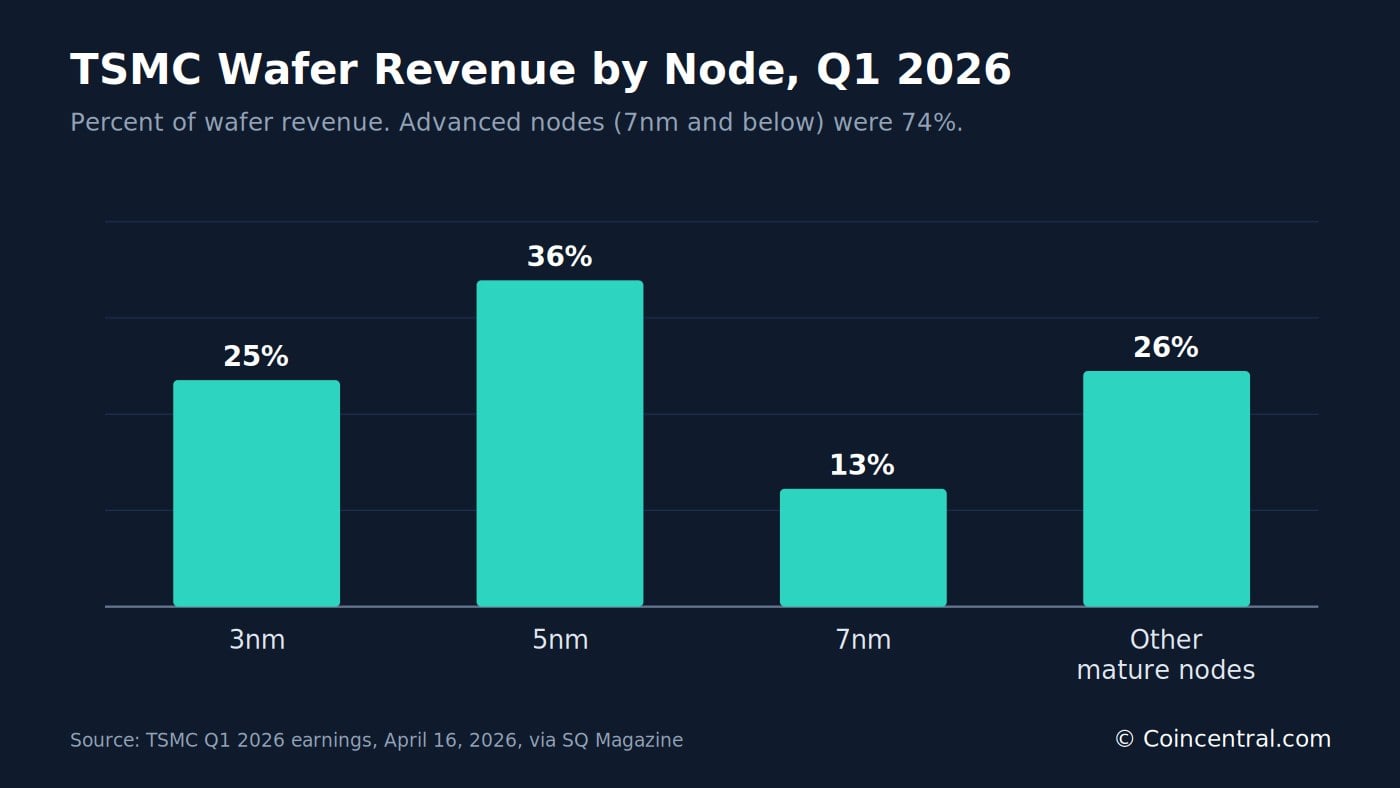
TSMC expects capital spending of $52 billion to $56 billion in 2026. Its CEO said in November 2025 that demand for advanced processes was about three times what the company could produce.
| Process node | Share of Q1 2026 wafer revenue |
|---|---|
| 3nm | 25% |
| 5nm | 36% |
| 7nm | 13% |
| Other (mature nodes) | 26% |
Source: TSMC Q1 2026 earnings, April 16, 2026, via SQ Magazine.
Presenc AI also tracks TSMC’s 2nm allocation as a topic to watch. AMD’s MI400 and MI500 lines are planned on that process, according to Zylos.
HBM Memory: The Other Supply Limit
High bandwidth memory (HBM) is the second supply limit for AI chips. SK hynix said in its Q2 2026 results that customer demand is higher than its supply. It has signed long-term supply deals with about 10 customers.
Micron explains the problem in its own filing. HBM needs more wafers and more cleanroom space than standard DRAM to produce the same number of bits. SK hynix expects relief after its Yongin Phase 1 cleanroom opens in early 2027.
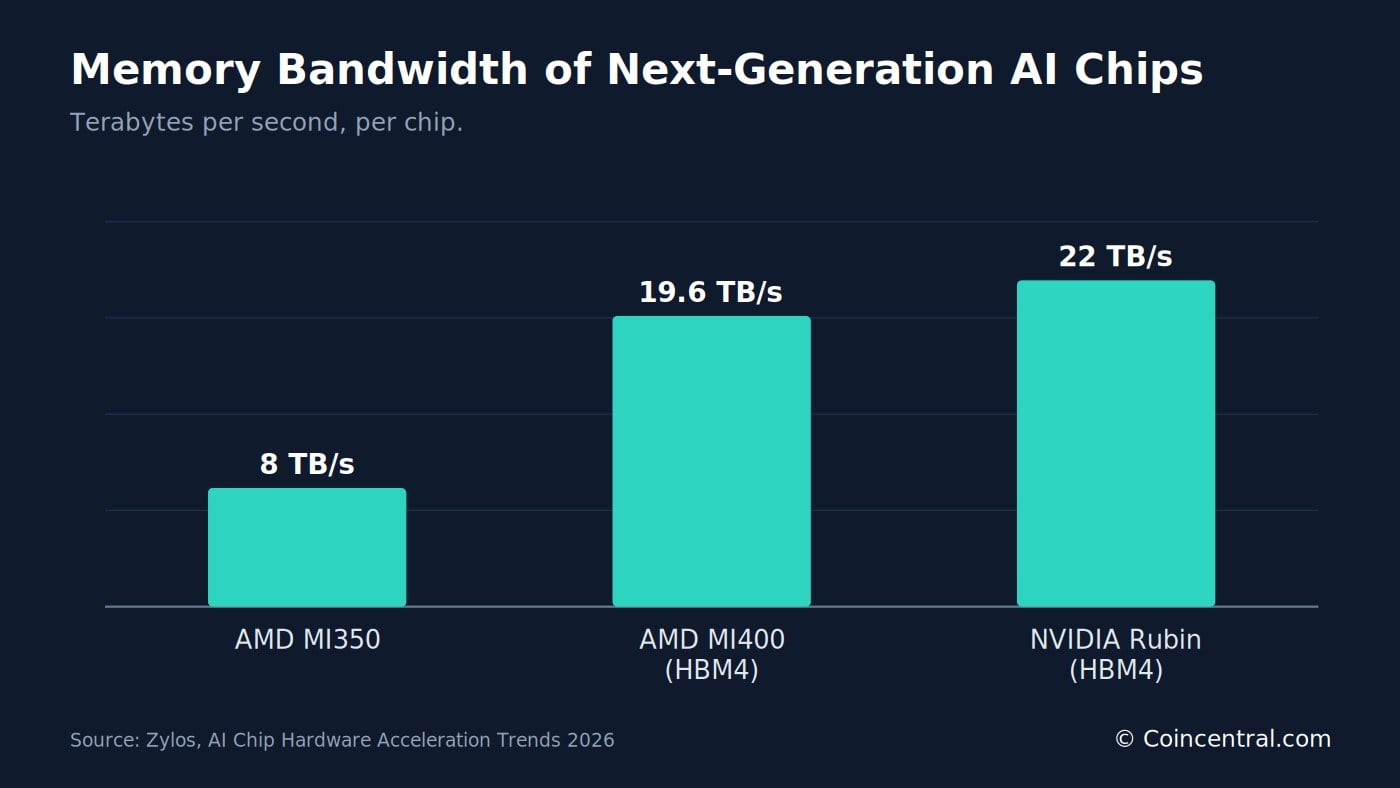
Zylos describes HBM4 as the key part of the next chip generation. It offers over 2 TB/s per stack, about 60% faster than HBM3e. It is also about 40% more power efficient.
SK hynix and Micron plan volume production in 2026. Samsung moved its first output up to February 2026. SK hynix also showed a 16-layer, 48GB HBM4 stack at CES 2026.
| Chip | Memory | Bandwidth |
|---|---|---|
| NVIDIA Rubin | 384GB HBM4 (eight stacks) | 22 TB/s |
| AMD MI400 | 432GB HBM4 | 19.6 TB/s |
| AMD MI350 | Not stated | 8 TB/s |
Source: Zylos, AI Chip Hardware Acceleration Trends 2026.
No memory maker publishes an HBM demand growth rate or a date when supply catches up. The timing of new cleanrooms in 2027 is the main marker.
Edge AI and Automotive Chips
Not all AI chips sit in data centers. Presenc AI sizes the on-device AI chip market at about $25 billion to $35 billion in 2026. Apple is the largest single vendor, with Qualcomm, Intel and AMD also competing.
Apple’s M4 chip has a 16-core Neural Engine rated at up to 38 trillion operations per second. AMD’s Ryzen AI 400 series offers up to 60 NPU TOPS. These ratings are not measured the same way across vendors, so they cannot be ranked directly.
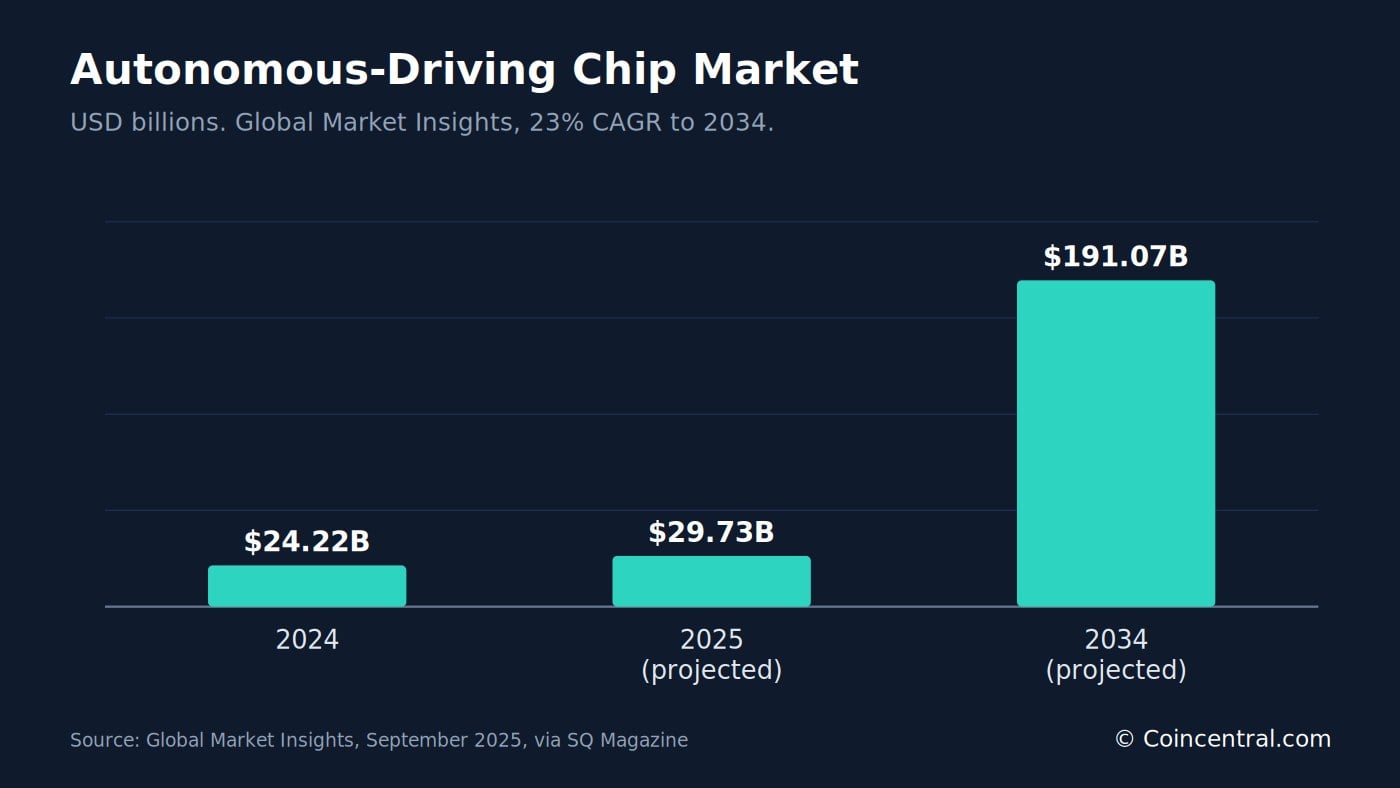
Cars are another growth area. Global Market Insights estimated the autonomous-driving chip market at $24.22 billion in 2024. It projects $29.73 billion in 2025 and $191.07 billion by 2034, a 23% CAGR.
NVIDIA’s DRIVE AGX Orin and DRIVE Thor platforms offer up to 2,000 TOPS. Mobileye’s EyeQ chips are in over 100 million vehicles.
| Segment | Figure | Source |
|---|---|---|
| On-device AI chips, 2026 | $25 billion to $35 billion | Presenc AI |
| Autonomous-driving chips, 2024 | $24.22 billion | Global Market Insights |
| Autonomous-driving chips, 2025 | $29.73 billion (projected) | Global Market Insights |
| Autonomous-driving chips, 2034 | $191.07 billion (projected) | Global Market Insights |
CHIPS Act Funding and Export Controls
The CHIPS and Science Act was signed on August 9, 2022 and created a $52 billion investment in US chip making. As of August 2026, more than $36 billion has been announced.
Intel reached agreement on up to $7.86 billion in direct funding for projects in Arizona, New Mexico, Ohio and Oregon. TSMC Arizona received up to $6.6 billion, plus the right to draw up to $5 billion in loans.
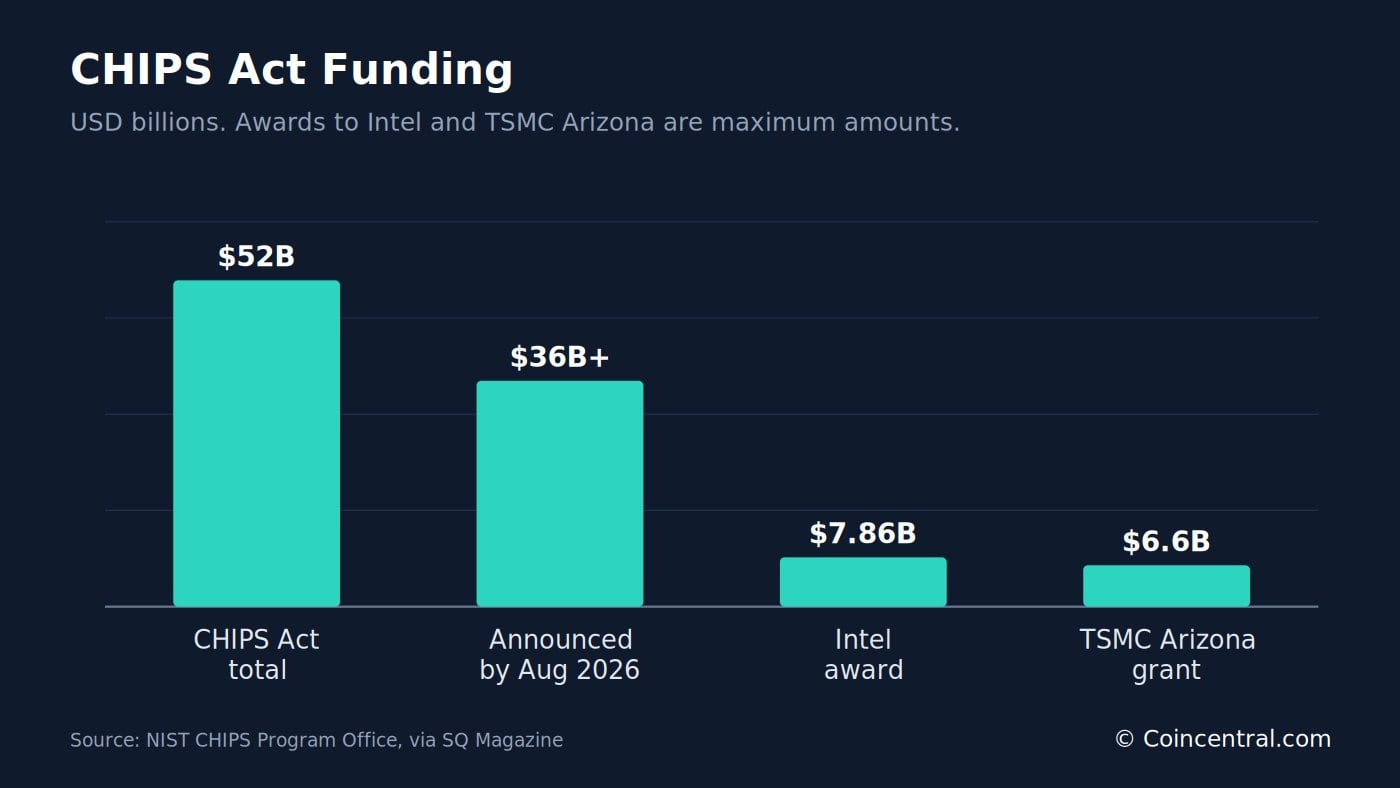
SQ Magazine notes that the awards lean toward leading-edge logic plants. Packaging and memory steps, which also limit accelerator output, receive less direct support.
| Recipient | CHIPS Act award | Location |
|---|---|---|
| Intel | Up to $7.86 billion | Arizona, New Mexico, Ohio, Oregon |
| TSMC Arizona | Up to $6.6 billion, plus up to $5 billion in loans | Phoenix, Arizona |
| Total announced (August 2026) | More than $36 billion | Of the $52 billion created |
Source: NIST CHIPS Program Office; Intel Newsroom; TSMC Form 20-F, via SQ Magazine.
Export rules also affect the market. On April 9, 2025, the US government told NVIDIA that it needs a license to export H20 chips to China. NVIDIA took a $4.5 billion charge in the first quarter of fiscal 2026.
The charge was small in the fourth quarter of fiscal 2026 and zero in the first quarter of fiscal 2027. NVIDIA’s guidance now assumes no China data center compute revenue. Presenc AI says vendors such as Huawei Ascend hold about 2% to 3% of the market, mostly in China.
What the Numbers Show
The data points to fast growth with a clear leader. NVIDIA reported $75.2 billion in data center revenue in one quarter, AMD reported $6.7 billion and Broadcom reported $10.8 billion in AI chip revenue. Each covers a different period, so they describe separate results.
The wider market is also large. Global chip sales hit $791.7 billion in 2025, and MarketsandMarkets expects the AI chip market to reach $564.87 billion by 2032.
Supply remains the main limit. TSMC wafers and HBM memory both fall short of demand, and new memory capacity arrives in 2027. Export rules add more uncertainty, especially for sales to China.
Market share estimates vary by source, and many figures are estimates. Readers should check the period and scope behind each number before comparing them.